• Contact
  • About
  • ISSN 3049-9771
  • Authors and editors
NEWSLETTER SIGN UP
East Anglia Bylines
Advertisement
  • HOME
  • News
    • Brexit
    • Health
    • Education
    • World
  • Politics
    • Local government
    • Justice
    • Activism
  • Climate
    • Environment
  • Lifestyle
    • Community
    • Culture
    • History
    • Humour
    • Property
  • Business
    • Development
    • Economics
    • Finance
    • Transport
    • Farming
  • ANGLIA
    • Bedfordshire
    • Cambridgeshire
    • Essex
    • Hertfordshire
    • Norfolk
    • Suffolk
  • Series
No Result
View All Result
East Anglia Bylines
Home Business Transport

Where do we put bikes?

The case — or not — for banning floating bus stops

Aidan Baker by Aidan Baker
31 May 2024
in Community, Featured, Technology, Transport
Reading Time: 7 mins read
A A
Bus at a floating bus stop

Bus at a floating bus stop. Pic by Aidan Baker. CC BY

Share on Bluesky

A floating bus stop is a bus stop where an intending passenger has to cross a cycle track to reach it. I’ve been surprised by the number of times I’ve needed to explain that. Clearly, they are not uppermost in everyone’s thinking. The cycle track is sometimes called a bus stop bypass, and some use that phrase as a name for the whole system of cycle track and bus stops.

How have floating bus stops come about?

No one seems to know when and where someone first had the idea of separating bus stops from their pavements in this way. The civil engineer Mark Philpotts, who blogs and tweets under the name Ranty Highwayman, writing in October 2021, could only give this history:

The concept isn’t new and you’ll be able to find service road and cycle track layouts going back decades. … In more recent times (maybe the last decade), floating bus stops acquired a name, and they became a ‘thing’.

They are everywhere in the Netherlands, and common across Europe; the UK has them in London, Cambridge, Brighton and Manchester, amongst other places.

The point of them was summarised in 2015 by the American website Citi I/O:

Cyclist overtaking a stationary bus at a stop
Cyclist overtaking a stationary bus at a stop. Image by waterford_man via Flickr (CC BY 2.0)

It’s one of the most disconcerting interactions on urban and suburban streets: the uncomfortable, out-of-sync dance between bicycles and buses travelling in the same direction. Often, the person riding a bike will have to leave the bike lane and go out into car traffic to pass a bus that has pulled into a stop — only to be quickly passed again by the bus driver, who then has to pull in for the next stop just as the cyclist is coming up from the rear again.

The floating bus stop neutralises that problem by putting the bike on to a separate lane that doesn’t interact with the bus at all. In Cambridge, floating bus stops have been a feature of the Cross-city cycling package of the Greater Cambridge Partnership.

What’s the problem with floating bus stops then?

The passenger has to cross a cycle track to get from the pavement to the bus stop. That’s OK for most people most of the time, but there is an element of risk. And the risk is bigger for people whose mobility or vision is impaired. There is a measure of popular opposition to floating bus stops.

Mark Philpotts’ Ranty Highwayman blog urges caution:

… people are using genuine concerns as a front for their culture war. All I would say is people should look very carefully at some of those who cluster around these causes because they do not have your interests at heart.

Cyclist using the bike track of a floating bus stop
Cyclist at floating bus stop. Pic by Aidan Baker. CC BY

Fair enough. He doesn’t airily dismiss the concerns, and recognises them as genuine. And the calls for the abolition of floating bus stops have been made by credible organisations. As recently as this month, the sight advocacy charity, Royal National Institute of Blind People, commented on reports of a proposed ban on the stops in a statement containing this demand:

We want to see a halt to building new bus stops with cycle lanes, and at the same time, existing floating bus stops need to be adapted so that they are safe and accessible to blind and partially sighted pedestrians.

If floating bus stops are better news for cyclists than for disabled people, it has to be said that disabled people greatly outnumber cyclists. Directly comparable statistics are hard to come by, but a rough measure can be worked out from the many figures that are available.

The number of cyclists in England – those who’d cycled at least twice in the previous 28 days – was reported by Sport England’s 2022-2023 survey as 6.1 million.

The number of disabled people for England was estimated by the Office for National Statistics, working from the 2021 census, as 9.8 million.

And some people belong to both categories.

Alongside those figures can be cited those for road accidents. Transport for London gave the number of reported accidents involving pedestrians and cyclists at floating bus stops, during the years 2020, 2021 and 2022, as no more than four. That statistic is outstripped by the nine pedestrians injured when a Range Rover crashed into an Aldwych bus stop in the small hours of 29 October 2023.

In London, at crowded bus stop, passengers are waiting on the other side of the cycle lane and will have to cross it when their bus arrives.
In London, when the bus stop gets crowded, passengers wait on the other side of the cycle lane. Image by diamond geezer via Flickr (CC BY-NC-ND 2.0)

Perhaps a comparison of that incident with cyclist/pedestrian spats at floating bus stops is unfair. Aldwych was an outlier: a Range Rover where it had no business to be, causing a number of life-changing injuries. When floating bus stops don’t work, it appears to be a matter of cyclists in their place but cycling badly. Not killing or maiming but triggering persistent anxiety.

Is there a solution?

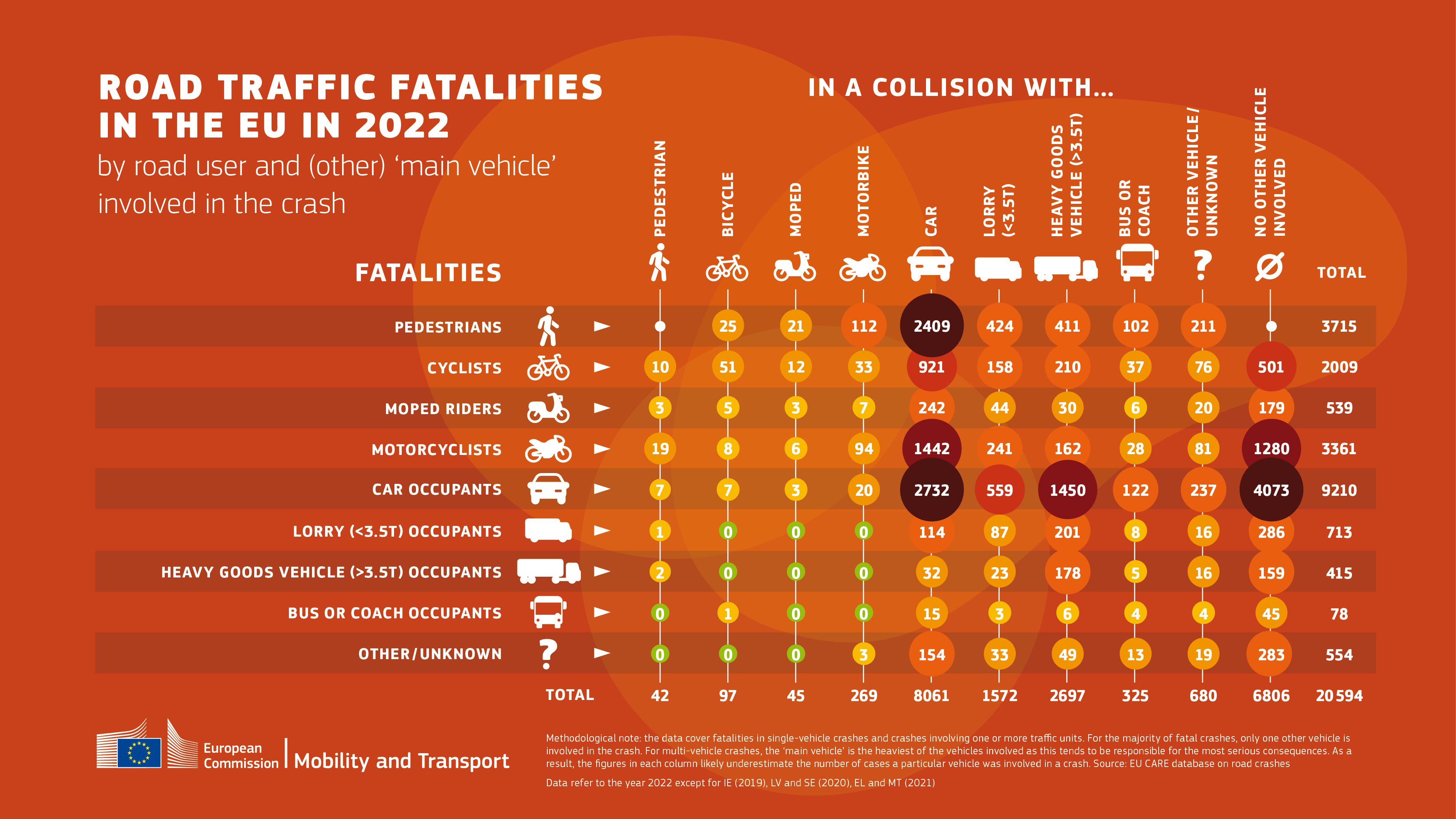
As I said above, floating bus stops are common in Europe. The collision matrix for 2022 records 25 pedestrian deaths caused by cyclists in the EU as a whole. Anecdotal evidence suggests that European cyclists are better trained than us in England.

In the UK, cyclists account for around 2% of pedestrian casualties in road traffic accidents. Cars account for 80%. That being so, I wouldn’t see a ban on floating bus stops as a high priority in road safety improvement.


More from East Anglia Bylines

Big bike revival
Anglia

Big Bike Revival in Norfolk

by Stuart Burrell
5 June 2022
Infographics from Easyfundraising

We are registered with easyfundraising! 8,000 brands will donate to us for free every time you use it.

It’s super quick and easy to SIGN UP, and will never cost you anything whatsoever. It’s FREE for you and HUGE for us!

Tags: Cycling
Previous Post

Britain and Europe: the populist pendulum

Next Post

Rainy day musings from a Pudding Island resident

Aidan Baker

Aidan Baker

Aidan Baker is a retired librarian living in Cambridge, England. His poems have appeared in ‘Sledgehammer’, ‘RIC’, ‘Orbis’, projects from 26 Characters, and numerous other outlets both printed and online. He blogs his published poems at Blurtmetry. Aidan is a member of the EAB editorial team.

Related Posts

Welded steel sculpture of two large open hands, I hold and am held by Rick Kirby, in Woodbridge, Suffolk.
Featured

Who gets to decide which of my parents is real?

by The Hidden Voice
11 October 2026
Two fruitcakes baked being dosed with alcohol ready for Christmas
Culture

The traditional Christmas fruitcake raised to new heights

by Kate Viscardi
3 October 2026
Group of older women in sparkling 1920s flapper dresses
Community

In praise of older people

by Celina Błędowska
1 October 2026
Two parents holding young children outside Cambridge council offices, with nappies reading “2 weeks is sh*t”. ChatGPT can make mistakes. Check important info.
Community

Cambridge parents renew paternity leave campaign

by East Anglia Bylines
30 September 2026
A wood sign post for Peddars Way against a blue cloudy sky and green hedge
Culture

Peddars Way: a beautiful gentle National Trail through Norfolk

by Sarah Pryor
29 September 2026
Next Post
Hand on a rainy window

Rainy day musings from a Pudding Island resident

SUPPORT OUR CROWDFUNDER

Tags

Activism Brexit Cartoons Christmas Climate Community Conservation Conservatives Democracy Economy Elections Environment EU Farming General Election 2024 Government Health History Housing Labour Letters Local government Net zero NHS Norwich Opinion Our place in Europe Party politics Pecksniff Politics Polling Pollution Poverty Reform UK Renewables Sewage Social care Something for the weekend Tax Trump Ukraine Voting Wealth Wildlife Women
East Anglia Bylines

We are a not-for-profit citizen journalism publication. Our aim is to publish well-written, fact-based articles and opinion pieces on subjects that are of interest to people in East Anglia and beyond.

East Anglia Bylines is a trading brand of Bylines Networks Limited which is separate to, but allied with, Byline Times.

Learn more about us

No Result
View All Result
  • About
  • Authors and editors
  • Complaints
  • Contact
  • Donate
  • Letters
  • Privacy
  • Network Map
  • Network RSS Feeds
  • Submission Guidelines
  • Download the Bylines Network App

© 2021-2026 East Anglia Bylines. Powerful Citizen Journalism. ISSN 3049-9771

No Result
View All Result
  • HOME
  • News
    • Brexit
    • Health
    • Education
    • World
  • Politics
    • Local government
    • Justice
    • Activism
  • Climate
    • Environment
  • Lifestyle
    • Community
    • Culture
    • History
    • Humour
    • Property
  • Business
    • Development
    • Economics
    • Finance
    • Transport
    • Farming
  • ANGLIA
    • Bedfordshire
    • Cambridgeshire
    • Essex
    • Hertfordshire
    • Norfolk
    • Suffolk
  • Series

Newsletter sign up

Crowdfunder

© 2021-2026 East Anglia Bylines. Powerful Citizen Journalism. ISSN 3049-9771