


Donald Trump saying: “Ukraine is finished”, as he did in September, and more recently indicating the USA might invade Greenland, take the Panama Canal by force, or coerce Canada into becoming the 51st state, highlights the question of what geopolitical approach the only hyper-power will adopt under his leadership.
He will take office at noon Eastern Time (17:00 in UK) on 20 January.
His return could hardly be more significant. Yet, Donald Trump is at least as much a symptom as a cause of profound problems we face.
Abandon Europe?

President Biden has warned that the USA is in danger of becoming a “tech-industrial” oligarchy. America’s domestic politics will significantly influence its international behaviour.
There is a broader and deeper story. But Europe is a vital part of the geopolitical calculation and is a useful point of focus.
The decision the USA has to make, as in the 1940s and at intervals after that, is whether it cares about Europe, and if so how much of it. All of western Europe? Central Europe? Eastern Europe? Ukraine?
None of this “caring” has ever been motivated by American desire to give free gifts to Europeans. It is about US interests.
And none of it, even protecting western Europe, still less points further east, is possible or sustainable without the USA fully engaged: politically, economically, militarily. Maybe some wish it were possible. In any currently foreseeable future, it isn’t.
Trump is Trump. But the answers he sometimes gives look similar to the one the USA gave about Europe east of the Elbe, following the Second World War: abandon it to Russia.
We won
In the 1940s and 1950s the USA decided on “containment” of the Soviet Union.
Joe Biden’s policy could be seen as a version of that. He had inherited a Euro-Atlantic security architecture, which had adapted over thirty years ago as much of the continent escaped Soviet domination. Back then, faced with the suggestion from Secretary of State James Baker and German Foreign Minister Hans-Dietrich Genscher that the USA might consider excluding central and eastern European countries from NATO, President George H.W. Bush ordered: “To hell with that. We won”.

By contrast, the “MAGA” approach can give the impression that Donald Trump is taking dictation from so-called “Realists” in international relations theory, who in turn appear almost indistinguishable in their positions from the Kremlin’s chief spokesman.
Some like to suggest Trump wants containment, but with a difference: leaving Europe to fend for itself. How that is supposed to work, MAGA can’t explain.
China, Europe and America
Still, Trump isn’t merely making up policy on the hoof. A large part reflects a genuine need to reassess US interests in the light of a decades-long, often short-term opportunist, American facilitation of the rise of Chinese Communist Party (CCP) power in the world.
American promotion of European development since 1945 has been, despite some tensions, highly beneficial to the USA, and to European partners.
In Europe, Americans got broadly Christian Democratic/ Social Democratic (or similar) governments, and more or less reliable participants – via NATO, the EEC/EU and other significant institutional arrangements – in the US-led international order, an essential foundation of American security and prosperity.
Europe’s closely integrated economy, with its remarkable common regulatory zone (the “Single Market”) and common customs and global trade zone (the “Customs Union”), has latterly rivalled the USA’s in size, but not in military or geopolitical power. That combination was always the deal, one misunderstood in European political discourse, and ignored by the less well-versed on the American side.
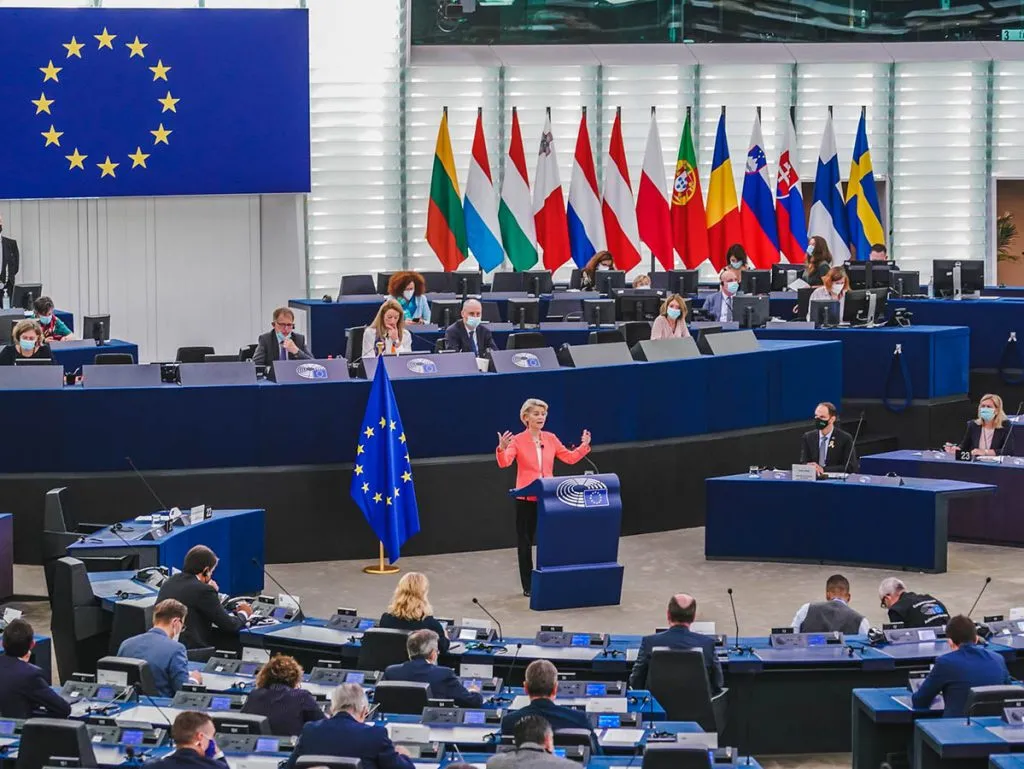
It has endured. It has been immensely successful. Even for those who set themselves up against it: chaos is the enemy both of dictatorships and democracies. Chaos, not a replacement order, is the alternative to a continuation of the American-led international system. In a world increasingly interconnected by powerful technologies, “Great Power” blocs don’t represent order. They represent 1914. Being “agile”, exploiting “shifting alliances”, sounds attractive to a transactional businessman: geopolitically it’s just another source of destructive chaos. China taking over is a pipe dream, and a nightmarish one at that.
In contrast to Europe’s ascent, with China the USA got the CCP, and potentially fatal, unintended consequences. China now also rivals the USA in economic weight, and is attempting to do so militarily and geopolitically. Americans are waking up to an emerging national security and economic catastrophe. That’s before even addressing questions of global climate, public health and nuclear weapons crises.
The USA needs Europe
Some in the USA say “without Europe we can’t prevail against China”. Others, “throw Europe to the wolves, we must focus on China”. Some suggest “it isn’t a question of ‘winning’: let’s do a deal with China”. The last misunderstands the nature of CCP ambitions. The second falsely assumes success is achievable without Europe.
Even with full control of North America, the Panama Canal and the Arctic, let alone without, the USA needs Europe.
That was true in 1950 when a technologically dominant USA represented 50% of world economic output and three-quarters of military expenditure. It is all the more so in 2025 when the figures are about 25% and a half. Perhaps in the past the USA could have managed alone. Perhaps. But now, concerting the USA’s and Europe’s (and Japan’s and others’) economic weight and military capacity is essential to American interests, vital to Europe, and existential for the world.
Eurasia, the oceans and space

The USA can’t protect its economic security – and ultimately its territorial integrity – without reliable control of both ends of the resource- and population-rich, strategically positioned Eurasian land mass, from the northern Atlantic to the northern Pacific; the sea routes between and around Eurasia’s eastern and western limits, including to and from the USA; and, unlike the otherwise quite similar case of the globally preeminent British Empire at its height, near-Earth space.
Some in Trump’s orbit imagine Russia could be a better partner than the USA’s NATO allies. That is dangerously unmoored from reality. Some others, think Europe is largely irrelevant to American interests. That is geopolitically, geoeconomically and militarily illiterate. Whether or not they understand it, even MAGA supporters rely for their ambitions on the USA truly being in charge. Not on cathartically yelling “USA, USA, USA”.
Security, prosperity and well-being
Powerless as many individuals will feel, Trump’s return demands that every one of us in Europe, the USA and elsewhere, gets a grip.
If we fail to, our democracies, our security, our prosperity and our well-being, won’t survive.
Share this article on Bluesky:
More from East Anglia Bylines








