• Contact
  • About
  • ISSN 3049-9771
  • Authors and editors
NEWSLETTER SIGN UP
East Anglia Bylines
Advertisement
  • HOME
  • News
    • Brexit
    • Health
    • Education
    • World
  • Politics
    • Local government
    • Justice
    • Activism
  • Climate
    • Environment
  • Lifestyle
    • Community
    • Culture
    • History
    • Humour
    • Property
  • Business
    • Development
    • Economics
    • Finance
    • Transport
    • Farming
  • ANGLIA
    • Bedfordshire
    • Cambridgeshire
    • Essex
    • Hertfordshire
    • Norfolk
    • Suffolk
  • Series
No Result
View All Result
East Anglia Bylines
Home Democracy

Could new voting trials drag UK elections into modern life?

For the first time in over a century, how – and when – we vote in the UK may finally change

East Anglia Bylines by East Anglia Bylines
14 April 2026
in Democracy, Local government, News
Reading Time: 7 mins read
A A
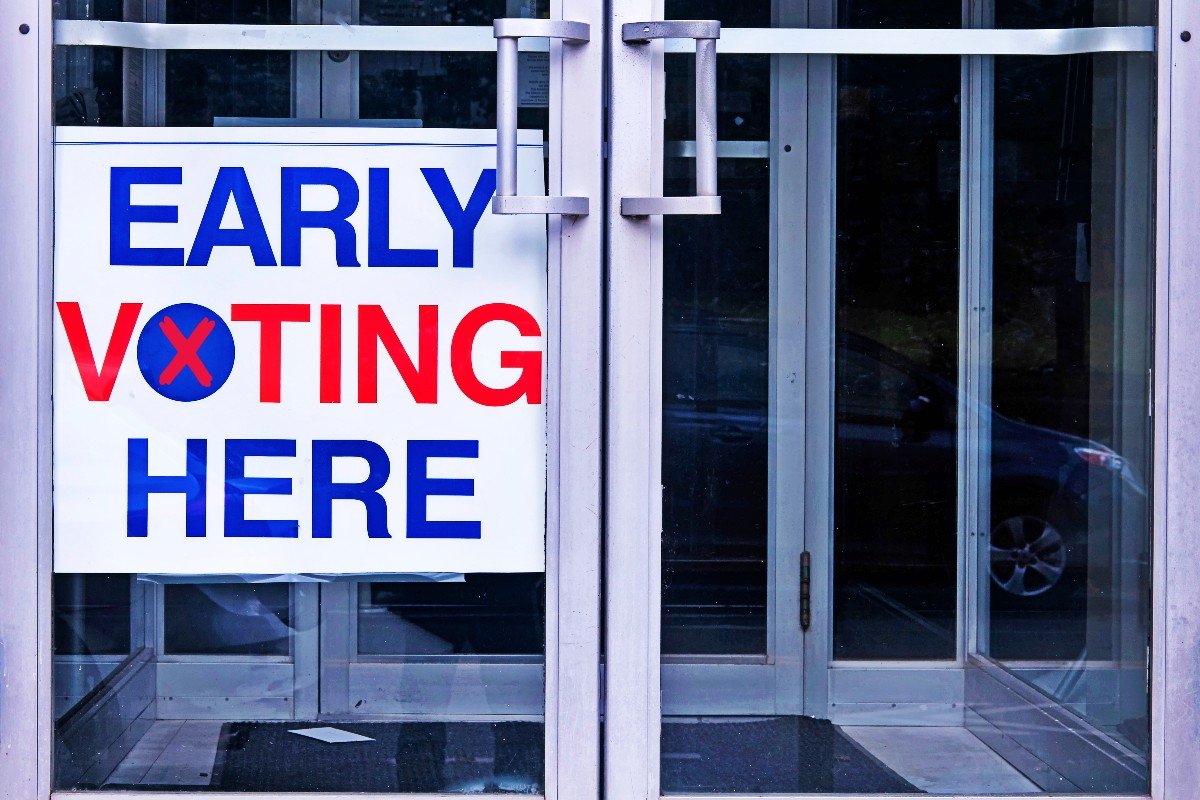
Glass swing doors with a sign saying "Early voting here"

Image by Dan Hanscom. Licensed by Shutterstock [AD]

Share on Bluesky

The way UK voters cast their ballots in person has remained largely unchanged since 1872. That may now be about to shift, bringing the UK closer to electoral systems widely used elsewhere, including one I saw in action during the 2016 US election.

In the local elections next month, four areas in England will trial new approaches designed to make voting more flexible, and crucially, more compatible with modern life. Two of those areas, Cambridge and North Hertfordshire, sit within the East Anglia Bylines patch.

Cambridge Guildhall
Cambridge Guildhall. Photo by Tom Bastin via Flickr (CC BY 2.0)

The pilots will test whether giving voters more choice over when and where they cast their ballot actually increases participation. In Cambridge, North Hertfordshire and Tunbridge Wells, people will be able to vote in person before election day, at a time that suits them – including over the weekend – in central buildings such as the Guildhall in Cambridge city centre and the Town Hall in Royston, Herts.

In Milton Keynes, a different model will be tested. There will be no early voting, but voters will have the option to cast their ballot at the Midsummer Place shopping mall in the centre of the city, rather than at a single designated polling station where they live.

Samantha Dixon, Minister for Democracy, describes this as the first meaningful update to in-person voting in more than 100 years; it is designed to make it more convenient and accessible for people with busy lives. Traditional polling stations will remain in place, alongside postal voting and proxy voting; the pilots will run in parallel rather than replace existing methods.

Voting built around people’s lives

The problem is straightforward: the current system assumes voters can attend a specific place on a specific day. For many, that isn’t always realistic.

The Electoral Reform Society has long argued that voting should better reflect how people live. Early voting is already used widely around the world, with more than 60 countries allowing ballots to be cast before election day – often in person, rather than by post.

While postal voting offers an alternative, it requires planning ahead. Applications must be made well before polling day, meaning that last-minute changes – a work commitment, illness or family emergency – can still leave people without a straightforward way to vote in person.

Postal vote application form heading
Postal Vote application form

There’s already evidence early voting can make a difference. Trials in Wales in 2022 found modest but promising levels of early participation, particularly in areas with historically low turnout. In New Zealand, early voting has been associated with increased turnout, including a 7.6% rise in the 2017 general election. In Canada’s 2025 federal election, millions of voters cast their ballots in advance, contributing to a significant overall turnout.

UK voters already have some flexibility. Postal voting allows people to vote in advance, while emergency proxy voting exists for those facing last-minute disruption. But both require planning or formal processes. What these pilots test is something more straightforward: the ability to vote in person at a time that fits around everyday life.

There is a risk, though. The UK has experimented with similar ideas before. Between 2000 and 2007, various pilots – including early voting – were tested, but no lasting national approach followed. As the Electoral Reform Society has warned, the risk isn’t that these trials fail, but that they succeed and are not acted upon.

List of early vote locations in Reno, Nevada, 2016.
List of early vote locations in Reno, Nevada, 2016. Image author-supplied

What I saw when early voting was already the norm

I had a chance to see how this works in practice during the 2016 US election where most states offer it. Shocked by the Brexit result and seeing a Trump presidency as a real possibility, I took up a friend’s offer to canvass for Democrats in Nevada – a ‘toss-up’ state where small shifts in turnout could decide the result.

Voters could cast their ballots at multiple locations over several days, rather than being restricted to a single ‘polling place’ on election day. On the doorstep, many told us they had already voted or planned to do so later that week.

The Democrats 'Get out the vote' hub for canvassing volunteers in Reno, 2016
The Democrats ‘Get out the vote’ hub for canvassing volunteers in Reno, 2016. Image author-supplied

This shaped how campaigns operated. In US elections, parties have access to data showing whether someone has voted (though not how they voted). Once a voter had cast their ballot, they were removed from canvassing lists, allowing efforts to focus on those yet to do so.

Early voting offered more than convenience – it changed behaviour. Participation was spread across days rather than just one, and campaigning adapted to match.

In recent US elections, early voting has sometimes been associated with different patterns of participation between parties. This reflects campaign strategies as much as voter preference. In 2016, early voting was more common among Democrats, with the party actively encouraging it at the time.

Whether a similar pattern would emerge in the UK if early voting was adopted for all elections remains to be seen. Certainly campaigns aim to get the majority of their canvassing and leafleting done by the time postal ballots are sent out. But it does highlight something important: how people vote can shape how politics works.

A small change – or a turning point?

For many voters, the reality is simpler. Elections are held on Thursdays, during working weeks, often requiring people to fit voting around jobs, childcare or other commitments. Polling stations are open for long hours, but the system still assumes a level of flexibility that people don’t always have.

These pilots test a different idea: not whether people are willing to vote, but whether the system makes it easy enough to do so.

If successful, early voting and centralised polling locations could mark the most significant shift in UK electoral practice in generations. But that depends on what happens next.

The real question isn’t whether these trials work – earlier pilots have already shown what’s possible. It’s whether the government chooses to follow through this time.


More from East Anglia Bylines

People queuing outside a polling station
Party politics

Local elections in the East: candidates and battlegrounds

by Stephen McNair
12 April 2026
Nigel Farage on the stage at the Norfolk Showground. Behind him are the words "Reform will fix it."
Local government

Reform wanted Norfolk’s elections – its record elsewhere raises serious questions

by East Anglia Bylines
7 April 2026
Keir Starmer giving a speech during the 2024 General Election campaign. Behind him a banner says "Change, Vote Labour"
Party politics

Beyond deliverism: Labour’s struggle with a new politics

by Stephen McNair
8 April 2026
Keir Starmer and Rachel Reeves, wearing high-viz jackets and hard hats, meet construction workers and apprentices whilst visiting the Panorama St Paul’s construction site in London.
Economics

Two years of hard work, drowned by Trump’s war

by East Anglia Bylines
9 April 2026

Friends of Bylines Network

There has never been a greater need for grassroots journalism that investigates the stories that really matter, holds power to account and champions the voices of everyday citizens. We are proudly powered by volunteers but what we do isn’t free.

STAND WITH US for independent, citizen-led journalism that makes democracy stronger, and you will even get some exclusive benefits.

BECOME A FRIEND
Tags: Local elections 2026
Previous Post

Trump dances the NATO hokey-cokey

Next Post

The bird with the most beautiful song returns for the summer

East Anglia Bylines

East Anglia Bylines

East Anglia Bylines is a not-for-profit regional online newspaper that supports citizen journalism. Our aim is to publish well-written, fact-based articles and opinion pieces by the public on subjects that are of interest to people in East Anglia and beyond. In doing so, we seek to demonstrate democracy in action by giving a voice to local people and holding our elected representatives to account. If you'd like to write something for us, please email us: editor@eastangliabylines.co.uk

Related Posts

Four slightly tilted panels showing the headquarters of Essex, Cambridgeshire, Norfolk and Suffolk county councils, each identified by its council logo, against a textured grey background.
Anglia

East Anglia’s council shake-up is back on – but a year later

by East Anglia Bylines
4 November 2026
Man sitting on a bed looks into an empty wallet
Norfolk

How do you prepare for an emergency when you can’t afford the essentials?

by East Anglia Bylines
30 October 2026
Four schoolgirls wearing lab coats and safety glasses carry out a chemistry experiment in a science classroom.
Education

Where are the women? Scientists missing from school science

by East Anglia Bylines
29 October 2026
St John Ambulance first aiders at the 2014 London Marathon. One of the runners is sitting on the ground and St John Ambulance volunteers are talking to him. One is helping him to stretch a muscle in his right leg. The other runners are streaming around to the left of him and there are crowds behind barriers on the right.
Lifestyle

Funding essential services the competitive way

by Yasmin van der Poel
28 October 2026
French and Swiss customs desks side by side at EuroAirport Basel-Mulhouse-Freiburg, displaying the French and Swiss flags.
Brexit

The Swiss route to a closer relationship with Europe?

by Niall Ó Conghaile
27 October 2026
Next Post
Nightingale on a branch, which is covered with lichen. It's in a tree, and singing. It has mid-brown wings and back, and a pale smooth chest with a slightly darker and rougher bib. the bright orange beak is wide open.

The bird with the most beautiful song returns for the summer

SUPPORT OUR CROWDFUNDER

Tags

Activism Brexit Cartoons Christmas Climate Community Conservation Conservatives Democracy Economy Elections Environment EU Farming General Election 2024 Government Health History Housing Labour Letters Local government Net zero NHS Norwich Opinion Our place in Europe Party politics Pecksniff Politics Polling Pollution Poverty Reform UK Renewables Sewage Social care Something for the weekend Tax Trump Ukraine Voting Wealth Wildlife Women
East Anglia Bylines

We are a not-for-profit citizen journalism publication. Our aim is to publish well-written, fact-based articles and opinion pieces on subjects that are of interest to people in East Anglia and beyond.

East Anglia Bylines is a trading brand of Bylines Networks Limited which is separate to, but allied with, Byline Times.

Learn more about us

No Result
View All Result
  • About
  • Authors and editors
  • Complaints
  • Contact
  • Donate
  • Letters
  • Privacy
  • Network Map
  • Network RSS Feeds
  • Submission Guidelines
  • Download the Bylines Network App

© 2021-2026 East Anglia Bylines. Powerful Citizen Journalism. ISSN 3049-9771

No Result
View All Result
  • HOME
  • News
    • Brexit
    • Health
    • Education
    • World
  • Politics
    • Local government
    • Justice
    • Activism
  • Climate
    • Environment
  • Lifestyle
    • Community
    • Culture
    • History
    • Humour
    • Property
  • Business
    • Development
    • Economics
    • Finance
    • Transport
    • Farming
  • ANGLIA
    • Bedfordshire
    • Cambridgeshire
    • Essex
    • Hertfordshire
    • Norfolk
    • Suffolk
  • Series

Newsletter sign up

Crowdfunder

© 2021-2026 East Anglia Bylines. Powerful Citizen Journalism. ISSN 3049-9771
