• Contact
  • About
  • ISSN 3049-9771
  • Authors and editors
NEWSLETTER SIGN UP
East Anglia Bylines
Advertisement
  • HOME
  • News
    • Brexit
    • Health
    • Education
    • World
  • Politics
    • Local government
    • Justice
    • Activism
  • Climate
    • Environment
  • Lifestyle
    • Community
    • Culture
    • History
    • Humour
    • Property
  • Business
    • Development
    • Economics
    • Finance
    • Transport
    • Farming
  • ANGLIA
    • Bedfordshire
    • Cambridgeshire
    • Essex
    • Hertfordshire
    • Norfolk
    • Suffolk
  • Series
No Result
View All Result
East Anglia Bylines
Home Democracy

What would a Reform surge do to Labour and the Liberal Democrats?

Britain’s centre left has been divided since the end of the first world war – now it is the centre right that has been split

Prof Paul Whiteley by Prof Paul Whiteley
3 July 2024
in Democracy, Politics
Reading Time: 7 mins read
A A
Keir Starmer and Ed Davey

Images of Ed Davey & Keir Starmer by Chatham House via Wikimedia Commons (CC BY 2.0)

Share on Bluesky

Labour leader Keir Starmer and Liberal Democrat leader Ed Davey had what looked like a political strategy meeting when they were sitting together in Westminster Abbey for the Coronation of King Charles. This produced what appears to be a tacit agreement between the two parties to campaign against the Conservatives but not against each other.

A tacit agreement makes a great deal of sense in 2024. In the 2019 general election, the Liberal Democrats came second to the Conservatives in 80 seats and second to Labour in only nine seats. They weren’t much of a threat to Labour. If we look at the 11 seats won by the Liberal Democrats last time, the Conservatives were in second place in seven of them, with Labour second in none. Labour was not much of a threat to them either.

But how is this arrangement affected by the surge in support for Reform? We can examine this by looking at the electoral battleground using two scenarios.

The first looks at a plausible swing to Labour and the Liberal Democrats in the absence of a Reform surge. The second looks at what might happen given that Nigel Farage’s party is now neck and neck with the Conservatives in voting intentions according to a recent YouGov poll.

Scenario 1: Without a Reform surge

Scenario one is a plausible sequence of events relating to Labour and Liberal Democrat seat gains across the regions of the country in the absence of a Reform surge. It lists the number of marginal seats in which Labour and the Liberal Democrats came second in 2019, and are therefore in the strongest position to defeat the Conservatives in 2024. In this scenario, a marginal seat is defined as the Conservative winner having a lead of 10% or less in the vote over their rivals.

In total, Labour was in second place in 56 of these marginal seat, and the Liberal Democrats in 15. When it comes to comparisons by regions, Labour dominated in the East Midlands, the north-east, the north-west, Scotland, Wales, the West Midlands and Yorkshire and Humberside. An electoral pact in these regions would be of little use to either party. But there are prospects for a deal in the east of England, London, the south-east and the south-west.

2019 Conservative Seats with a 10% Lead over Labour/Lib Dems
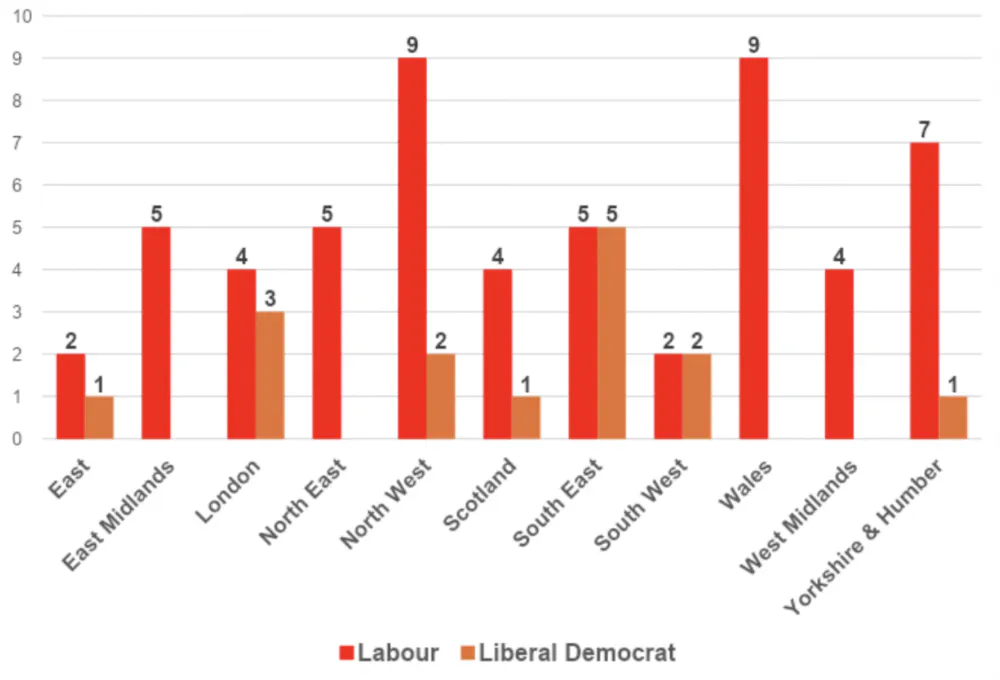
A chart showing how many seats across the country had a 10% lead for the Conservatives over either Labour or the Liberal Democrats in 2019.
Where Labour and the Lib Dems stand to gain from the Tories. P Whiteley

If we look at the case of London in the chart, then given the increase in support for the two parties in the polls, they have a good chance of winning in all seven of the seats where they are in second place. To clarify, Labour came second in the marginal seats of Chingford and Wood Green, Chipping Barnet, Hendon, and in Kensington in the 2019 election. The Liberal Democrats came second in Carshalton and Wallington, the City of Westminster, and in Wimbledon.

All seven seats are ripe to be taken by the two parties but the chances of this happening are increased by a tacit agreement in which Labour puts up a token candidate in the potential Liberal Democrat wins and the Liberal Democrats do the same in the potential Labour wins. This tacit agreement should be kept secret of course otherwise it would be weaponised by the Conservatives.

Scenario 2: The Reform insurgency

The assumption that marginal seats are defined as Conservative seats with a lead of up to 10% ahead of Labour and the Liberal Democrats in 2019 has been overturned by the rise in support for the Reform party. Seats with what were once considered healthy majorities are at risk.

In the last election, Nigel Farage withdrew Reform candidates (then standing under the banner of the Brexit Party) from Conservative seats with strong Brexit supporting MPs and fielded only 275 candidates altogether. This means that the party was not a real threat to the Tories in 2019.

This year, however, Reform is standing candidates in the vast majority of constituencies, making the Tories much more vulnerable. The YouGov poll which put Reform in the lead shows that 32% of 2019 Conservative voters have now switched to Reform. Only 6% of Labour voters have switched to Reform and only 3% of Liberal Democrats – so the Reform surge has shifted the battleground significantly in favour of both parties.

In the second scenario, we assume that Labour and the Liberal Democrats threaten the Tories in seats won by the party with up to a 20% lead over their rivals.

In seats falling into this category, Labour was in second place in 117 seats and the Liberal Democrats in 29. Labour was still dominant in the East Midlands, the north-west, Scotland, Wales, the West Midlands and Yorkshire and Humberside. However, the Liberal Democrats could do much better in the east, London, the south-east and the south-west.

If the two parties won all these seats, then Labour would have 321 seats and the Liberal Democrats 44 seats altogether as a result of adding them to the present total of their MPs in the Commons. That said, this figure ignores the effects of the nationalist parties in Scotland and Wales, both of which could contribute to Conservative losses. In practice, both Labour and the Liberal Democrats could do even better than this.

2019 Conservative Seats with a 20% Lead over over Labour/Lib Dems

A chart showing seats the tories could lose to Labour of the Lib Dems because of Reform.
20% majorities at risk. P Whiteley

These are just two scenarios, and so things could be different in reality. However, they highlight a unique feature of the current election. The centre-left has been divided since Labour replaced the Liberals as the main party of opposition in Britain after the first world war. This is the main reason why the Conservatives have been so successful in winning elections over the past century. The situation has now changed, with the centre-right divided. It is likely to have a devastating effect on the Conservatives on July 4.

The Conversation

This article is republished from The Conversation under a Creative Commons license. Read the original article.


More from East Anglia Bylines

Two canvassers knocking on doors
Activism

Hidden force: the volunteers behind every election campaign

by Stacey Richards
26 June 2024
Infographics from Easyfundraising

We are registered with easyfundraising! 8,000 brands will donate to us for free every time you use it.

It’s super quick and easy to SIGN UP, and will never cost you anything whatsoever. It’s FREE for you and HUGE for us!

Tags: General Election 2024Reform party
Previous Post

Thursday’s election: a big win for ‘don’t know’

Next Post

Election recap: it’s time to decide

Prof Paul Whiteley

Prof Paul Whiteley

After studying economics as an undergraduate at the University of Sheffield Paul Whiteley obtained Masters and Doctoral degrees at the University of Essex. After working in the US, Paul returned to Britain as a Professor of Politics at the University of Sheffield before moving to the University of Essex in 2001. His research interests are in electoral behaviour, public opinion, political economy and political methodology. He is the author or co-author of some 27 books on these topics and more than a 100 academic articles. He is an active blogger and broadcaster commenting mainly on contemporary British politics.

Related Posts

Four slightly tilted panels showing the headquarters of Essex, Cambridgeshire, Norfolk and Suffolk county councils, each identified by its council logo, against a textured grey background.
Anglia

East Anglia’s council shake-up is back on – but a year later

by East Anglia Bylines
4 November 2026
Around 20 demonstrators outside Princess of Wales Hospital, Ely. Their banner reads 'No Palantir in the NHS'.
Activism

⁠Palantir under fire: the battle over its NHS role

by Aidan Baker
26 October 2026
Climate demonstration. Poster reads 'there is no planet b
Climate

Are we being told enough about the ecological collapse?

by Cllr Gary Champion
25 October 2026
The palace of Westminster on fire. An impressionistic image, viewed from across the river. The white stonework of Westminster Bridge on the right of the image glows orange from half way across the river as it reflects the huge flames from the fire. There are dense crowds on the shore in front of the artist, and boats with more spectators on the river.
Democracy

Westminster: it’s time for reform from the ground up

by Calix Eden
16 October 2026
Woman holding an EU flag beside a large yellow bus emblazoned ‘Bollocks to Brexit – It’s not a done deal!’
Brexit

Another referendum on the EU? You must be joking

by Peter Thurlow
16 October 2026
Next Post
Photo of a hand dropping a ballot paper into a box.

Election recap: it’s time to decide

SUPPORT OUR CROWDFUNDER

Tags

Activism Brexit Cartoons Christmas Climate Community Conservation Conservatives Democracy Economy Elections Environment EU Farming General Election 2024 Government Health History Housing Labour Letters Local government Net zero NHS Norwich Opinion Our place in Europe Party politics Pecksniff Politics Polling Pollution Poverty Reform UK Renewables Sewage Social care Something for the weekend Tax Trump Ukraine Voting Wealth Wildlife Women
East Anglia Bylines

We are a not-for-profit citizen journalism publication. Our aim is to publish well-written, fact-based articles and opinion pieces on subjects that are of interest to people in East Anglia and beyond.

East Anglia Bylines is a trading brand of Bylines Networks Limited which is separate to, but allied with, Byline Times.

Learn more about us

No Result
View All Result
  • About
  • Authors and editors
  • Complaints
  • Contact
  • Donate
  • Letters
  • Privacy
  • Network Map
  • Network RSS Feeds
  • Submission Guidelines
  • Download the Bylines Network App

© 2021-2026 East Anglia Bylines. Powerful Citizen Journalism. ISSN 3049-9771

No Result
View All Result
  • HOME
  • News
    • Brexit
    • Health
    • Education
    • World
  • Politics
    • Local government
    • Justice
    • Activism
  • Climate
    • Environment
  • Lifestyle
    • Community
    • Culture
    • History
    • Humour
    • Property
  • Business
    • Development
    • Economics
    • Finance
    • Transport
    • Farming
  • ANGLIA
    • Bedfordshire
    • Cambridgeshire
    • Essex
    • Hertfordshire
    • Norfolk
    • Suffolk
  • Series

Newsletter sign up

Crowdfunder

© 2021-2026 East Anglia Bylines. Powerful Citizen Journalism. ISSN 3049-9771
