• Contact
  • About
  • ISSN 3049-9771
  • Authors and editors
NEWSLETTER SIGN UP
East Anglia Bylines
Advertisement
  • HOME
  • News
    • Brexit
    • Health
    • Education
    • World
  • Politics
    • Local government
    • Justice
    • Activism
  • Climate
    • Environment
  • Lifestyle
    • Community
    • Culture
    • History
    • Humour
    • Property
  • Business
    • Development
    • Economics
    • Finance
    • Transport
    • Farming
  • ANGLIA
    • Bedfordshire
    • Cambridgeshire
    • Essex
    • Hertfordshire
    • Norfolk
    • Suffolk
  • Series
No Result
View All Result
East Anglia Bylines
Home Democracy

Why Conservative MPs standing down are a huge electoral threat to Rishi Sunak

The large number of MPs deciding not to stand in the forthcoming election adds yet more electoral pressure on the PM

Alia Middleton by Alia Middleton
26 May 2024
in Democracy, Politics
Reading Time: 5 mins read
A A
Prime Minister Rishi Sunak at the dispatch box in the House of Commons

Image by UK Parliament via Wikimedia Commons (CC BY-NC-ND 2.0)

Share on Bluesky

At the last count, over 120 MPs have announced they will not contest July’s general election. The vast majority – more than 75 – are Conservatives (or former Conservatives who have been suspended from the party). They include veterans such as Graham Brady, chairman of the backbench 1922 Committee, former prime minister Theresa May, and former cabinet ministers Dominic Raab, Ben Wallace and Michael Gove. Even some of the 2019 cohort, such as Dehenna Davison, intend to leave after just one term.

Of course some MPs step down at every election. Some decide to pursue other interests, some just want to step away from the national political scene. However, we do tend to see spikes in the numbers of MP stepping down ahead of general elections where a subsequent change of government is likely, particularly from the incumbent party. For example, in 1997 the highest proportion of MPs standing down were Conservative, whereas in 2010, Labour MPs represented the highest proportion of those quitting.

Record numbers quitting

The number of MPs who have already announced they are stepping down ahead of the next general election is as high as in 2010. And the departure of so many Conservatives creates a significant electoral headache for Sunak, who is already facing an uphill struggle. Seats where the sitting MP steps down have a history of underperforming for their party at the subsequent general election, compared to seats where the MP has stayed in place.

So a party which is behind in the polls, and already likely to see widespread falls in its vote share, can expect to see even more substantial falls in seats where one of its MPs retires. For some of these seats in 2024, an MP stepping down could be the difference between the Conservatives winning or losing the seat. Esher and Walton, where Raab is leaving behind a seat with a very small majority (taking into account boundary changes), is just one of the areas of concern for Sunak.

The vulnerability of these seats can come down to the fact that an MP has represented a constituency for a long time and has built up a personal vote among people who might otherwise be lukewarm on their party. Local voters may feel more attached to an MP who is a familiar face with a track record of delivering for the constituency. A new, unproven candidate may make them think twice in the polling booth.
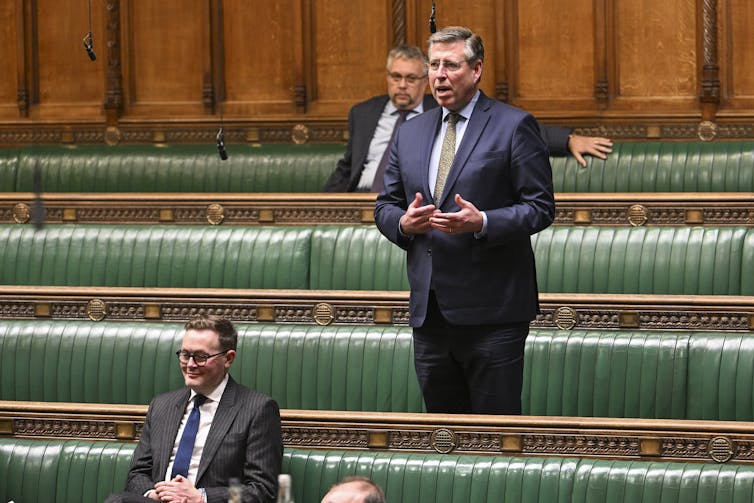
Graham Brady giving a speech in parliament.
Graham Brady is a key figure in the Conservative parliamentary party. Flickr/UK Parliament/Maria Unger, CC BY-NC-ND

Those who are cabinet ministers or other senior party figures, also bring to their constituency an element of kudos associated with their positions. At a time when a party is unpopular, voters are again less “sticky” if a replacement candidate is on offer rather than a former minister.

Can anything be done?

Tracking what might happen in 2024 is a little more complex because the boundary lines between constituencies are being redrawn, but these changes are unlikely to change the pattern in Sunak’s favour. With his party so far behind in the polls and with recent by-elections showing that even Conservative seats with very large majorities are at risk of being lost, any MP stepping down adds an extra layer of vulnerability.

Sunak may be able to take some steps to mitigate the loss of personal votes in seats where his MPs are standing down. My research has shown that choosing the right candidate to stand is key. They shouldn’t be someone who has already fought a general election somewhere else in the country. A track record of this kind implies that party HQ is keen to get the candidate into Westminster, regardless of whether they know the local area. Counterintuitively, the evidence suggests they also shouldn’t be someone who went to school locally – but we don’t really know why that is.

Sunak should instead choose someone who has ties to the seat – such as by living there or working there. It should also ideally be someone who has fought and won other elections locally, such as former local councillors, who come with the added bonus of being used to campaigning in the local area and are well-versed on local issues.

With the election now rapidly approaching, and many Conservative candidates yet to be confirmed where the MP has stepped down, time is running out to choose the best candidates possible to try and offset this unwelcome extra vulnerability.

The Conversation

This article is republished from The Conversation under a Creative Commons license. Read the original article.


More from East Anglia Bylines

Infographics from Easyfundraising

We are registered with easyfundraising! 8,000 brands will donate to us for free every time you use it.

It’s super quick and easy to SIGN UP, and will never cost you anything whatsoever. It’s FREE for you and HUGE for us!

Tags: General Election 2024
Previous Post

Quiet concessions to tactical voting?

Next Post

New medics caught in IT confusion

Alia Middleton

Alia Middleton

After completing undergraduate, postgraduate and doctoral degrees in Politics at the University of Edinburgh, Alia Middleton was appointed as a Research Associate at Newcastle University on the CUPESSE and interEURO projects. She joined the University of Surrey in 2015. Her research interests are British general elections, campaigning strategies, party leadership and voter behaviour. She has published on the electoral impact of retiring MPs, leadership in recent elections in the UK and regional electoral distinctiveness.

Related Posts

James Talarico and Andy Burnham against a graphic background featuring the US Capitol, the Palace of Westminster and a crowd of people.
Brexit

The politics of blame – who pays the price?

by East Anglia Bylines
13 November 2026
Compilation image of the logos of privatised public companies
Business

No more private rip-offs: we need principled public control

by Stephen McNair
12 November 2026
Four slightly tilted panels showing the headquarters of Essex, Cambridgeshire, Norfolk and Suffolk county councils, each identified by its council logo, against a textured grey background.
Anglia

East Anglia’s council shake-up is back on – but a year later

by East Anglia Bylines
4 November 2026
Around 20 demonstrators outside Princess of Wales Hospital, Ely. Their banner reads 'No Palantir in the NHS'.
Activism

⁠Palantir under fire: the battle over its NHS role

by Aidan Baker
26 October 2026
Climate demonstration. Poster reads 'there is no planet b
Climate

Are we being told enough about the ecological collapse?

by Cllr Gary Champion
25 October 2026
Next Post
Online medical exam room

New medics caught in IT confusion

SUPPORT OUR CROWDFUNDER

Tags

Activism Brexit Cartoons Christmas Climate Community Conservation Conservatives Democracy Economy Elections Environment EU Farming General Election 2024 Government Health History Housing Labour Letters Local government Net zero NHS Norwich Opinion Our place in Europe Party politics Pecksniff Politics Polling Pollution Poverty Reform UK Renewables Sewage Social care Something for the weekend Tax Trump Ukraine Voting Wealth Wildlife Women
East Anglia Bylines

We are a not-for-profit citizen journalism publication. Our aim is to publish well-written, fact-based articles and opinion pieces on subjects that are of interest to people in East Anglia and beyond.

East Anglia Bylines is a trading brand of Bylines Networks Limited which is separate to, but allied with, Byline Times.

Learn more about us

No Result
View All Result
  • About
  • Authors and editors
  • Complaints
  • Contact
  • Donate
  • Letters
  • Privacy
  • Network Map
  • Network RSS Feeds
  • Submission Guidelines
  • Download the Bylines Network App

© 2021-2026 East Anglia Bylines. Powerful Citizen Journalism. ISSN 3049-9771

No Result
View All Result
  • HOME
  • News
    • Brexit
    • Health
    • Education
    • World
  • Politics
    • Local government
    • Justice
    • Activism
  • Climate
    • Environment
  • Lifestyle
    • Community
    • Culture
    • History
    • Humour
    • Property
  • Business
    • Development
    • Economics
    • Finance
    • Transport
    • Farming
  • ANGLIA
    • Bedfordshire
    • Cambridgeshire
    • Essex
    • Hertfordshire
    • Norfolk
    • Suffolk
  • Series

Newsletter sign up

Crowdfunder

© 2021-2026 East Anglia Bylines. Powerful Citizen Journalism. ISSN 3049-9771
