• Contact
  • About
  • ISSN 3049-9771
  • Authors and editors
NEWSLETTER SIGN UP
East Anglia Bylines
Advertisement
  • HOME
  • News
    • Brexit
    • Health
    • Education
    • World
  • Politics
    • Local government
    • Justice
    • Activism
  • Climate
    • Environment
  • Lifestyle
    • Community
    • Culture
    • History
    • Humour
    • Property
  • Business
    • Development
    • Economics
    • Finance
    • Transport
    • Farming
  • ANGLIA
    • Bedfordshire
    • Cambridgeshire
    • Essex
    • Hertfordshire
    • Norfolk
    • Suffolk
  • Series
No Result
View All Result
East Anglia Bylines
Home Environment Climate

Arctic ice is vanishing – our bold experiment is trying to protect it

Scientists are pumping seawater onto existing ice to make it thicker and more resilient

Dr Shaun Fitzgerald by Dr Shaun Fitzgerald
14 May 2025
in Climate, Environment, Science
Reading Time: 8 mins read
A A
Two people on snow scooters

The author and colleagues exploring in the Canadian Arctic. Real Ice.

Share on Bluesky

Like ice in a drink, Arctic sea ice keeps things cold – until it melts. Using the same principle, some scientists are investigating whether they can make sea ice thicker and better able to cool the planet. I recently returned from Cambridge Bay in the far north of Canada, where I saw some early experiments in practice.

Over the winter months, the build-up of sea ice around Cambridge Bay and across the Arctic helps keep the sea water underneath close to the freezing temperature, which for saltwater is around -1.8°C.

These conditions are broadly maintained even through the early summer until the ice begins to melt and break up. The white ice cover, which reflects a large portion of the sun’s energy, is then replaced by dark blue water, which has the opposite effect. Now absorbing more sunlight, the water warms up.

Such has been the balanced perennial cycle of sea ice in the Arctic, but recent decades of global warming might be putting it in jeopardy.

Over the past 30 years, sea ice in the Arctic has decreased. Rising air temperatures coupled with warmer water flowing in from further south have meant the ice starts to form later in the year and melt earlier.

With less sea ice, there are longer periods in summer where more of the sun’s energy is absorbed rather than reflected into space. This creates a feedback loop – the warmer the water, the less sea ice is formed; the less sea ice there is, the warmer it gets.
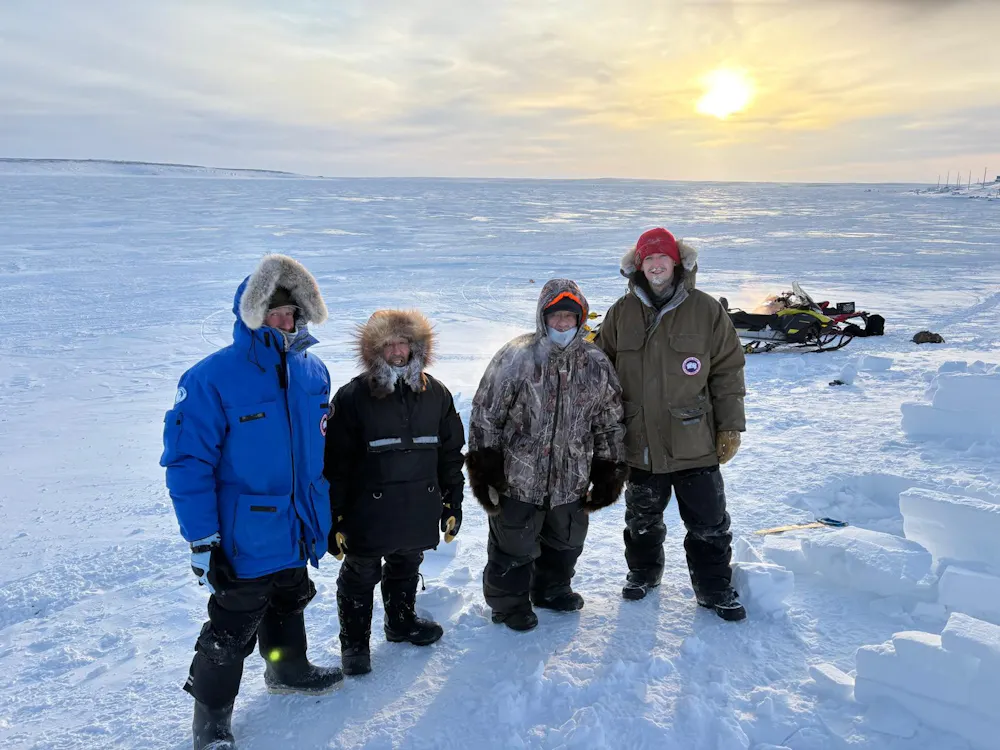
People posing on ice
The author (in blue) and colleagues on the ice near Cambridge Bay in March 2025. Real Ice

My trip to Cambridge Bay was as part of a team of scientists and engineers who have gathered together with local communities in the Arctic and two umbrella projects: Real Ice and Arctic Reflections. These groups want to research whether anything can be done to temporarily slow down or even reverse the loss of sea ice.

The ultimate solution is, undoubtedly, deep and rapid reductions in greenhouse gas emissions. But with slow progress over the past few decades, additional measures may buy us time.

Buying time

Several big ideas are currently being explored. The first involves pumping seawater on top of existing ice to try and promote ice growth on top of the sea ice.

Usually, any new sea ice that forms naturally does so on the underside of the ice. The process of freezing gives off some energy, which must escape through the ice above – a good insulator.

The idea of pumping on top of the ice is that by bypassing the insulating effect, more sea ice might form – and the heat it gives off can be transferred to the cold winter Arctic air or directly radiated out to space.
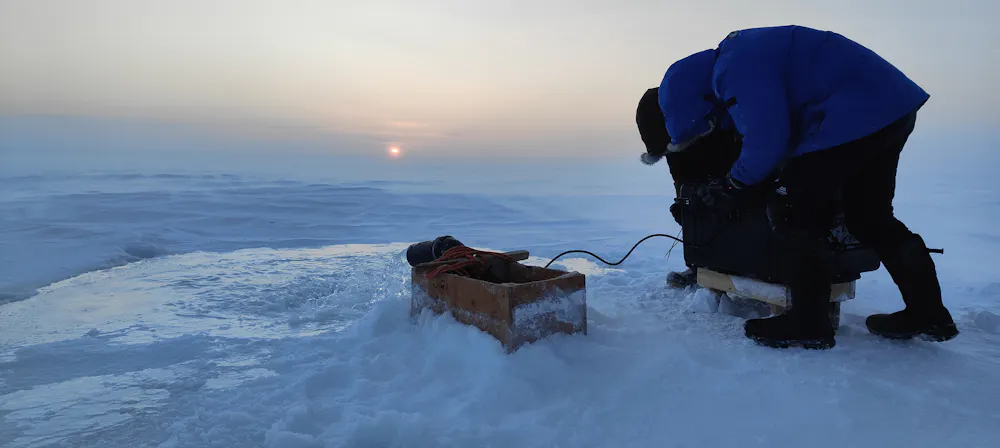
Man with water pump on ice
The author, pumping water onto ice. Real Ice

The second idea stems from the realisation that snow is an even better insulator than ice. The proposal is therefore to pump just enough water onto the snow to flood it.

As it freezes and turns into solid ice, it becomes much more conductive than snow. In turn, this will enable more sea ice to form naturally on the underside of sea ice.

A third idea is derived from the observation that as sea ice melts in the early summer, melt ponds form on the surface. These melt ponds are much darker and absorb more heat than the original ice.

So the idea is to explore whether it might be possible to drill small holes in the ice to drain them, exposing reflective ice and slowing the melt.

These ideas might sound fanciful, but the dramatic changes in the Arctic warrant investigation into interventions that could have an impact sooner than cutting emissions or removing greenhouse gases.

Can we really save sea ice?

Crucially, the research is focused on developing our understanding of these potential ideas. The research could show that they are impractical, unfeasible or would potentially make things worse.

For example, if pumping sea water onto sea ice leads to thicker ice at the end of the winter, that may not be much use if the ice is so much saltier that it melts more quickly.

Barges & tugs overwintering in Cambridge Bay
Barges & tugs overwinter in Cambridge Bay, Canada, as the sea around the town turns to ice. Image by Alan Sim via Wikimedia Commons (CC BY-SA 3.0)

Therefore, researchers are using a combination of mathematical modelling, laboratory experiments, and limited-scale field experiments to address fundamental questions. A research project funded by the UK government has just been launched which includes modelling of thickening of sea ice.

A further one including additional outdoor experiments will be starting soon funded by the UK’s Advanced Research and Invention Agency (Aria) as part of its Exploring Climate Cooling programme.

These experiments will be conducted in close collaboration with local communities and under Aria’s stringent governance framework, prioritising safety and environmental monitoring. The goal is to gather essential real-world data to rigorously assess if this intervention warrants further consideration.

The initial results and observations from preliminary field experiments are inconclusive but encouraging. For example, the ice formed by pumping sea water onto sea ice appears to become less salty (and therefore less prone to melting) over a few weeks.

The brine which forms as seawater freezes on the surface is more dense than the ice and appears to migrate downwards through the ice. This seems theoretically plausible, but it is too early in the experiments to be confident in the results.

If this research suggests that thickening sea ice works, then the next step will be to engage with more Arctic locals and various policymakers, and determine whether scaled-up testing of some of these approaches would be appropriate.

The Conversation

This article is republished from The Conversation under a Creative Commons license. Read the original article.


More from East Anglia Bylines

Signpost saying 'fake ads' against a backdrop of a huge wildfire
Business

How ‘Big Oil’ manipulates climate truth – and how to fight back

by Sarah Collins
12 March 2025
Eurasian skylark in flight
Climate

Why even common birds are now at risk from climate change

by East Anglia Bylines
14 April 2025
"Globo verde" by Aproximando Ciência e Pessoas is licensed under CC BY 2.0
Climate

Educating for the climate change emergency

by Jenny Rhodes
12 October 2021
Climate demonstration. Poster reads 'there is no planet b
Climate

Social media platforms are still helping climate denial

by Stephen McNair
5 March 2024
Infographics from Easyfundraising

We are registered with easyfundraising! 8,000 brands will donate to us for free every time you use it.

It’s super quick and easy to SIGN UP, and will never cost you anything whatsoever. It’s FREE for you and HUGE for us!

Tags: Climate
Previous Post

Letter: We are not strangers

Next Post

New: retired couple loses battle over footpath through their garden

Dr Shaun Fitzgerald

Dr Shaun Fitzgerald

Shaun is Director of Research in the Centre for Climate Repair at the University of Cambridge as well as Director of Research for Cambridge Zero. He is also a Teaching Fellow and Director of Studies in Engineering at Girton College. At the height of the pandemic, Shaurn served on the Scientific Advisory Group for Emergencies (SAGE) Environmental Modelling Group and Transmission Working Group for SARS-CoV-2.

Related Posts

A newly excavated, muddy pond area containing a shallow pool of water, showing signs of recent conservation work. The clearing is surrounded by bare, turned-up brown earth, mature green trees, and low ground vegetation. In the background to the right sits a traditional black weatherboarded barn with a red tiled roof, separated from the clearing by a wooden fence.
Environment

Seven ponds set to reveal their hidden wildlife potential

by Rebecca Turner
8 November 2026
Jason Williams, also known as the Cloud Gardener, with Harriet Festing in her Norwich balcony garden. They are sitting together looking at the garden, which has wide variety of plants, all in pots. Beyond them at the other end of the balcony a group of people are sitting on the balcony and chatting.
Environment

How a Norwich balcony became a haven for wildlife

by East Anglia Bylines
1 November 2026
Air source heat pump: photo Stephen McNair
Economics

The great heat pump paradox: more heat, less progress

by Stephen McNair
1 November 2026
Houses stand close to the edge of a steep, eroding sandy cliff above the beach at Thorpeness, Suffolk.
Anglia

Dredging for profit but losing our villages?

by Rachel Fulcher
30 October 2026
Four schoolgirls wearing lab coats and safety glasses carry out a chemistry experiment in a science classroom.
Education

Where are the women? Scientists missing from school science

by East Anglia Bylines
29 October 2026
Next Post
Scott's garden gate notice says: "Private land. No public right of way."

New: retired couple loses battle over footpath through their garden

SUPPORT OUR CROWDFUNDER

Tags

Activism Brexit Cartoons Christmas Climate Community Conservation Conservatives Democracy Economy Elections Environment EU Farming General Election 2024 Government Health History Housing Labour Letters Local government Net zero NHS Norwich Opinion Our place in Europe Party politics Pecksniff Politics Polling Pollution Poverty Reform UK Renewables Sewage Social care Something for the weekend Tax Trump Ukraine Voting Wealth Wildlife Women
East Anglia Bylines

We are a not-for-profit citizen journalism publication. Our aim is to publish well-written, fact-based articles and opinion pieces on subjects that are of interest to people in East Anglia and beyond.

East Anglia Bylines is a trading brand of Bylines Networks Limited which is separate to, but allied with, Byline Times.

Learn more about us

No Result
View All Result
  • About
  • Authors and editors
  • Complaints
  • Contact
  • Donate
  • Letters
  • Privacy
  • Network Map
  • Network RSS Feeds
  • Submission Guidelines
  • Download the Bylines Network App

© 2021-2026 East Anglia Bylines. Powerful Citizen Journalism. ISSN 3049-9771

No Result
View All Result
  • HOME
  • News
    • Brexit
    • Health
    • Education
    • World
  • Politics
    • Local government
    • Justice
    • Activism
  • Climate
    • Environment
  • Lifestyle
    • Community
    • Culture
    • History
    • Humour
    • Property
  • Business
    • Development
    • Economics
    • Finance
    • Transport
    • Farming
  • ANGLIA
    • Bedfordshire
    • Cambridgeshire
    • Essex
    • Hertfordshire
    • Norfolk
    • Suffolk
  • Series

Newsletter sign up

Crowdfunder

© 2021-2026 East Anglia Bylines. Powerful Citizen Journalism. ISSN 3049-9771

