• Contact
  • About
  • ISSN 3049-9771
  • Authors and editors
NEWSLETTER SIGN UP
East Anglia Bylines
Advertisement
  • HOME
  • News
    • Brexit
    • Health
    • Education
    • World
  • Politics
    • Local government
    • Justice
    • Activism
  • Climate
    • Environment
  • Lifestyle
    • Community
    • Culture
    • History
    • Humour
    • Property
  • Business
    • Development
    • Economics
    • Finance
    • Transport
    • Farming
  • ANGLIA
    • Bedfordshire
    • Cambridgeshire
    • Essex
    • Hertfordshire
    • Norfolk
    • Suffolk
  • Series
No Result
View All Result
East Anglia Bylines
Home REGIONS Cambridgeshire

Britain’s most artificial landscape may not survive climate change

The Fens, source of a third of England’s vegetables, faces rising floods, drought and heat as climate risks collide.

East Anglia Bylines by East Anglia Bylines
18 September 2026
in Cambridgeshire, Climate, Farming, Featured, Norfolk, Science
Reading Time: 7 mins read
A A
A canal boat on a large fen waterway with wind turbines in the distance and green fields to the side.

Boating in The Fens image by Richard Humphrey. CC BY-SA 2.0

Share on Bluesky

By Katie Jenkins, University of East Anglia and Robert James Nicholls, University of East Anglia

Stretching across much of eastern England, the Fens produce a third of the country’s vegetables and support tens of thousands of jobs. Yet around 33% of the region lies below average sea level, while 87% is below the highest spring tides

The landscape only exists due to centuries of engineering – pumps, embankments and drainage channels – that keeps water moving almost constantly. Now climate change is introducing new challenges that this system was never designed to face.

The Fens face several climate threats that reinforce one another. Rising sea levels, heavier downpours, hotter summers, longer droughts and biodiversity loss are all expected to intensify over the coming decades. These are all serious challenges, and in the Fens they will play out within one tightly interconnected system.

The Fens cover parts of Cambridgeshire, Lincolnshire and Norfolk:
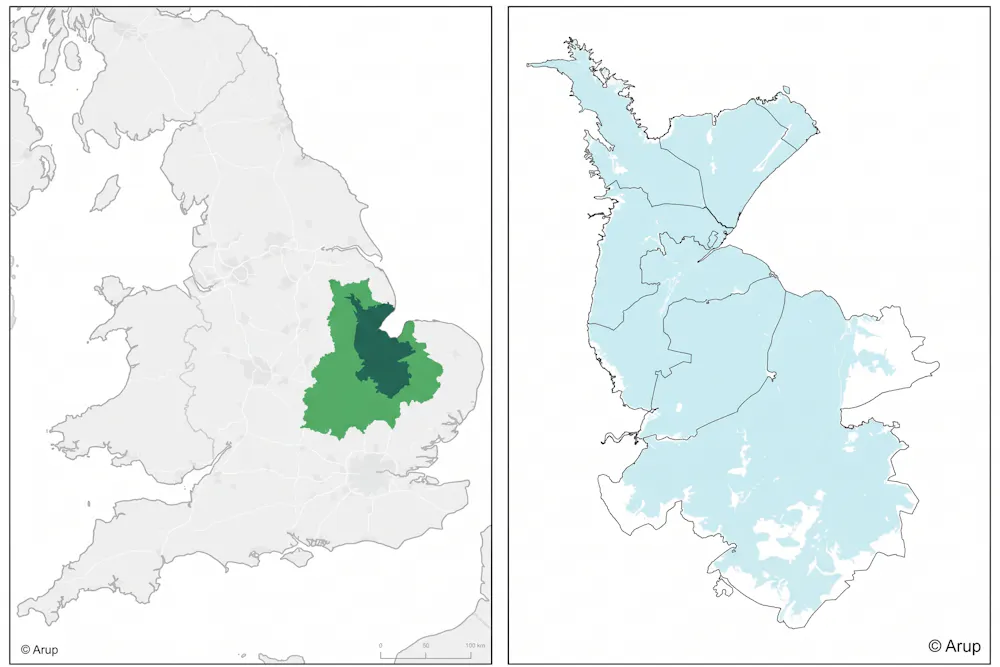
two maps of the Fens
The Fens (dark green) and their wider catchment area (light green). The map on the right shows the area (shaded blue) below the mean high spring tides that would be at risk without human engineering. Environment Agency / Arup: ‘Fens 2100+: Summary baseline report’, CC BY-SA

In June, we published an academic analysis of these climate risks in the Fens. Our research examined flood risk from rivers, surface water and the sea, alongside drought, water scarcity, heat, biodiversity loss and agricultural productivity. It found that these hazards increasingly overlap as the climate warms.

With around 2°C of warming, the region will experience more frequent flooding, more extreme heat, declining summer river flows and accelerated biodiversity loss.

By 2100, under a 4°C warming scenario, annual flood damages to homes and businesses in the region could rise from £16 million today to £250 million, while ecosystems could collapse and parts of the Fens would be rendered uninhabitable without major investment in new infrastructure.

Importantly, sea-level rise is different from other risks as it will continue for centuries even if global temperatures are stabilised. Even a high emissions scenario, where the sea would rise by a metre by 2100, would still be followed by further rise. This is an existential risk for the low-lying Fens, meaning that more radical adaptation approaches will be needed in the long term. Decisions about how to adapt must begin well before then, as major changes to infrastructure and land management take decades to plan and implement.

Connected climate hazards

A golden photo of a fen waterway against golden fields under an evening sky
Fens in the evening image by Kate Jewell. CC BY-SA 2.0

National climate risk assessments are essential, but they can mask the severity and complexity facing regions with distinct characteristics. The Fens is a case in point given its low-lying geography means that it is exposed to multiple climate risks that can compound each other.

River flows could fall by more than 25% under 4°C warming, at the same time as floods from surface water, rivers and seas would increase. Agriculture could faces crop losses from both drought and water scarcity and from water logging and flooding, alongside a decline in insect pollinators that could reduce productivity. These issues cannot be managed by only tackling single hazards in turn.

We therefore developed a way to assess all the climate-related risks to a single place, rather than looking at each hazard in isolation. This provides an integrated picture of how multiple risks develop and interact over time, and gives interested people and groups locally relevant information to help them plan for climate change.

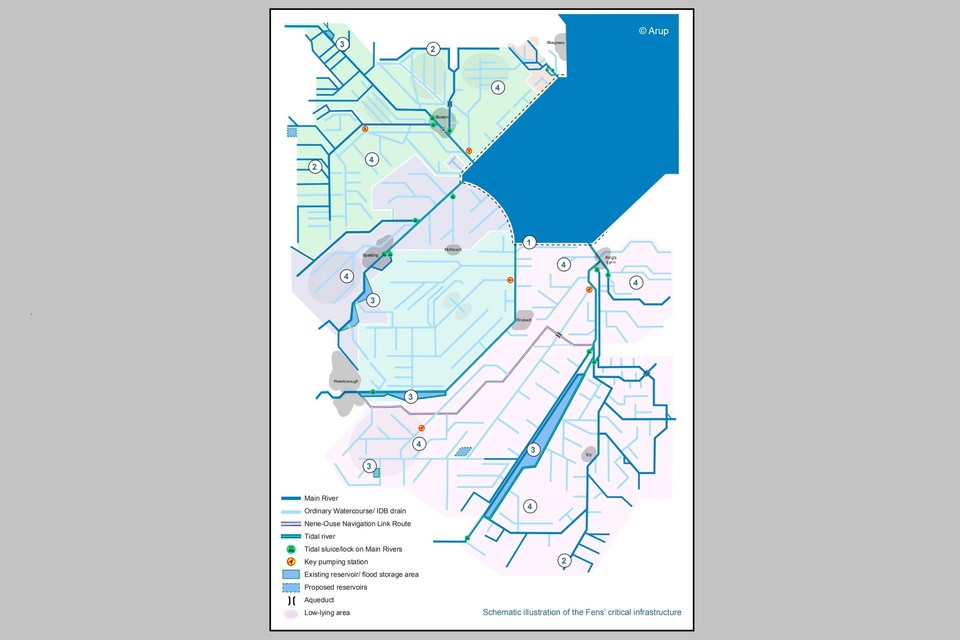
Map of Fenland infrastructure.
A schematic map of the many rivers, canals and other waterways that keep the Fens drained. Environment Agency / Arup: ‘Fens 2100+: Summary baseline report’, CC BY-SA

Aligned with the engineering evidence

The Environment Agency’s Fens 2100+ programme, published in April 2026, reaches similar conclusions on the region’s infrastructure. For the first time, it brings together evidence on the entire flood risk management system, covering around 17,000 assets including 318 pumping stations, embankments and tidal defences.

Together, these assets are estimated to provide £58.8 billion in benefits through avoided flood damage over the next 100 years. However, nearly a third of these defences need upgrading in the next 15 years.

Both our analysis and the Fens 2100+ evidence conclude that dealing with these challenges separately or only in the short term cannot work.

The Fens needs to be considered as one connected landscape with decisions about flood protection, water, agriculture and the environment made together. Coastal lowlands around the world, from the Netherlands to the Mekong delta in Vietnam, are grappling with similar interconnected challenges of sea level rise, flooding and competing demands for land and water. The approach we have developed could be applied to help people in these regions assess their options for adaptation.


Katie Jenkins, British Academy Innovation Fellow, Tyndall Centre for Climate Change Research, and
Robert James Nicholls, Professor of Climate Adaptation, both at University of East Anglia

The Conversation

This article is republished from The Conversation under a Creative Commons license. Read the original article.


Depleted numbers at a climate protest, Westminster. A banner strung between traffic lights says 'Rebel against climate chaos"; Four activists are sitting on the ground in front of it, and another 2 or 3 are standing nearby. People are walking past without taking much notice.
Climate

Is no one concerned about the climate any longer?

by Max Terzza
15 July 2026
A car stopped at a flooded road intersection at dusk. So the image has a bluey hue.
Community

Our new climate: adapting to survive – and thrive

by Prof Rupert Read
21 February 2026
Climate change is going global
Climate

Climate change: an expensive myth or a question of survival?

by Marc Ainge
21 November 2025
Tags: floodingFoodResearch
Previous Post

Are solar farms really stealing the food from our mouths?

Next Post

Pecksniff – The MPs’ terror that dare not speak its name: Brexit

East Anglia Bylines

East Anglia Bylines

East Anglia Bylines is a not-for-profit regional online newspaper that supports citizen journalism. Our aim is to publish well-written, fact-based articles and opinion pieces by the public on subjects that are of interest to people in East Anglia and beyond. In doing so, we seek to demonstrate democracy in action by giving a voice to local people and holding our elected representatives to account. If you'd like to write something for us, please email us: editor@eastangliabylines.co.uk

Related Posts

Peterborough Town Hall
Democracy

They planned to rewire local government. Now they’ve pulled the plug

by Stephen McNair
12 October 2026
Welded steel sculpture of two large open hands, I hold and am held by Rick Kirby, in Woodbridge, Suffolk.
Featured

Who gets to decide which of my parents is real?

by The Hidden Voice
11 October 2026
A group of children crouch together on grass, using a magnifying glass to examine something on the ground during an outdoor activity
Climate

‘ClimateReady Schools’: putting young people at the heart of climate action

by Kit Marie Rackley
9 October 2026
A close-up shot of golden wheat stalks ready for harvest in the foreground, with a combine harvester blurred in the background driving through a vast field under a hazy sky.
Farming

Food security and resilience vital after extreme summer drought

by Martin Lines
9 October 2026
Harvesting potatoes. A large machine is digging them out of the soil and transferring them via a funnel into crates on a trailer being hauled by a tractor.
Economics

Five foods that could cost even more this winter – and why

by East Anglia Bylines
8 October 2026
Next Post
EU and Union Jack flags flying beside Big Ben against a clear blue sky in Westminster.

Pecksniff – The MPs’ terror that dare not speak its name: Brexit

SUPPORT OUR CROWDFUNDER

Tags

Activism Brexit Cartoons Christmas Climate Community Conservation Conservatives Democracy Economy Elections Environment EU Farming General Election 2024 Government Health History Housing Labour Letters Local government Net zero NHS Norwich Opinion Our place in Europe Party politics Pecksniff Politics Polling Pollution Poverty Reform UK Renewables Sewage Social care Something for the weekend Tax Trump Ukraine Voting Wealth Wildlife Women
East Anglia Bylines

We are a not-for-profit citizen journalism publication. Our aim is to publish well-written, fact-based articles and opinion pieces on subjects that are of interest to people in East Anglia and beyond.

East Anglia Bylines is a trading brand of Bylines Networks Limited which is separate to, but allied with, Byline Times.

Learn more about us

No Result
View All Result
  • About
  • Authors and editors
  • Complaints
  • Contact
  • Donate
  • Letters
  • Privacy
  • Network Map
  • Network RSS Feeds
  • Submission Guidelines
  • Download the Bylines Network App

© 2021-2026 East Anglia Bylines. Powerful Citizen Journalism. ISSN 3049-9771

No Result
View All Result
  • HOME
  • News
    • Brexit
    • Health
    • Education
    • World
  • Politics
    • Local government
    • Justice
    • Activism
  • Climate
    • Environment
  • Lifestyle
    • Community
    • Culture
    • History
    • Humour
    • Property
  • Business
    • Development
    • Economics
    • Finance
    • Transport
    • Farming
  • ANGLIA
    • Bedfordshire
    • Cambridgeshire
    • Essex
    • Hertfordshire
    • Norfolk
    • Suffolk
  • Series

Newsletter sign up

Crowdfunder

© 2021-2026 East Anglia Bylines. Powerful Citizen Journalism. ISSN 3049-9771