


Look, I moved away from South Africa for a reason.
It wasn’t just the politics (though yes, that too). It was the heat. The smothering, oppressive, wall-of-fire summer heat that melts your will to live faster than ice cream on a braai plate. Growing up in SA, I spent December through February basically hibernating indoors, emerging only when absolutely necessary, like a sweaty vampire with a deep appreciation for air conditioning.
I came to Britain expecting drizzle, cardigans and seasonal affective disorder. I wanted grey skies, wet pavements and an entire national mood that could be described as “slightly damp”. I was promised a country where people apologise for the weather and carry umbrellas as a religious practice. Where the most exciting meteorological event would be someone saying “bit nippy today” while wearing three layers in July.
What I absolutely did not want – what I most certainly did not sign up for – was a June in London that feels like I’m being slowly roasted in a microwave built by Satan’s middle managers. It was 31 degrees yesterday. It’s set for 29 degrees today. Tomorrow it will be 32. I am 6’3″, heavyset and made almost entirely of sarcasm and sweat glands. I am not coping.

I have taken to lying very still on the sofa like a Victorian invalid, occasionally making pathetic groaning sounds for sympathy. My cat has abandoned me for the cooler bathroom tiles, shooting me judgmental looks as if this is somehow my fault. My husband keeps cheerfully suggesting we “go for a walk” or “sit on the patio”, which I can only interpret as a hate crime.
The inside of my thighs feel like they should be classified as a heritage site. My desk chair has developed what I can only describe as a permanent human-shaped puddle. I’ve started rating my days not by productivity but by how many times I’ve had to peel myself off various surfaces.
And this is just June. June. We haven’t even reached the bit where the government starts issuing heat warnings and the tabloids run headlines about “BRITAIN BURNS”.
And yet – and yet – here comes the inevitable tweet. Every single time. Like clockwork. Like a particularly irritating cuckoo clock that only tells the time in bad takes.
“Anyone remember the summer of ’76? It was hot then too. Melted the tarmac! Had to wear shorts! Got a bollocking from mum! Memories like that stop me believing in climate change.”
Right.
Let’s talk about that.
Why ’76 isn’t the smoking gun you think it is (and why that narrative persists anyway)
The summer of 1976 was, yes, very hot. It was dry. It was unusual. And it was an outlier. That’s why people still talk about it. You know what they don’t do? Talk about the summer of 1983. Or 1994. Or that bank holiday in 2002 when it rained sideways for six days straight. Because those weren’t weird enough to remember.
Here’s what ’76 actually looked like: it was the hottest summer Britain had recorded at that time. Temperatures peaked at 35.9°C at Cheltenham. It was also, crucially, a single year.
Since then, we’ve smashed that record multiple times. 2022 hit 40.3°C in Coningsby. We’re not talking about slightly warmer weather – we’re talking about temperatures that break critical infrastructure and kill vulnerable people. The problem isn’t that we’re having a hot summer – it’s that we’re having them every single year. 40°C is no longer a freak outlier but something we now plan for.
But here’s what’s particularly insidious: the “remember ’76” narrative isn’t just wrong – it’s deliberately cultivated. This is weaponised nostalgia.
Every heatwave triggers the same media cycle. Telegraph op-eds about how “the Edwardians had it just as bad“. Mail photo galleries of children in fountains captioned “When Britain knew how to enjoy the sun”. Radio phone-ins flooded with melted ice lolly memories.
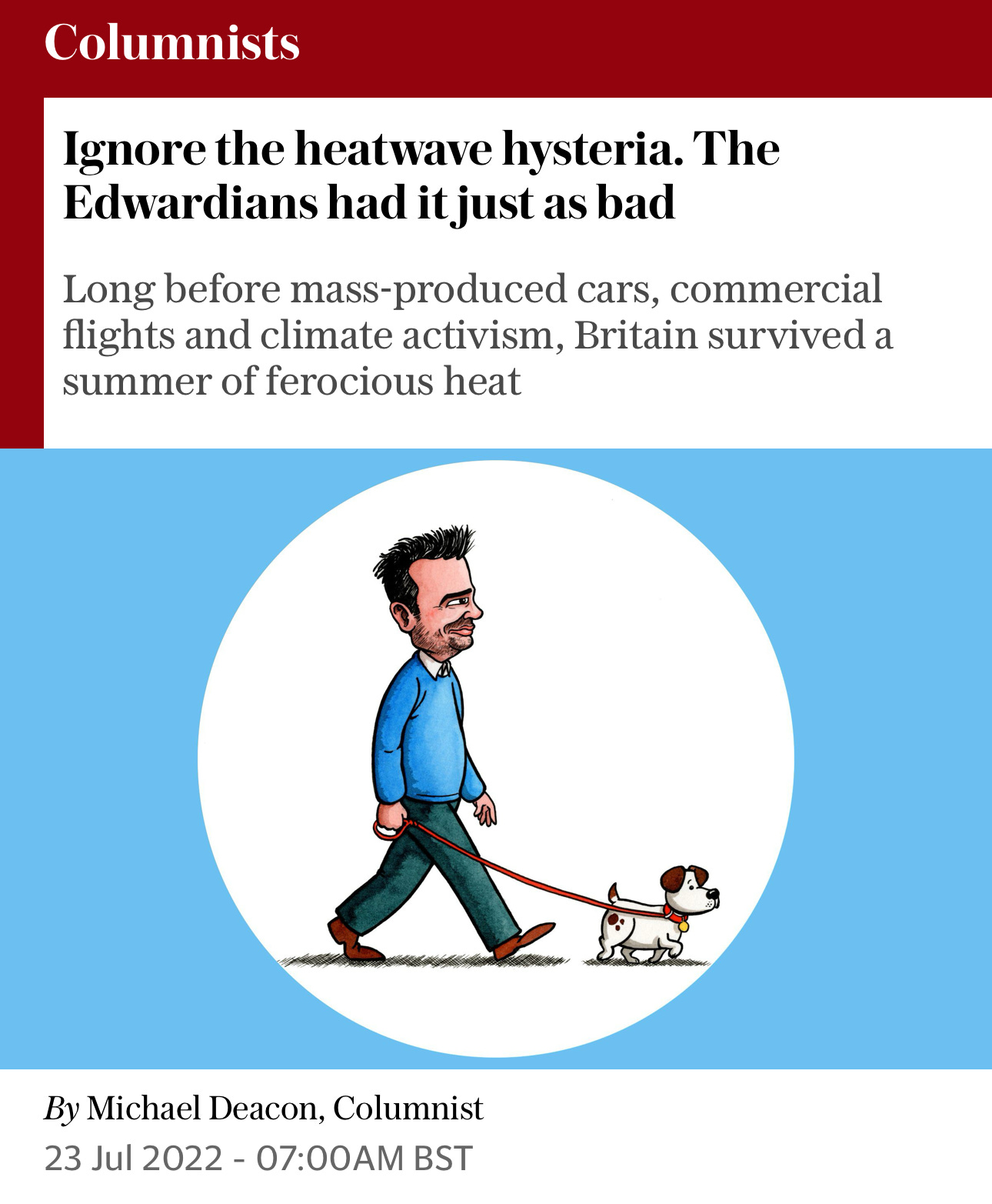
It’s climate denial rebranded as heritage – a Union Jack comfort blanket pulled over the eyes while the planet burns.
This serves two purposes: it shifts responsibility backwards (why worry about something that’s “always happened”?) and immunises against future action (why spend billions on adaptation if we ‘coped fine in ’76’?). The media amplifies this because nostalgia performs brilliantly. Politicians enable it because it’s easier than governing.
The result? We’re sleepwalking into a crisis while telling ourselves bedtime stories.
Weather ≠ climate – but Climate shapes weather
Let’s do the basics, with actual numbers.
Weather is what you get. Climate is what you expect. And what we should expect has fundamentally changed.
The UK’s average temperature has risen by 1.2°C since the 1960s. That might sound modest, but in climate terms, it’s seismic. The difference between our current climate and the last ice age was only about 6°C.
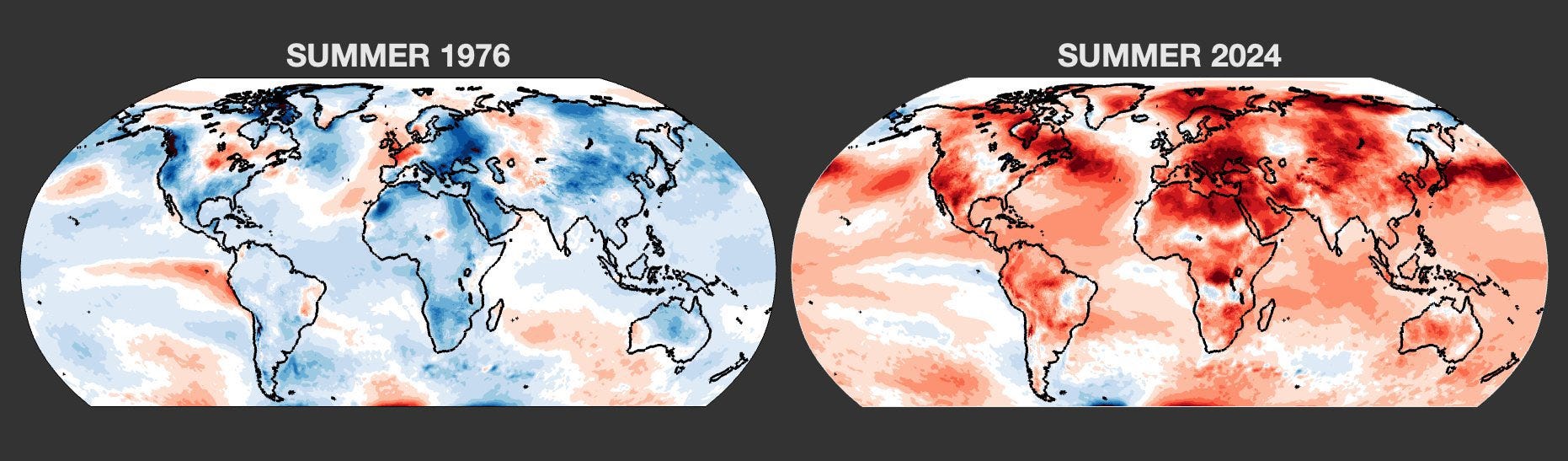
Here’s what that 1.2°C increase actually means:
Frequency changes: The probability of 40°C days has increased tenfold since the 1970s. According to the Met Office, without human-induced climate change, the 2022 heatwave would have been virtually impossible. The odds have shifted from 1-in-300 years to 1-in-15.
Intensity changes: The UK temperature record has been broken three times since 2003: 38.7°C in 2019, 40.3°C in 2022. The 1976 record of 35.9°C stood for 27 years. We’ve shattered it multiple times in four years.
System changes: UK winter temperatures have risen even faster, by 1.7°C since the 1960s. Spring arrives earlier, growing seasons extend longer and rainfall patterns are shifting toward more intense but less frequent events.
The crucial point: a 1.2°C rise doesn’t mean ‘slightly warmer summers’ – it means the entire probability distribution has shifted. What were once extreme outliers become regular occurrences.
I’m in no way saying that 1976 didn’t happen. But it was a statistical outlier in a stable system. What we’re seeing now are outliers in a rapidly changing system, occurring with increasing frequency in a new baseline reality.
Even the hot countries are breaking
If you need proof that this isn’t just ‘weather being weather’, look at what’s happening to countries that actually know how to handle heat.
India hit 50.5°C in 2024 – temperatures so extreme that airports had to suspend flights because planes couldn’t take off safely. Roads literally melted. The power grid collapsed under air conditioning demand. These are people whose ancestors have lived with serious heat for millennia, in cities designed around surviving summers that would kill most Europeans. And they’re struggling.
In Pakistan, temperatures reached 53.3°C while the country was already dealing with devastating floods – the kind of extreme weather whiplash that climate scientists have been warning about for decades.
Even Canada – Canada – saw temperatures hit 49.6°C in British Columbia, literally cooking entire towns off the map. Lytton, a town that had stood for over a century, burned to the ground the day after setting the national temperature record. The heat dome was so intense it created its own weather system.
Australia, a continent that built its entire national identity around surviving hostile weather, recorded its hottest day ever at 50.7°C. These aren’t places that shut down because of a bit of sunshine – they have infrastructure, culture and centuries of experience dealing with extreme heat. And they’re being overwhelmed.
Meanwhile, we’re sitting in Britain debating whether 40°C is “really that unusual” because someone’s granddad once had a memorable sunburn in 1976.
The countries that know heat are struggling. The countries that don’t know heat are in crisis. And we’re still arguing about whether this is normal because we remember a single hot summer from nearly 50 years ago.
The heat is real. The denial still isn’t.
I’m very sorry to say that your soiled childhood shorts, the tar on the roads and the bollocking you got from your mum aren’t data. They’re not a peer-reviewed study. They’re not even helpful. They’re just a memory. And if we’re being honest, one that’s been polished and repeated so many times it probably owes more to folklore than fact.
We’re not living in 1976 anymore. We’re living in 2025, where heatwaves now threaten critical infrastructure, hospitals don’t have cooling systems and vulnerable people actually die from preventable overheating while politicians wax nostalgic about hosepipe bans and garden paddling pools.
This isn’t just a bit of weather. This is what climate collapse feels like at first: uncomfortable, uncanny and wrapped in denial that looks suspiciously like national identity.
And if we don’t snap out of it, it gets worse. Not just hotter, but harder. Harder to grow food. Harder to stay healthy. Harder to keep the systems running that make modern life even remotely bearable.
So yes, remember ’76 if you want to. That’s fine. But remember it properly. Not as an excuse to dismiss the crisis, but as a warning of what a single hot summer once did to a relatively stable system. Then multiply it by every year from now on.
That’s where we are. That’s what we’re living through. And no amount of nostalgic bollockings or melted tarmac memories is going to get us out of it.
Start paying attention.
And for the love of god, someone install air con on the Northern Line.
This article by The Bear is republished with kind permission from his Substack. Read the original here.
More from East Anglia Bylines



