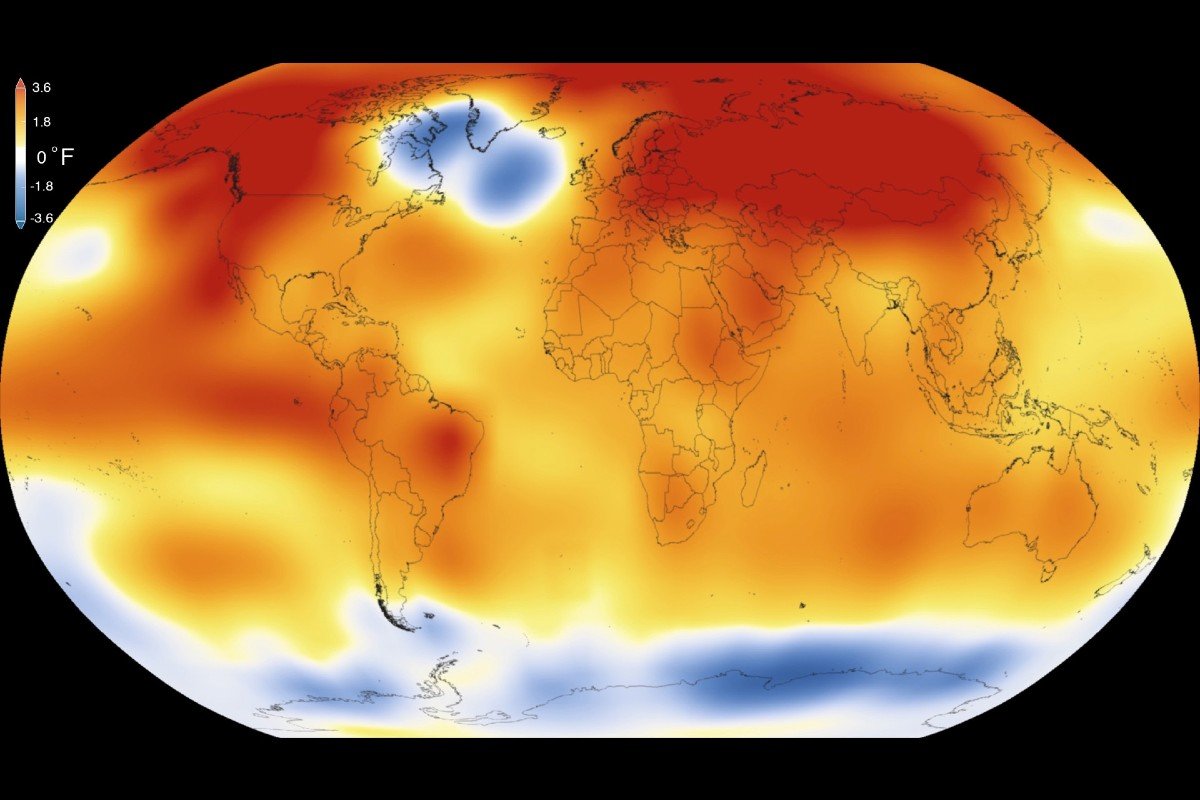
On maps showing how much the world’s oceans have warmed, one area stands out. South of Greenland, amid a sea of reds and oranges, sits a stubborn patch of blue. Scientists call it the North Atlantic warming hole, although it has become better known as the “blue blob”.
Far from disproving climate change, researchers believe it may be linked to changes in one of the systems that helps regulate the climate of Britain itself. The blue blob is thought to be connected to a weakening of a vast system of ocean currents, including the Gulf Stream, which helps move heat around the North Atlantic.
A baby born this World Oceans Day will probably still be alive in 2100. By then, they may be living in a country that looks broadly familiar but feels noticeably different. If they grow up in a coastal community such as Happisburgh or Thorpeness, they may witness further retreat of a coastline already under pressure from erosion. If they become a farmer in East Anglia, they may face growing uncertainty over drought, flooding and harvests. If they make their living from the sea, the fish landed in British ports may not be the same species familiar to previous generations.

The current most people know as the Gulf Stream
Most people will have heard of the Gulf Stream – the warm ocean current often credited with helping keep Britain milder than other places at similar latitudes. What many don’t realise is that the Gulf Stream forms part of a much larger system of currents known as the Atlantic Meridional Overturning Circulation, or AMOC.
The AMOC acts like a giant conveyor belt, carrying warm water northwards through the Atlantic. As that water approaches Europe, it releases heat into the atmosphere. The prevailing winds then help carry some of that warmth across Britain and north-west Europe before the cooler, denser water sinks and begins its journey back southwards at depth.
According to the Met Office, this circulation is one reason Britain enjoys a relatively mild climate despite our northerly location. London lies further north than Calgary in Canada, while Edinburgh sits at a similar latitude to parts of Alaska. Without the Atlantic transporting heat northwards, life in Britain would feel rather different.
Scientists broadly agree that the AMOC has weakened over recent decades and is likely to weaken further during this century. Freshwater entering the North Atlantic from melting Greenland glacier ice and increased rainfall is thought to be making it harder for water to sink and drive the circulation.
The debate is less about whether the AMOC is changing – there’s broad scientific agreement that it is – than about how quickly it will weaken, and what the consequences might be. As climate specialist Jeff Berardelli recently put it, the real question is “when and by how much”. Some recent studies suggest the risk of crossing a tipping point may be higher than previously thought, while others argue a complete collapse remains unlikely this century. What remains uncertain is how quickly the system might change and what the consequences would be for countries around the North Atlantic.
What kind of climate will today’s children inherit?
The immediate concern is not that Britain suddenly freezes. The Met Office says greenhouse warming is still expected to outweigh the cooling effect of the gradual weakening projected during this century, meaning the UK is likely to continue warming overall.
But a warmer climate doesn’t simply mean warmer weather. Changes in ocean circulation can influence rainfall patterns, winter temperatures, storm tracks and sea levels around the North Atlantic. The question is not how cold or wet next winter will be, but whether the long-established patterns that have shaped life in Britain become less predictable.

That uncertainty is already being felt. Analysis by the Energy and Climate Intelligence Unit found that three of the five worst English harvests on record have occurred this decade.
Farmers endured one of the most volatile periods in recent agricultural history, with exceptionally wet conditions in 2024 followed by drought and record-breaking heat in 2025.
For a child born today who later chooses a career in farming, the challenge may not simply be adapting to a warmer climate. It may be adapting to a climate that swings more frequently between extremes, making long-established assumptions about planting, harvesting and water management less reliable. As researchers at the London School of Economics’ Grantham Research Institute note, the AMOC is likely to weaken during the 21st century, adding further uncertainty to a climate that is already changing.
Living with water
Few parts of Britain understand the importance of water better than East Anglia. For families living close to the coast, climate change is not measured in global temperature records. It is measured in metres of cliff lost to the sea. According to the Environment Agency, rising sea levels and more frequent storms are accelerating coastal erosion, forcing communities to adapt to a changing coastline.
A child growing up in Happisburgh today is likely to witness more houses disappear over the cliff edge during their lifetime. From Essex to Yorkshire, residents have already experienced the loss of homes to erosion, discovering that climate change is not measured only in rising temperatures, but in places that can no longer be lived in. In some communities, roads, footpaths, farmland and even cemeteries are now at risk from a coastline that continues to retreat. There’s no question the coast will change – it has for millennia, and the process has been speeded up by climate change – so the challenge now is how communities respond when it does.

Inland, the challenge is different but no less significant. The Environment Agency’s Fens 2100+ programme warns that climate change is expected to increase both river and tidal flooding while also increasing the risk of drought. Much of the Fenland landscape already depends on an extensive network of drains, embankments and pumping stations to keep water moving and farmland productive. Around 87% of the Fens lies below mean spring tide level.
The challenge facing future generations may not simply be keeping the sea out. It may be from the sky as well. Parts of the Fens already rely on pumps to move water into rivers that, in places, sit above the surrounding land. As sea levels rise and periods of intense rainfall become more common, maintaining those systems is likely to become increasingly demanding and expensive.
The same questions extend beyond East Anglia. Over recent decades, housing has continued to be built on flood plains across Britain. The climate around which many communities planned their flood defences, drainage systems and infrastructure is changing. The blue blob matters because it may be signalling change in one of the systems that helps shape Britain’s climate.
More than an ocean current
The effects will not be limited to land. As ocean temperatures and currents change, marine ecosystems change with them. Fish species are already shifting their ranges in search of suitable conditions, altering what is caught in nets and sold in fish markets. The North Sea of the late 21st century may not support exactly the same mix of species as the North Sea of today.
None of these challenges can be blamed on a single ocean current. Coastal erosion, flooding and poor harvests are already being driven by a warming climate. Now scientists are paying close attention to the blue blob because it may be telling us that one of the systems helping to regulate our climate is also changing. If they are right, then communities will need to rapidly adapt – and many already are. The uncertain question is what they will need to adapt to.
The child born this World Oceans Day may never hear the term Atlantic Meridional Overturning Circulation or see the blue blob on a scientific chart. But the decisions made today could help determine the weather they experience, the food they eat, the homes they can afford to insure and the landscapes they inherit. That’s why a patch of unusually cool water thousands of miles away has become one of the most closely watched places on Earth.
This article was researched with the help of AI, written by Anna Damski and edited by East Anglia Bylines.
More from East Anglia Bylines


Bylines Network Gazette is out!
The latest Bylines Network Gazette is out now. Become a Friend of Bylines Network or upgrade to a paid Substack subscription, and you will get access to a vital collection of citizen articles and stories.
Journalism by the people, for the people.