COP26 is creating confusion and expectation. The question that emerges, is regardless of the politicians, what can I do personally? The problem is there’s a bewildering number of terms, which many of us don’t always understand. And frequently we’ll see people debating the merits of one renewable technology over another, but we’re unable to engage due to a lack of knowledge about how they can best be evaluated. I am a chartered engineer working in the energy sector and so for my bit I’m going to give you the key to those terms, unlocking the door to understanding renewable options.
Let’s start with the basics.
- Renewable: The energy source can be replaced.
- Zero carbon: The energy generated does not produce Carbon Dioxide gas (CO2).
The two are more-or-less equivalent, but for the purpose of this analysis I will address. energy sources in relation to the carbon dioxide produced, since this is a ‘greenhouse gas’ and contributes to global warming.
Zero carbon energy sources are:
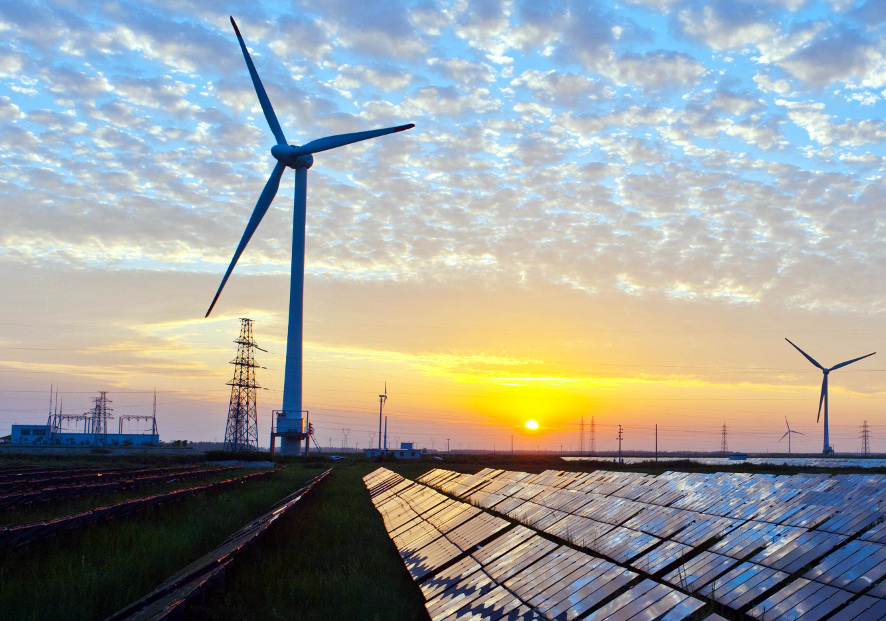
- Wind: Wind turbines generate electricity when the wind is strong enough. This electricity can be sent over long distances.
- Solar PV: Photo Voltaic, often called simply “Solar Cells”, these are silicon-based panels, that produce direct current electricity (DC), which in itself cannot be transmitted over long distances without conversion into alternating current (AC), but can be used as a local source of energy. They produce energy when in sunlight.
- Solar direct: This is a variety of technologies which usually heat up air, to heat a building for example, or water.
- Water: Water can be used to create electricity in a number of ways, such as a hydroelectric dam, waves or tidal power. This gives a constant source of energy since they are sited in places of continual water flow.
- Geothermal: Heat from the earth itself. This technique is used for instance in Iceland and gives continuous power.
- Nuclear: Provides continuous energy, but has safety risks and a very high decommissioning cost.
All these technologies produce energy, which is usually transmitted by electricity. Each can be evaluated using three factors:
- Lifetime cost: This is a measure of the total of the costs of creating, maintaining and disposing of the energy-generating facility. In the case of nuclear, oil and gas, these costs are very considerable.
- Lifetime carbon emission: The facility may appear to produce energy with CO2 emission, but in the case of a wind turbine for example, there is a large amount of CO2 produced in its manufacture and in the case of offshore installation, significant CO2 production in the maintenance procedures.
- Energy output: This is the easiest of the parameters to measure.
- Energy Cost: The cost is calculated from the lifetime cost as a ratio to the lifetime energy output.
This analysis does not include environment or social impact.
You will see from the list of zero carbon energy sources that some technologies do not give a continuous supply, as seen with wind and solar. To make these sources useful therefore we need ways to store the energy when the wind has stopped and it has gone dark.
Storage
They are grouped as:
- Chemical: The obvious form of chemical storage is the battery. Battery technology is constantly improving, but has a high requirement for rare earth metals and disposal problems. The other main contender is hydrogen generation by electrolyses.
- Thermal energy: We are all familiar with the “storage heater”, which goes back decades and was one of the first mainstream technologies to iron out the peaks and troughs of energy demand. It was a derivative of the “Masonry Heaters” used for centuries in Northern Europe. There is an interesting feasibility project going on which uses PV electricity to heat molten salt, which in turn runs a conventional power station. The molten salt is stored in underground insulated tanks and so the whole power station can run 24 hours a day.
- Kinetic energy: Kinetic meaning movement. The main use of this is for very localised systems, typically vehicles. Hybrid racing cars use a heavy flywheel to slow the car down as a form of braking, then re-use the energy to accelerate it. The same technique is used on some trams and trains.
- Potential energy: The best example of this are facilities such as the Electric Mountain. This plant uses two natural lakes and stores energy by pumping the water from the lower to the higher, then releases it by running the water down again through a generator.
Each technology can be evaluated in terms of effectiveness by the following parameters:
- Efficiency: The energy produced compared to the energy consumed.
- Unit cost: The cost of the energy in currency (eg £) per joule (the unit of energy)
- Life time cost: The cost per joule taking into account the creation, maintenance and decommissioning of the facility.
- Life time carbon emission: The actual CO2 produced during the life of the facility.
Usage
It is futile to expect a new energy supply system that exactly replaces the previous ‘steady state model’. Henry Ford famously said, “If I’d asked my customers what they wanted, they would have said Faster Horses”. The carbon impact of any system depends upon the way it is used. No distribution utility can supply its peak demand and rely on some kind of compromise to keep the cost reasonable. For example, there would not be enough water if all the taps were tuned on simultaneously; there would not be enough waste disposal capacity if everyone flushed their toilet and let out their baths simultaneously; and there is not enough phone capacity for everyone to call simultaneously. Likewise, the energy generation system will be most efficient under specific usage profiles:
- Less: Consider more energy efficient ways of doing everything – home working being an obvious option, and insulation, which is the topic of my other article in this series.
- Better directed: We are all familiar with the old ‘off-peak electricity’ product. This was a market lead offering to match the constant electricity supply model to the varying demand. This can be turned around to get the device which consumes energy, like washing machines, to communicate with the machines that supply it.


Summary
We can almost eliminate carbon dioxide emissions from our energy sources. I have described here all the technologies which are available for low carbon energy production in terms of their science and engineering.
How this is done is now up the politicians to decide.