• Contact
  • About
  • ISSN 3049-9771
  • Authors and editors
NEWSLETTER SIGN UP
East Anglia Bylines
Advertisement
  • HOME
  • News
    • Brexit
    • Health
    • Education
    • World
  • Politics
    • Local government
    • Justice
    • Activism
  • Climate
    • Environment
  • Lifestyle
    • Community
    • Culture
    • History
    • Humour
    • Property
  • Business
    • Development
    • Economics
    • Finance
    • Transport
    • Farming
  • ANGLIA
    • Bedfordshire
    • Cambridgeshire
    • Essex
    • Hertfordshire
    • Norfolk
    • Suffolk
  • Series
No Result
View All Result
East Anglia Bylines
Home Lifestyle Community

Harnessing nature-based solutions to help combat flooding

Natural England’s projects on the Wissey and Deben show how working with nature can combat flooding

East Anglia Bylines by East Anglia Bylines
5 May 2025
in Community, Environment, Farming, Norfolk, Suffolk
Reading Time: 5 mins read
A A
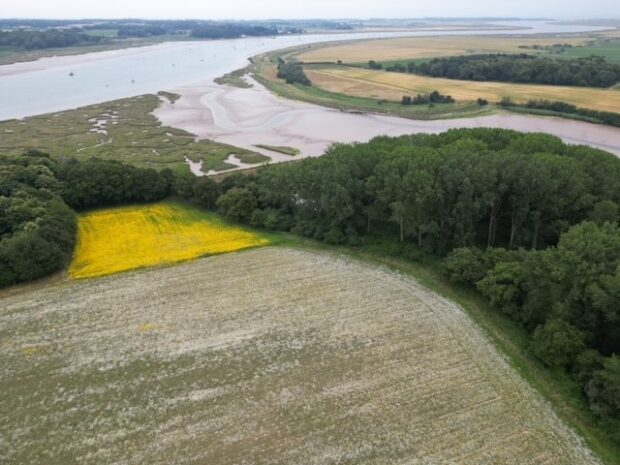
Aerial view of the Deben estuary

Aerial view of the Deben estuary. Image © John Fielding All rights reserved. Used with permission of the photographer.

Share on Bluesky

As climate change brings more frequent and severe flooding, innovative solutions are emerging to tackle these challenges. Working with nature, not against it, Natural England is proposing schemes to help tackle flooding in Norfolk and Suffolk.  

Projects in our region – one on the River Wissey in Norfolk and another along Suffolk’s Deben Estuary (pronounced Dee-ben) – are showing how nature-based solutions can help reduce flood risks while revitalising landscapes and supporting wildlife. 

Norfolk: natural solutions on the River Wissey

In Norfolk, Natural England is using technology to help restore and manage water along the River Wissey. They, together with Catchment Sensitive Farming, have captured stunning aerial footage of the river and its surroundings to kickstart discussions around future restoration proposals and natural flood management solutions.  
Drone footage of the River Wissey
Drone footage of the River Wissey captured by Natural England/Catchment Sensitive Farming, which will kickstart discussions around future restoration proposals and natural flood management solutions (OGL3)

This technology has allowed experts to map a 6.6km stretch in detail, offering a unique view to inform which areas of arable land on either side of the river are less productive and better suited to manage flooding. This technique helps to prevent larger, catastrophic flood events from occurring by giving the river more room to expand in desired locations, rather than it bursting its banks uncontrollably. 

Natural Flood Management, (NFM), is an approach that works with nature, not against it. Instead of relying on traditional flood defences like walls and dams, NFM focuses on natural techniques like tree planting, wetland creation, and river re-meandering to slow water flow.  

This, in turn, creates and interconnects habitats for wildlife and improves soil structure and quality by reducing uncontrolled flooding, run-off and loss of topsoil. This approach can turn less-productive farmland into vibrant wetlands that not only absorb excess water and carbon but also support biodiversity. 

The drone footage will be shared with local landowners, conservationists, and stakeholders, igniting discussions about how to restore both the river and surrounding farmland. By working together, these groups have the opportunity to transform the landscape by making it more resilient to flooding whilst creating wetlands to boost biodiversity. In a region like East Anglia, where flooding is a growing concern, this project could become a model for future efforts across the country. 

Suffolk: nature-led farming on the Deben estuary

Meanwhile, on the Deben Estuary in Suffolk, a farmer, Patrick, is leading the way with his own nature-based solutions. Patrick’s farm borders a saltmarsh designated as a Site of Special Scientific Interest (SSSI), and a ditch separates his fields from the tidal waters. 

Deben wetland
Deben wetland. Image by Natural England (OGL3)

As sea levels rise, Patrick noticed the ditch filling with sediment, prompting him to seek advice from farm advisers at Natural England. What started as a routine conversation about maintenance quickly evolved into an innovative new plan: managed realignment and intertidal creation.  

Rather than battling the encroaching tides, Patrick chose to work with nature, allowing estuary waters to flow onto his land to create new intertidal habitats. These habitats are vital for the local wildlife that Patrick loves and act as natural flood buffers. 

With the support of a stewardship agreement, Patrick is now creating these habitats, turning a challenge into an opportunity. His decision marks a significant shift in how coastal landowners can adapt to rising sea levels. By letting nature take the lead, Patrick is not only protecting his farm for the future from uncontrolled, unwanted flooding, but also enhancing habitats and the local environment. 

This work by Natural England is part of a wider movement to save the Deben, which is of ecological importance in feeding a Ramsar wetland that supports internationally important flora and fauna. The river is suffering from pollution, habitat loss and the impacts of climate change. Following years of local initiatives, a year ago the East Suffolk Catchment Partnership (hosted by the Essex and Suffolk Rivers Trust) launched a major action plan, “Recovering the Deben – From Source to Sea,” to restore the river’s health.

Only 11% of the river length is currently in good ecological condition, with rising temperatures, sewage pollution and land runoff taking a toll. The initiative brings together conservationists, farmers, community groups and agencies to deliver landscape-scale restoration, aiming to transform the Deben into a thriving habitat not only for wildlife once again, but also for the communities that use them.

Together, these projects on the River Wissey and the Deben Estuary are showcasing the power of nature-based solutions. By collaborating with nature, they offer a sustainable way to manage flooding, support biodiversity, and create resilient, thriving landscapes for the future. 

This article is adapted from one by Natural England and is republished under an Open Government Licence (OGL 3.0). Read the original here.


More from East Anglia Bylines

Looking across the Deben estuary at sunset
Activism

Tides of change: East Suffolk unites to restore River Deben

by East Anglia Bylines
13 May 2024
Ramsholt Quay, River Deben
Environment

Some things I know about the River Deben

by Martin Waller
27 May 2022
This is a 3M Petrifilm, which contains 1ml of sample. We took the sample on 18/8/22, near an Anglian Water Sewage Treatment Plant, close to high tide. The sample was then incubated for 24 hrs at 42c. This allowed any e.Coli colonies to form. Each blue dot is an individual colony. DEFRA issued a table which says that 1000 colonies per 100ml is poor, and in these cases a sign must be erected to warn against swimming. So, as we test only 1ml, there should be less than ten (10) dots within the circle. A reader kindly counted the dots, and got as 390. That means this sample is 39x the DEFRA-defined limit. DM me for any further info, or if you’d like to set up your own testing station.
Community

Sewage, citizen science and the River Deben

by Anna Damski
21 August 2022
Eamonn O'Nolan explains the issues with Deben River water quality to a woman visiting the Deben Climate Centre centre.
Community

The citizen scientists who challenge the surge in sewage

by Anna Damski
7 September 2024


Infographics from Easyfundraising

We are registered with easyfundraising! 8,000 brands will donate to us for free every time you use it.

It’s super quick and easy to SIGN UP, and will never cost you anything whatsoever. It’s FREE for you and HUGE for us!

Tags: EnvironmentRewilding
Previous Post

Reform UK offers nostalgia, not solutions

Next Post

Why don’t we punish people who break company law?

East Anglia Bylines

East Anglia Bylines

East Anglia Bylines is a not-for-profit regional online newspaper that supports citizen journalism. Our aim is to publish well-written, fact-based articles and opinion pieces by the public on subjects that are of interest to people in East Anglia and beyond. In doing so, we seek to demonstrate democracy in action by giving a voice to local people and holding our elected representatives to account. If you'd like to write something for us, please email us: editor@eastangliabylines.co.uk

Related Posts

A newly excavated, muddy pond area containing a shallow pool of water, showing signs of recent conservation work. The clearing is surrounded by bare, turned-up brown earth, mature green trees, and low ground vegetation. In the background to the right sits a traditional black weatherboarded barn with a red tiled roof, separated from the clearing by a wooden fence.
Environment

Seven ponds set to reveal their hidden wildlife potential

by Rebecca Turner
8 November 2026
Eleven East Anglia Bylines volunteers gathered around pub tables in Norwich, smiling towards the camera, with large windows behind them.
Anglia

Good news for independent journalism in East Anglia – and for you

by Anna Damski
6 November 2026
Close-up photo of a fiercely burning bonfire
Community

Remember, remember… to keep wild animals safe this Bonfire Night

by East Anglia Bylines
3 November 2026
Jason Williams, also known as the Cloud Gardener, with Harriet Festing in her Norwich balcony garden. They are sitting together looking at the garden, which has wide variety of plants, all in pots. Beyond them at the other end of the balcony a group of people are sitting on the balcony and chatting.
Environment

How a Norwich balcony became a haven for wildlife

by East Anglia Bylines
1 November 2026
Air source heat pump: photo Stephen McNair
Economics

The great heat pump paradox: more heat, less progress

by Stephen McNair
1 November 2026
Next Post
Royal Courts of Justice

Why don’t we punish people who break company law?

SUPPORT OUR CROWDFUNDER

Tags

Activism Brexit Cartoons Christmas Climate Community Conservation Conservatives Democracy Economy Elections Environment EU Farming General Election 2024 Government Health History Housing Labour Letters Local government Net zero NHS Norwich Opinion Our place in Europe Party politics Pecksniff Politics Polling Pollution Poverty Reform UK Renewables Sewage Social care Something for the weekend Tax Trump Ukraine Voting Wealth Wildlife Women
East Anglia Bylines

We are a not-for-profit citizen journalism publication. Our aim is to publish well-written, fact-based articles and opinion pieces on subjects that are of interest to people in East Anglia and beyond.

East Anglia Bylines is a trading brand of Bylines Networks Limited which is separate to, but allied with, Byline Times.

Learn more about us

No Result
View All Result
  • About
  • Authors and editors
  • Complaints
  • Contact
  • Donate
  • Letters
  • Privacy
  • Network Map
  • Network RSS Feeds
  • Submission Guidelines
  • Download the Bylines Network App

© 2021-2026 East Anglia Bylines. Powerful Citizen Journalism. ISSN 3049-9771

No Result
View All Result
  • HOME
  • News
    • Brexit
    • Health
    • Education
    • World
  • Politics
    • Local government
    • Justice
    • Activism
  • Climate
    • Environment
  • Lifestyle
    • Community
    • Culture
    • History
    • Humour
    • Property
  • Business
    • Development
    • Economics
    • Finance
    • Transport
    • Farming
  • ANGLIA
    • Bedfordshire
    • Cambridgeshire
    • Essex
    • Hertfordshire
    • Norfolk
    • Suffolk
  • Series

Newsletter sign up

Crowdfunder

© 2021-2026 East Anglia Bylines. Powerful Citizen Journalism. ISSN 3049-9771