• Contact
  • About
  • ISSN 3049-9771
  • Authors and editors
NEWSLETTER SIGN UP
East Anglia Bylines
Advertisement
  • HOME
  • News
    • Brexit
    • Health
    • Education
    • World
  • Politics
    • Local government
    • Justice
    • Activism
  • Climate
    • Environment
  • Lifestyle
    • Community
    • Culture
    • History
    • Humour
    • Property
  • Business
    • Development
    • Economics
    • Finance
    • Transport
    • Farming
  • ANGLIA
    • Bedfordshire
    • Cambridgeshire
    • Essex
    • Hertfordshire
    • Norfolk
    • Suffolk
  • Series
No Result
View All Result
East Anglia Bylines
Home Environment

Learning to love toads

Toads need our help. Two regional wildlife experts tell us why it is important to help toads across roads and have access to large ponds.

Aidan Baker by Aidan Baker
28 April 2026
in Environment
Reading Time: 7 mins read
A A
Female toad

Female toad. Image by Rebecca Neal, used with permission

Share on Bluesky

How do you feel about toads?

Wildlife expert John Heaser says that most people don’t like them very much. He shows audiences a picture of a slug and his own cat on the same slide, and asks, “On a scale of one to five, if the slug is one and the cat five, where would you put the toad in terms of how you relate to it?” At the start of the talk, people tend to say, “one or two”. They see toads as a life-form with as much mental capacity as a slug. At the end of the talk, once they’ve learned more about toads, they rate them up at five.

Toads and roads

John is Area Co-ordinator for Toadwatch, a Norfolk-based charity working for the well-being of toads. In the spring, Toadwatch’s principal activity is helping toads across the road.

“We try to minimise the distance we move them. We believe they are retracing the steps they take as toadlets. At Carleton Forhoe, the toads arrive at all four corners of the bridge. You’d think, if they had any sense, they’d take the shortcut directly into the river. But some of them cross the road, some of them cross the bridge.”

Outside Norfolk, the charity Froglife coordinates patrols across the country and serves as a central point for data. In Cambridgeshire, the Papworth and Bourn patrols are under the eye of Rebecca Neal of the Wildlife Trust for Beds, Cambs and Northants. Rebecca explained:

“We pick up toads and also frogs and newts from one side of the road, and stick them in a bucket and carry them safely to the other side of the road, usually closer to the pond. If they’ve done their thing, and they’re moving away, we just put them safely on the other side of the road.”

Rebecca had advice for anyone who might come across a migrating toad.

“They are persistent. So, even if there are roads in their way when they are going to their breeding ponds, they will still try to migrate. They are calm. A frog is slippery and jumpy, and will do anything to get out of your hand, which means you sometimes drop them because they will squeeze out the tiniest of holes. But toads are calm, and will allow you to help them along their way.”

Unappetising toads

And that’s not the only difference between frogs and toads. Rebecca went on:

“Frogs are eaten by loads of different things. So, they often lay their eggs in what could potentially be an ephemeral pond – one that might dry out – because it’s less likely to have fish in it. They kind of take that risk. Toads can go for the slightly better option of a bigger, deeper pond or lake, because they don’t taste very nice to fish.”

John Heaser had more to say on this last point:.

“Toads need big ponds. They need to spend the winter where they’re not going to get frozen to death. They like big heaps of rubble, which they can get into, old mole holes – all things that not many people put in their garden. Fortunately, there are people who’ve got big gardens and are prepared to heap up a load of logs and chuck some old carpet over them, and let nature cover the lot in stinging nettles. In Little Massingham, somebody dug out a lake in their garden. The toads said, ‘Whoopee, thanks. We’ll breed here.’ “

The taste of toads came up more than once in these discussions. John explained:

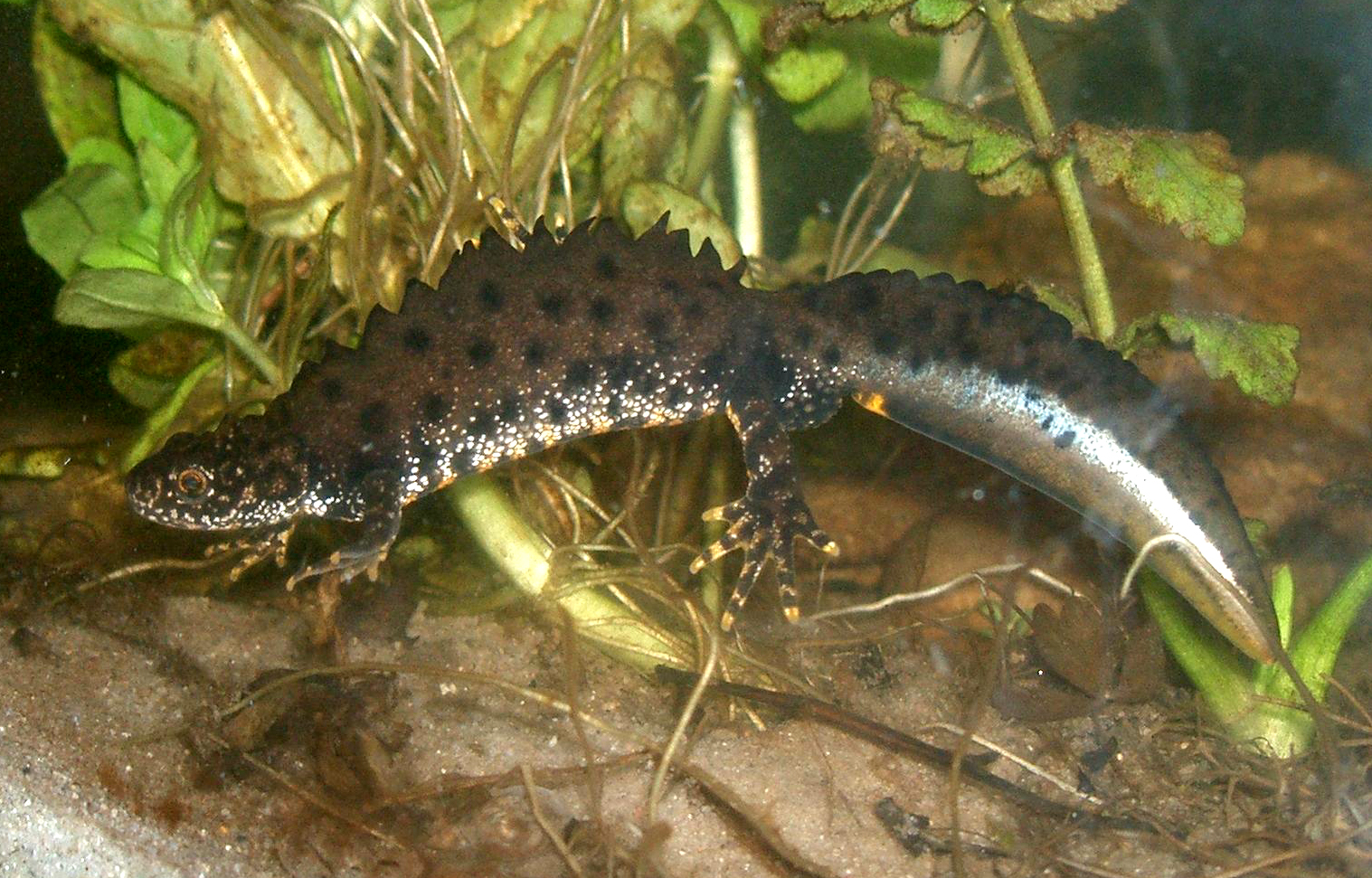
Crested newt. It's lizard-like, dark grey-green with black spots, and the very distinctive crest it displays in the mating season. It has a bulbous tail-like portion which is as long as its body, a sperm ampulla, which will be transferred to the female.
Crested newt image by Rainer Theuer. via Wikimedia Commons (Public domain)

“Newts predate more on frog spawn than on toad spawn. Toads have a toxic substance on their skin, and in parts of the world, people lick them to get a high. (We don’t recommend that to people on toad patrol, for various reasons.) We have seen a staggering increase in common newts by a factor of 10 or even 100 in places. Nobody seems to know where these newts are coming from.”

Conflicts of interest

The two activists talked about whether there is ever a problem when species they were concerned about preyed on each other. Rebecca replied:

Toad spawn image by Mike Krueger. CC BY-SA 3.0

“I had a question the other day about the carrying capacity of the pond, and whether we are interfering by doing patrols. But we’re interfering in an interference. Getting run over on the road is an interference. People dislike sparrowhawks, but you only have sparrowhawks where you’ve got a healthy population of small birds. Humans do far more damage.”

John’s reply was similar:

“I’ve yet to come across anybody who has a problem with toads eating slugs, snails and wood lice. A toad in your garden is entirely beneficial. The biggest threat to toads at the moment, other than where they’re being lost on roads, is loss of winter habitat. A derelict farmyard with collapsed barns, and heaps of corrugated roofing had lots of good places for a toad to spend the winter. Toad winter habitat is a big mound that it can get into to avoid freezing to death. Such things tend to be unpopular in people’s barn conversions.”

Both Toadwatch and Froglife are online. Toadwatch operates in Norfolk only. Froglife posts regularly on Bluesky. With the 2026 toad migration season drawing to a close, they have begun to post about how to make your garden wildlife-friendly for the rest of the year: plant pollinator-friendly flowers, start a compost bin, build a bug hotel, create a mini pond. Another body active in this area is the Cambridgeshire & Peterborough Amphibian & Reptile Group.

And share your pics with them – and us – on social media!


More from East Anglia Bylines

2 men in a field planting a hedgerow of saplings
Cambridgeshire

Restoring Britain’s hedgerows: Why Wimpole Estate’s 10-year plan matters

by Kate Moore
24 March 2026
The first two eggs in Cromer, one cream with red markings, the other red with cream markings. The parent is standing over them protectively.
Anglia

High above us, it’s the season of love again

by Sarah Patey
22 March 2026
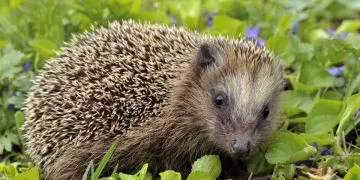
Hedgehog facing camera in a bed of violets
Activism

Saving hedgehogs starts with small steps close to home

by Kate Moore
8 February 2026
Bittern at Strumpshaw Fen. It's wading in shallow water among reeds, with its beak pointing upwards. Its feathers are a complex pattern of brown, ivory and pale orange, and the foot that's out of the water is pale green.
Environment

New nature reserve announced as Norfolk Wildlife Trust marks its centenary

by East Anglia Bylines
10 March 2026
Infographics from Easyfundraising

We are registered with easyfundraising! 8,000 brands will donate to us for free every time you use it.

It’s super quick and easy to SIGN UP, and will never cost you anything whatsoever. It’s FREE for you and HUGE for us!

NOTE. This version of the article, published on 29 April 2026, incorporates corrections requested by John and Rebecca.

Tags: NatureWildlife
Previous Post

Where did I come from? Mapping our ancestors

Next Post

How political parties lost members but gained millionaires

Aidan Baker

Aidan Baker

Aidan Baker is a retired librarian living in Cambridge, England. His poems have appeared in ‘Sledgehammer’, ‘RIC’, ‘Orbis’, projects from 26 Characters, and numerous other outlets both printed and online. He blogs his published poems at Blurtmetry. Aidan is a member of the EAB editorial team.

Related Posts

A newly excavated, muddy pond area containing a shallow pool of water, showing signs of recent conservation work. The clearing is surrounded by bare, turned-up brown earth, mature green trees, and low ground vegetation. In the background to the right sits a traditional black weatherboarded barn with a red tiled roof, separated from the clearing by a wooden fence.
Environment

Seven ponds set to reveal their hidden wildlife potential

by Rebecca Turner
8 November 2026
Jason Williams, also known as the Cloud Gardener, with Harriet Festing in her Norwich balcony garden. They are sitting together looking at the garden, which has wide variety of plants, all in pots. Beyond them at the other end of the balcony a group of people are sitting on the balcony and chatting.
Environment

How a Norwich balcony became a haven for wildlife

by East Anglia Bylines
1 November 2026
Air source heat pump: photo Stephen McNair
Economics

The great heat pump paradox: more heat, less progress

by Stephen McNair
1 November 2026
Houses stand close to the edge of a steep, eroding sandy cliff above the beach at Thorpeness, Suffolk.
Anglia

Dredging for profit but losing our villages?

by Rachel Fulcher
30 October 2026
Climate demonstration. Poster reads 'there is no planet b
Climate

Are we being told enough about the ecological collapse?

by Cllr Gary Champion
25 October 2026
Next Post
Stack of £20 notes

How political parties lost members but gained millionaires

SUPPORT OUR CROWDFUNDER

Tags

Activism Brexit Cartoons Christmas Climate Community Conservation Conservatives Democracy Economy Elections Environment EU Farming General Election 2024 Government Health History Housing Labour Letters Local government Net zero NHS Norwich Opinion Our place in Europe Party politics Pecksniff Politics Polling Pollution Poverty Reform UK Renewables Sewage Social care Something for the weekend Tax Trump Ukraine Voting Wealth Wildlife Women
East Anglia Bylines

We are a not-for-profit citizen journalism publication. Our aim is to publish well-written, fact-based articles and opinion pieces on subjects that are of interest to people in East Anglia and beyond.

East Anglia Bylines is a trading brand of Bylines Networks Limited which is separate to, but allied with, Byline Times.

Learn more about us

No Result
View All Result
  • About
  • Authors and editors
  • Complaints
  • Contact
  • Donate
  • Letters
  • Privacy
  • Network Map
  • Network RSS Feeds
  • Submission Guidelines
  • Download the Bylines Network App

© 2021-2026 East Anglia Bylines. Powerful Citizen Journalism. ISSN 3049-9771

No Result
View All Result
  • HOME
  • News
    • Brexit
    • Health
    • Education
    • World
  • Politics
    • Local government
    • Justice
    • Activism
  • Climate
    • Environment
  • Lifestyle
    • Community
    • Culture
    • History
    • Humour
    • Property
  • Business
    • Development
    • Economics
    • Finance
    • Transport
    • Farming
  • ANGLIA
    • Bedfordshire
    • Cambridgeshire
    • Essex
    • Hertfordshire
    • Norfolk
    • Suffolk
  • Series

Newsletter sign up

Crowdfunder

© 2021-2026 East Anglia Bylines. Powerful Citizen Journalism. ISSN 3049-9771