Occasionally we publish stories on science and technology. This one, exploring the potential of geothermal energy to contribute to the net zero targets, was widely viewed in August 2022.
Among the many technologies have been proposed to get us to net zero, geothermal energy has received relatively little attention. It currently accounts for only 0.3% of all global energy supply. But a new project, based on research at the highly respected Massachusetts Institute of Technology (MIT), may offer the hope of a real leap forward.
An inexhaustible energy source under our feet
The principle of geothermal energy is simple. Below the earth’s crust is the mantle, a vast inexhaustible pool of extremely hot molten rock (magma), left over from the creation of the earth. Periodically, it boils over as lava in volcanoes, but usually it remains well below us, heating the rock above. Less than 1% of it could meet all the energy needs of the human race for millennia.
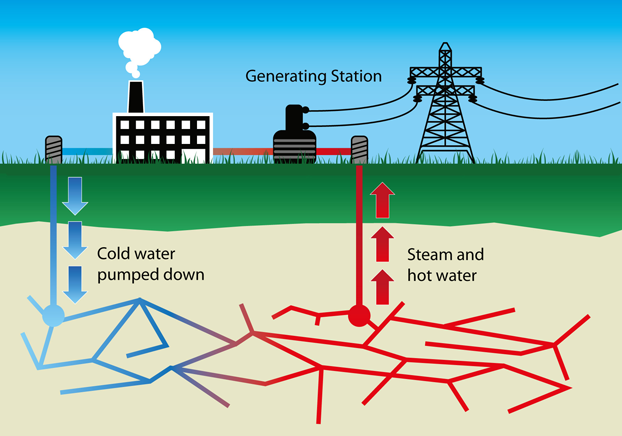
In principle, if you can drill down far enough, you can access this energy. Water, or other fluid, is pumped down an “injection” borehole. It flows through natural rock faults or special pipework, and returns, heated, to the surface up a “production” borehole. At the surface it can then be used to heat water or to generate steam. It is an unlimited source, and available twenty-four hours a day for millions of years.
In theory it offers the promise that we need never use fossil fuels again. The problem is that the deeper you go, the greater the benefits, but conventional drilling technologies struggle with the harder rock and higher temperatures below 6 kilometres. The Russian Kola Deep Borehole was abandoned after 25 years work at a depth of 12 kilometres.
This is not fantasy
In some places, geothermal heat is so close to the surface that it emerges naturally as hot water or steam. Such sources feed spas, and district and greenhouse heating schemes. The Romans built the hot baths which gave the city of Bath its name on just such a source. In the USA, 450 homes in Boise, Idaho have been heating in this way since 1892. In a few places like Iceland and New Zealand water emerges at the surface at high enough temperatures to drive power stations, and geothermal energy provides 89% of Iceland’s energy needs.
In other places, a similar effect has been achieved by drilling down into the hot rock above the magma. This is possible with current drilling technologies, but the temperatures are relatively low (usually below 200°C). Again they are mainly used for district heating and industrial uses like greenhouse heating. In Europe, only Turkey, Italy and Iceland have geothermal power stations.

There are some parts of the UK with serious geothermal potential. The greatest is in Cornwall where the Eden Project and the United Downs project have both drilled down far enough to begin operation this year. Here, there is an added benefit, that the Cornish rock contains significant quantities of lithium. This can be recovered from the fluid which comes up, providing a domestic source of a critical but rare component of most electronic technologies.
Twenty-nine countries are currently generating geothermal electricity, producing a total of over 15 Gigawatts, led by the US (4GW), with Indonesia, Philippines, Turkey and New Zealand.
Far more on geothermal energy can be found here. But to date, we have barely started to tap the potential. To do that requires a technological breakthrough.
Getting further down: a new generation
Drilling to extreme depths is a different challenge. So far, no one has successfully tapped the much higher temperatures beyond 6 kilometres down, though the potential energy there is very much greater. A well at 400°C could produce ten times the energy of one at 200°C.
However, a new company (Quaise Energy) spun off from MIT, hopes to transform this situation by reaching much further down, possibly as far as 20 kilometres. At those levels, the heat is easily able to drive conventional power stations.
Quaise propose to replace conventional drill bits with millimetre wave beams (a hugely more powerful version of the element in a microwave oven), which simply vaporise the rock. Quaise believe that this will enable them to reach much further down, where the heat approaches 500°C. The wave beam technology is already available, and its ability to vaporise the hardest rock has been demonstrated in the laboratory.
Unlike conventional drilling, millimetre wave beam technology is not affected by increasing depth or temperature, making it possible to bore much deeper, faster and cheaper. An added advantage is that the beams vitrify the surrounding rock, creating a strong, glass-like tube which protects the shaft from leakage.
Conventional geothermal energy is limited by variations in the thickness of the rock above the magma. But Quaise expect to reach much greater depths, making high temperature geothermal energy available almost anywhere on the globe.
Repurposing existing infrastructure
Quaise therefore propose to use their technology alongside existing infrastructure. By sinking their boreholes close to existing power stations, the geothermal energy can replace the steam which is currently generated by fossil fuels. Existing power stations thus become entirely carbon free with no need to create new cables and power lines to connect to the grid. Existing staff remain in place and can use their existing expertise. Unlike solar, it takes almost no land, and unlike wind, it does not require visually intrusive wind turbines.
Quaise have now raised 52 million US dollars to demonstrate the feasibility of this technology. They plan to build a full-scale working drill within two years, to be producing 100 MW of energy by 2026, and have the first power station converted to geothermal by 2028.
This might be the breakthrough that we need to take carbon permanently out of our electricity generation . It might be the gateway to net zero.