• Contact
  • About
  • ISSN 3049-9771
  • Authors and editors
NEWSLETTER SIGN UP
East Anglia Bylines
Advertisement
  • HOME
  • News
    • Brexit
    • Health
    • Education
    • World
  • Politics
    • Local government
    • Justice
    • Activism
  • Climate
    • Environment
  • Lifestyle
    • Community
    • Culture
    • History
    • Humour
    • Property
  • Business
    • Development
    • Economics
    • Finance
    • Transport
    • Farming
  • ANGLIA
    • Bedfordshire
    • Cambridgeshire
    • Essex
    • Hertfordshire
    • Norfolk
    • Suffolk
  • Series
No Result
View All Result
East Anglia Bylines
Home REGIONS Cambridgeshire

Our favourite stories: Rewilding: leaving nature alone

Each member of our small editorial team has a favourite story from the last two years. To illustrate the range and variety of our work, we are republishing one each week. This is Jenny Rhodes' choice.

Richard Broughton by Richard Broughton
10 December 2023
in Cambridgeshire, Environment, Featured, Science
Reading Time: 10 mins read
A A
Deer in rewilded woods

UK Centre for Ecology & Hydrology, Author provided

Share on Bluesky
East Anglia is a heavily farmed region with relatively few ‘unmanaged woodlands’. Planted forests can be artificial monocultures: plantations are not naturally regenerated woodland with a mix of local trees, plants, birds and animals.
This thought-provoking article shows what happened ‘when people walked away’ allowing nature to take care of itself, repair degraded ecosystems and restore the landscape. Within a few decades, the field transformed into a closed canopy woodland with an increased biodiversity of wildlife.
The Wilderness Experiment in Cambridgeshire shows that humans don’t need to ‘do’ anything. Nature, allowed time and space, creates a more biodiverse habitat for free. I found the description of this process fascinating and inspirational. This article was first published on 14 June 2023.

In the archive of the UK Centre for Ecology & Hydrology there is a typed note from the 1960s that planted the seed of an idea. Written by Kenneth Mellanby, director of the Monks Wood Experimental Station, a former research centre in Cambridgeshire, the note describes a four-hectare arable field that lies next to the station and the ancient woodland of the Monks Wood National Nature Reserve. After harvesting a final barley crop, the field was ploughed and then abandoned in 1961.

The note reads:

It might be interesting to watch what happens to this area if man does not interfere. Will it become a wood again, how long will it take, which species will be in it?

So began the Monks Wood Wilderness experiment, which is now 60 years old. A rewilding study before the term existed, it shows how allowing land to naturally regenerate can expand native woodland and help tackle climate change and biodiversity loss.

A black-and-white aerial photograph of the field station with an empty farm field highlighted.
The Monks Wood Wilderness field (outlined in red) shortly after abandonment in the early 1960s. UK Centre for Ecology & Hydrology, Author provided

How new woodland generates itself

A shrubland of thorn thickets emerged after the first ten to 15 years. Dominated by bramble and hawthorn, its seeds were dropped by thrushes and other berry-eating birds. This thicket protected seedlings of wind-blown common ash and field maple, but especially English oak, whose acorns were planted by Eurasian jays (and maybe grey squirrels too) as forgotten food caches. It’s thought that jays were particularly busy in the Monks Wood Wilderness, as 52% of the trees are oaks.
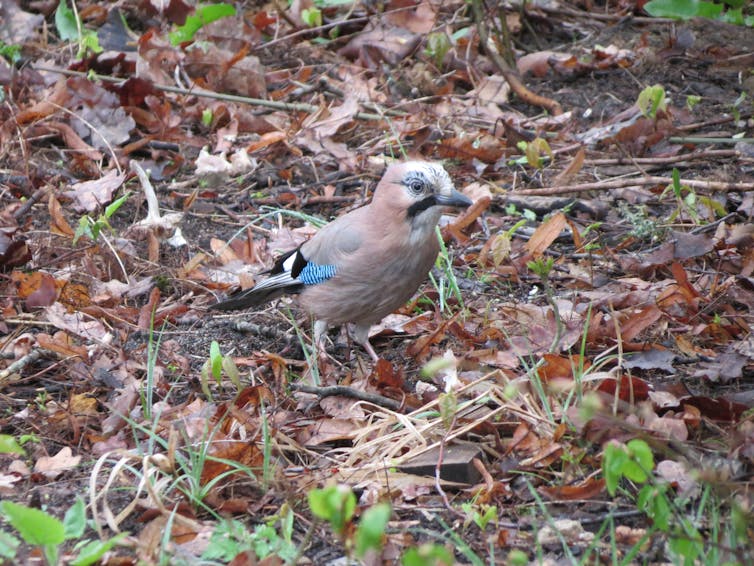
A Eurasian jay on the woodland floor.
Jays habitually collect and cache acorns in autumn. Forgotten caches germinate into oak seedlings. UK Centre for Ecology & Hydrology, Author provided

The intermediate shrubland stage was a suntrap of blossom and wildflowers. Rabbits, brown hares, muntjac deer and roe deer were all common, but the protective thicket meant there was no need for fencing to prevent them eating the emerging trees. Those trees eventually rose up and closed their canopy above the thicket, which became the woodland understorey.

The result is a structurally complex woodland with multiple layers of tree and shrub vegetation, and accumulating deadwood as the habitat ages. This complexity offers niches for a wide variety of woodland wildlife, from fungi and invertebrates in the dead logs and branches, to song thrushes, garden warblers and nuthatches which nest in the ground layer, understorey and tree canopy.
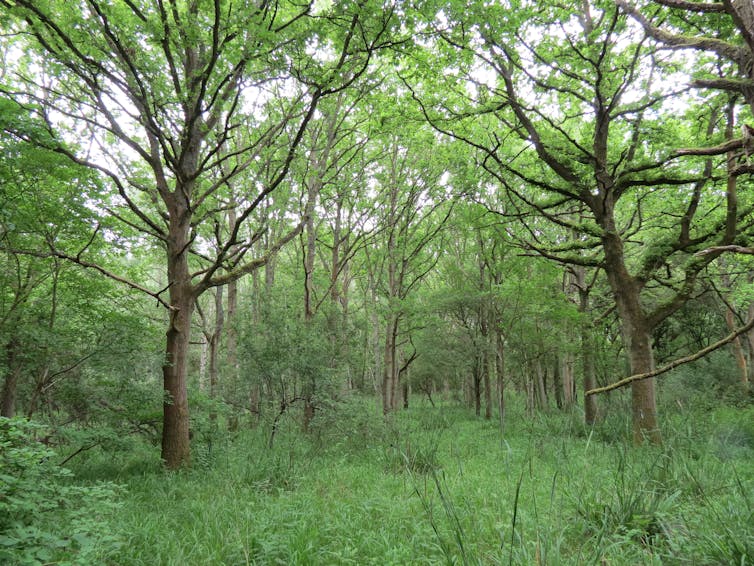
A woodland scene with trees and green understorey.
The Monks Wood Wilderness in 2021, after 60 years of natural regeneration. UK Centre for Ecology & Hydrology, Author provided

The Monks Wood experiment benefited from the field lying close to an ancient woodland, which meant an ample supply of seeds and agents for their dispersal – jays, rodents, and the wind. Such rapid colonisation of the land would be unlikely in more remote places, or where deer are superabundant.

But there are many woods in the UK that could expand by allowing adjacent fields to return to nature. This would eventually add up to a significant increase in total woodland cover.

An aerial view of the field station with a square patch of woodland highlighted.
The Monks Wood Wilderness (outlined in red) in 2014. UK Centre for Ecology & Hydrology, Author provided

In May, Norfolk County Council cut the grass outside Mundesley Library
Environment

Norfolk: the verge of a crisis

by Nessa Carey
5 June 2023

Tree planting or natural regeneration?

The UK is one of the least forested places in Europe, with just 13% forest cover compared to an average of 38% across the EU. Only half of the UK’s forest is native woodland, which sustains a wide variety of indigenous species. The rest is dominated by non-native conifer plantations grown for timber.

This situation is gradually changing. The UK government aims to create 30,000 hectares of new woodland each year until 2025, providing new habitat for wildlife and helping reach net zero emissions, as woodland stores more carbon than any other habitat except peatlands.

With the climate and biodiversity crises getting worse each day, there’s an urgent need to expand woodland fast. But how? Tree planting is the usual approach, but it’s costly. Saplings also have to be grown, transported, planted and protected with fencing and plastic tubes – that’s a lot of carbon emissions and potential plastic pollution, as tubes break down into the soil.

What about doing virtually nothing instead? Natural regeneration involves creating woodlands by allowing trees and shrubs to plant themselves under natural processes. It’s free and involves no plastic or nursery-grown saplings, which can introduce diseases. The result is woodland that’s well adapted to local conditions.
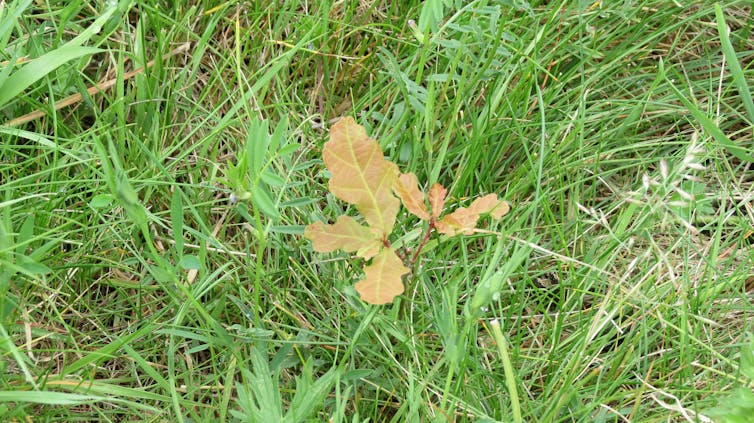
An oak seedling poking through a grass field.
Oak seedlings were early pioneers in the regeneration of the woodland. UK Centre for Ecology & Hydrology, Author provided

Allowing the land to naturally regenerate sounds exciting, but planners and ecologists need to know where this approach is likely to work best. How abandoned land turns into woodland is rarely documented, as it usually happens where people have walked away.

The Monks Wood Wilderness fills in this gap in our knowledge as an example of planned natural regeneration that has been monitored over decades, with a second two-hectare field (named the New Wilderness) added in 1996 to expand the experiment.

An aerial view of new woodland.
Shrubland in the New Wilderness field after 25 years, with hawthorns blossoming. UK Centre for Ecology & Hydrology, Author provided

Since the 1990s, the two Wildernesses have been regularly surveyed by scientists counting and measuring trees on foot and tracking tree cover from planes and drones. These surveys documented the development of woodland over 60 years in our recently published study, revealing the patterns of habitat regeneration.

We can now finally answer Mellanby’s 60-year old questions. Within 40 to 50 years, the ploughed field became a closed canopy woodland with almost 400 trees per hectare. And as the canopy grows taller, more plant and animal species are arriving, such as marsh tits and purple hairstreak butterflies – mature woodland specialists that have made a home here as the habitat gradually converges with the ancient woodland nearby.

The Wilderness experiment shows what’s possible when nature is allowed to create rich, native woodland for free. I think Mellanby would be pleased with how it all turned out.

The Conversation

This article is republished from The Conversation under a Creative Commons license. Read the original article.


More from East Anglia Bylines

Rewilding meadows in Essex
Anglia

Is East Anglia Going Wild?

by Jenny Rhodes
22 September 2021
Tags: NatureRewilding
Previous Post

Do you know your human rights?

Next Post

Tory councillors lose the faith, as local councils collapse

Richard Broughton

Richard Broughton

Richard is an ecologist and GIS specialist at the UK Centre for Ecology & Hydrology, and a Senior Research Associate at the University of Oxford (Dept. of Biology). His main interests are British farmland and woodland, the Białowieża Forest in Poland, and the ecology of birds and mammals. A major part of his research has been overseeing or collaborating on long-term studies of woodland birds to understand their ecology and population declines. He is also active in long-term studies of natural regeneration of woodland and shrubland for passive rewilding.

Related Posts

Compilation image of the logos of privatised public companies
Business

No more private rip-offs: we need principled public control

by Stephen McNair
12 November 2026
Bylines Network logo above a grid showing the logos and regional imagery of its ten publications across England, Scotland and Wales
Featured

Journalism is nothing without facts, and the Spectator has got its facts wrong

by Ben Dickenson
11 November 2026
Large car park with solar structures over the cars, keeping them in shade.
Climate

Good news for the planet: the soaring rise of solar energy

by East Anglia Bylines
10 November 2026
A newly excavated, muddy pond area containing a shallow pool of water, showing signs of recent conservation work. The clearing is surrounded by bare, turned-up brown earth, mature green trees, and low ground vegetation. In the background to the right sits a traditional black weatherboarded barn with a red tiled roof, separated from the clearing by a wooden fence.
Environment

Seven ponds set to reveal their hidden wildlife potential

by Rebecca Turner
8 November 2026
German radio operator WW2. This is a display in a museum in the Ardennes about the 1945 Battle of the Bulge. It shows a soldier sitting at a desk with a telephone attached to the wall, and a radio on the desk. It has wires coming from it to something in his hands - he is probably transmitting in Morse code.
Cambridgeshire

The Nazi spy at large in Cambridgeshire

by Stuart Burrell
8 November 2026
Next Post
Library closed sign

Tory councillors lose the faith, as local councils collapse

SUPPORT OUR CROWDFUNDER

Tags

Activism Brexit Cartoons Christmas Climate Community Conservation Conservatives Democracy Economy Elections Environment EU Farming General Election 2024 Government Health History Housing Labour Letters Local government Net zero NHS Norwich Opinion Our place in Europe Party politics Pecksniff Politics Polling Pollution Poverty Reform UK Renewables Sewage Social care Something for the weekend Tax Trump Ukraine Voting Wealth Wildlife Women
East Anglia Bylines

We are a not-for-profit citizen journalism publication. Our aim is to publish well-written, fact-based articles and opinion pieces on subjects that are of interest to people in East Anglia and beyond.

East Anglia Bylines is a trading brand of Bylines Networks Limited which is separate to, but allied with, Byline Times.

Learn more about us

No Result
View All Result
  • About
  • Authors and editors
  • Complaints
  • Contact
  • Donate
  • Letters
  • Privacy
  • Network Map
  • Network RSS Feeds
  • Submission Guidelines
  • Download the Bylines Network App

© 2021-2026 East Anglia Bylines. Powerful Citizen Journalism. ISSN 3049-9771

No Result
View All Result
  • HOME
  • News
    • Brexit
    • Health
    • Education
    • World
  • Politics
    • Local government
    • Justice
    • Activism
  • Climate
    • Environment
  • Lifestyle
    • Community
    • Culture
    • History
    • Humour
    • Property
  • Business
    • Development
    • Economics
    • Finance
    • Transport
    • Farming
  • ANGLIA
    • Bedfordshire
    • Cambridgeshire
    • Essex
    • Hertfordshire
    • Norfolk
    • Suffolk
  • Series

Newsletter sign up

Crowdfunder

© 2021-2026 East Anglia Bylines. Powerful Citizen Journalism. ISSN 3049-9771
