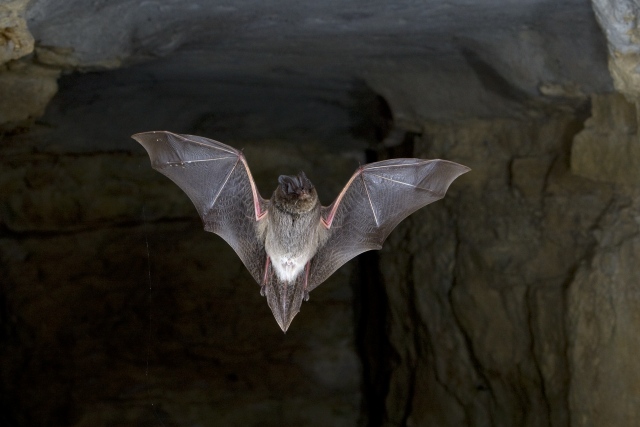
For a couple of nights in mid-August, I joined independent ecologists on a bat emergence survey, and watched Barbastelle bats leaving a tree just metres from the proposed route of the Norwich Western Link. There is no doubt that this road will devastate the habitat on which they depend. The area of woodland is close to the wood I own with my family.
The larger wood is sub-divided into sections owned by woodland enthusiasts, but it is important not to get too caught up with these artificial boundaries drawn up on title deeds. The bats know nothing of this, and neither do badgers, or hares, or the birds that frequent this wood. It is important also, not to lose sight of the way this area of woodland is part of an important patchwork of habitats in the Wensum valley, comprising old woods, wet pastures, meadows, chalk streams, and traditional farmland, unspoilt by major infrastructure development.
The Barbastelle Bat Super-Colony
The ecologist I was with was aiming to count the bats emerging from their roosts shortly after sunset.

On a previous night, a couple of female barbastelles had been trapped and released again with a very small and temporary radio-transmitter tag attached to them. Over the past few years, they have been able to gather data on how barbastelles use the wider landscape, tracking them as they travel miles in a single night to forage for food.
However, it is the woodlands that are the focus of this study, and the way certain trees are used for roosts. The radio-tags can be traced to roost trees, and the bats then counted. Already a number of new roost trees have been identified, adding important data to the growing picture of the importance of this woodland for this rare species.
This woodland is a home to one of the populations comprising what has become known as Britain’s only super-colony of Barbastelle bats, as well as to many other species of bat and bird. It is a habitat of national significance, worthy of protection, and the Norwich Western Link will pass straight through it.
How Roads Harm Wildlife
The Norwich Western Link will cast a barrier across this landscape, fragmenting and degrading it for wildlife. Apart from the immediate destruction of woodlands used by bats and birds for foraging, breeding, and roosting, it will also have secondary long-term impacts on the surrounding habitat, resulting in the decline of the populations of many species.
For bats, and indeed other animals, this is due to a variety of factors. The road creates a barrier, and with a dual carriageway, four lanes of tarmac, a central reservation, hard shoulders, and banks, this barrier is significant and wide, preventing bats and other creatures from following their habitual routes between roosts and foraging areas, interrupting their linear flight lines.

Such roads, and the speed of the vehicles, also expose bats and other wildlife to the risk of fatal road collisions. Roads are sources of light, noise, and chemical pollution, all of which might add to the barrier effect of the road and degrade the suitability of existing habitat. The barriers that roads create then also disrupt the flow of individuals between local and neighbouring populations, leading potentially, to genetic isolation and decline, with wildlife forced to live in ever smaller pockets of suitable habitat.
Studies have found reduced activity in bat populations for up to 1600m either side of a major road. Even if the bat populations were to survive the noise and violence of the construction phase of the road, they would likely go into decline once the road was in operation.
A similar set of concerns exists regarding the sensitive ecology of the River Wensum, a rare chalk river, and a Special Area of Conservation (SAC) , that the proposed road would cross on a steel and concrete viaduct.
Mitigation
The Norwich Western Link has been proposed by Norfolk County Council, who are currently carrying out a pre-planning application public consultation on their plans (until Sunday 9 October 2022). The plans include proposed designs to mitigate the impact the road will have on wildlife. These include green bridges (bridges planted with vegetation) and a hop-over design which retains trees in a central reservation.
There are reasons to doubt the likelihood of either of these designs successfully delivering mitigation. The evidence that underpins such ecological mitigation is often flawed and insufficient, recent research suggests. The mitigation methods described (green bridges and a hop-over design) are largely untested, and there is already a poor track history of protecting the Barbastelle, given that according to experts, the bat bridges along the Norwich Northern Distributer Road (NDR) have failed to work since the road opened.
A hop-over design, if it were to even stand a chance of being successful, would need to have a near continuous canopy across all four lanes of the road, which seems a very unlikely scenario given the safety implications.
The design also assumes that the bats will fly over the trees, whereas the Barbastelle flies low and fast beneath the canopy. The visualisations of the green bridges show something more like a footbridge with planting rather than anything that truly mimics the habitat that would be lost. Such designs are there to impress the planners, but many ecologists remain unimpressed.
The truth is that this is costly window dressing for a project that will have a devasting effect on wildlife.
Have Your Say
Norfolk Wildlife Trust, CPRE, the Woodland Trust, and the Stop the Wensum Link campaign are just a few of the groups working together to challenge the council over the impact the Norwich Western Link will have on the environment.
Recently an open letter was sent to Cllr Andrew Proctor objecting to the Norwich Western Link and signed by a number of eminent ecologists and naturalists, and over ten thousand members of the public have now signed a petition against the road. If you want the council to reconsider their plans for the Norwich Western Link, then it is important that your voice is heard in the pre-planning public consultation. Guidance on how to respond is available on the Stop the Wensum Link website, and further help will be released by Norfolk Wildlife Trust in the coming weeks.