• Contact
  • About
  • ISSN 3049-9771
  • Authors and editors
NEWSLETTER SIGN UP
East Anglia Bylines
Advertisement
  • HOME
  • News
    • Brexit
    • Health
    • Education
    • World
  • Politics
    • Local government
    • Justice
    • Activism
  • Climate
    • Environment
  • Lifestyle
    • Community
    • Culture
    • History
    • Humour
    • Property
  • Business
    • Development
    • Economics
    • Finance
    • Transport
    • Farming
  • ANGLIA
    • Bedfordshire
    • Cambridgeshire
    • Essex
    • Hertfordshire
    • Norfolk
    • Suffolk
  • Series
No Result
View All Result
East Anglia Bylines
Home Environment

UK drought: are farmers facing the crop failures of 1976 all over again?

Despite record UK temperatures, the drought isn't severe. But a dry winter could leave arable farmers in trouble next year.

East Anglia Bylines by East Anglia Bylines
6 August 2022
in Environment, Farming, Featured, UK
Reading Time: 8 mins read
A A
Low water in the Upper Neuadd Reservoir, 1976

In 1976 the Upper Neuadd Reservoir in the Brecon Beacons experienced very low water levels. Photo by Dr Mary Gillham Archive Project via Flickr (CC BY 2.0)

Share on Bluesky

Tim Hess and Ian Holman, Cranfield University

July 2022 was the driest July in England since 1935. Combined with record breaking temperatures, we are hearing talk of a drought comparable to the great drought of 1976, with fears of disruptions to public water supply and poor crop yields, especially for fruit and vegetables. But not all droughts are the same and not all farmers are affected by the same type of drought.

To a meteorologist, drought is usually defined as a period of significantly below-average rainfall. However, low rainfall even over a whole season does not necessarily mean the water supply will run low, or that industry or agriculture will suffer, since there could be lots of water already stored in reservoirs and groundwater.

Of course, such reserves are little help for grassland, cereals and other crops that are entirely rain-fed and are badly impacted when we get a dry spring and summer. The past 12 months have been particularly dry over much of the UK and since May 2021, only October and February have recorded above-average rainfall.

A parched cricket field, Cambridge.
A parched cricket field, Cambridge. Photo taken in early August by John Sutton via Geograph (CC BY-SA 2.0)

Things are even worse if combined with the high temperatures and plentiful sunshine we have seen this year, which increases evaporation and depletes soils of the water required for plant growth – a so-called “agricultural drought”.

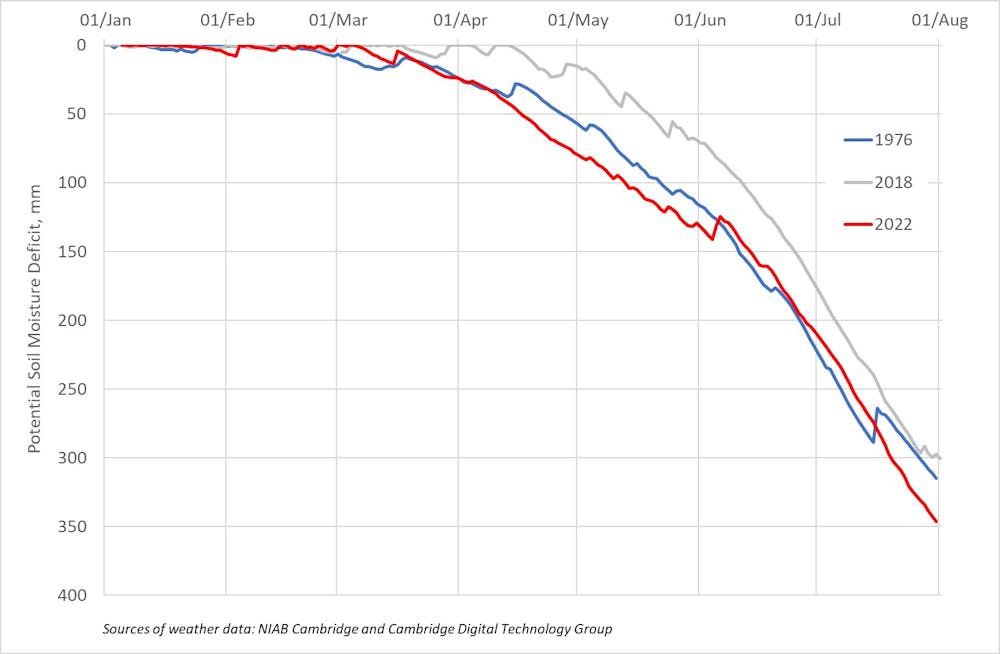
We have evaluated the combined impact of the low rainfall and hot, sunny weather using potential soil moisture deficit (PSMD), which is a cumulative measure (in millimetres) of the balance between rainfall input to the soil and potential losses through evaporation and plant transpiration.

When evaporation exceeds rainfall, the soils become drier and the PSMD increases. When it rains, it reduces. Usually, the PSMD starts to increase from late March or early April, peaking in August or September when the soils are at their driest. A high PSMD means that rain-fed crops like cereals and grass, as well as our gardens, will suffer.

Using data from weather stations in Cambridge, we estimate the PSMD in 2022 has (so far) behaved very similarly to 1976. The deficit started to increase in early March and has continued to grow through to the end of July.

This is in contrast to the last drought in 2018, when the spring was wetter and the soil drying was delayed. PSMD currently stands at about 350mm, which is around 50% higher than the average peak between 1981 and 2010. So for farmers that rely solely on rainfall, 2022 looks like it could be as severe an agricultural drought as 1976.
graph with three similar lines
Potential Soil Moisture Deficit (PSMD) in Cambridge, UK, in 1976, 2018 and 2022. NIAB Cambridge and Cambridge Digital Technology Group, Author provided

Irrigated farming might be restricted

Most grassland and “broadacre” crops like cereals and oilseeds are grown in the UK without irrigation. It is not that they don’t need the water, but that it is financially unattractive to invest in irrigation equipment.

However, to ensure yield and particularly crop quality, much of the UK’s potato, vegetable and fruit crops are given extra water from irrigation during dry periods. Dry soil also means that demand for water for irrigated crops will be higher, competing with reduced available water resources for other sectors.

To the water resources manager, a “hydrological drought” is when the water available in rivers, reservoirs and groundwater is insufficient to meet demand – including demand to maintain a healthy aquatic ecosystem.

Field with sprinklers
Spud soaking: potato is the UK’s main irrigated crop. Giovanni Arrè, Author provided

Potatoes account for more than half of the UK’s irrigated area and volume of irrigation water used. In a dry year, we estimate that a hectare of potatoes (just over half a football pitch) needs more than 2 million litres of irrigation water to maintain yield and quality. That is more than 40 litres for every kg of potatoes.

As UK irrigated agriculture and horticulture needs lots of water but is regarded as a non-essential user, irrigated farmers are at risk of mandatory restrictions during a drought, with potentially severe financial implications.

Here we see a difference between 1976 – which followed a very dry 1975 – and 2022. The Met Office described rainfall in 2021 as “unremarkable”. This, together with better water metering and investment in infrastructure to move water from areas of availability to need, means water resources are in a better condition now than they were in 1976.

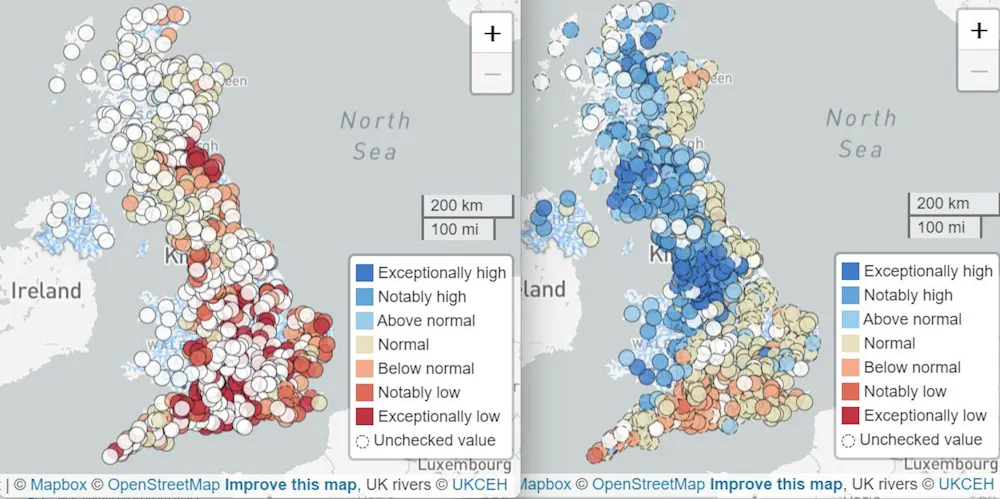
The maps below show the status of river flows across the country in February 1976 and February 2022. Pinks to reds indicate river flows that were below normal (pink) to exceptionally low (crimson) for the time of year.

So while this year’s dry and hot weather has been similar to 1976 with similar effects on our gardens and farming, last winter finished with water resources that were mostly around normal for the time of year. This means we don’t expect widespread mandatory restrictions on irrigated farms, although some restrictions may be imposed to protect supplies in certain catchments.
Two maps of the UK
River flow was much lower in the spring before the 1976 flood (left) compared to 2022. Data: UK Water Resources Portal, Author provided

However, despite the water resources situation not being as severe in 2022 as it was in 1976, demand across all uses needs to be managed to prevent a severe hydrological drought this year. It is also prudent to manage our water resources carefully in the summer of 2022, not only to avoid restrictions this year but also to reduce the risk of more severe restrictions next year if the UK follows this dry summer with a dry winter.

The Conversation

Tim Hess, Professor of Water and Food Systems, Cranfield University and Ian Holman, Professor of Integrated Land and Water Management and Head of the Centre for Water, Environment and Development, Cranfield University

This article is republished from The Conversation under a Creative Commons license. Read the original article.


More from East Anglia Bylines

Climate change is going global
Activism

Climate change now: acting for ourselves and our children

by Dr Jocelynne Scutt
16 May 2022
Tags: Farming
Previous Post

Pecksniff’s Diary

Next Post

The Government’s Fantasy Food Strategy

East Anglia Bylines

East Anglia Bylines

East Anglia Bylines is a not-for-profit regional online newspaper that supports citizen journalism. Our aim is to publish well-written, fact-based articles and opinion pieces by the public on subjects that are of interest to people in East Anglia and beyond. In doing so, we seek to demonstrate democracy in action by giving a voice to local people and holding our elected representatives to account. If you'd like to write something for us, please email us: editor@eastangliabylines.co.uk

Related Posts

A newly excavated, muddy pond area containing a shallow pool of water, showing signs of recent conservation work. The clearing is surrounded by bare, turned-up brown earth, mature green trees, and low ground vegetation. In the background to the right sits a traditional black weatherboarded barn with a red tiled roof, separated from the clearing by a wooden fence.
Environment

Seven ponds set to reveal their hidden wildlife potential

by Rebecca Turner
8 November 2026
Farage creeps away. He is tip-toeing away from a signpost that points in 3 different directions: Westminster and Clacton towards the left and, towards the right, 'Away', which is the direction he's going in.
Featured

Farage is a firebrand

by Helen Forte
6 November 2026
Jason Williams, also known as the Cloud Gardener, with Harriet Festing in her Norwich balcony garden. They are sitting together looking at the garden, which has wide variety of plants, all in pots. Beyond them at the other end of the balcony a group of people are sitting on the balcony and chatting.
Environment

How a Norwich balcony became a haven for wildlife

by East Anglia Bylines
1 November 2026
Air source heat pump: photo Stephen McNair
Economics

The great heat pump paradox: more heat, less progress

by Stephen McNair
1 November 2026
Woodcut of 3 witches on broomsticks flying with the middle one depicted as a devil heading towards a lady.
Culture

The magic hidden in our homes: six centuries-old ways to ward off evil

by East Anglia Bylines
31 October 2026
Next Post
Photo montage: picking apples, fishing and food market

The Government’s Fantasy Food Strategy

SUPPORT OUR CROWDFUNDER

Tags

Activism Brexit Cartoons Christmas Climate Community Conservation Conservatives Democracy Economy Elections Environment EU Farming General Election 2024 Government Health History Housing Labour Letters Local government Net zero NHS Norwich Opinion Our place in Europe Party politics Pecksniff Politics Polling Pollution Poverty Reform UK Renewables Sewage Social care Something for the weekend Tax Trump Ukraine Voting Wealth Wildlife Women
East Anglia Bylines

We are a not-for-profit citizen journalism publication. Our aim is to publish well-written, fact-based articles and opinion pieces on subjects that are of interest to people in East Anglia and beyond.

East Anglia Bylines is a trading brand of Bylines Networks Limited which is separate to, but allied with, Byline Times.

Learn more about us

No Result
View All Result
  • About
  • Authors and editors
  • Complaints
  • Contact
  • Donate
  • Letters
  • Privacy
  • Network Map
  • Network RSS Feeds
  • Submission Guidelines
  • Download the Bylines Network App

© 2021-2026 East Anglia Bylines. Powerful Citizen Journalism. ISSN 3049-9771

No Result
View All Result
  • HOME
  • News
    • Brexit
    • Health
    • Education
    • World
  • Politics
    • Local government
    • Justice
    • Activism
  • Climate
    • Environment
  • Lifestyle
    • Community
    • Culture
    • History
    • Humour
    • Property
  • Business
    • Development
    • Economics
    • Finance
    • Transport
    • Farming
  • ANGLIA
    • Bedfordshire
    • Cambridgeshire
    • Essex
    • Hertfordshire
    • Norfolk
    • Suffolk
  • Series

Newsletter sign up

Crowdfunder

© 2021-2026 East Anglia Bylines. Powerful Citizen Journalism. ISSN 3049-9771
