• Contact
  • About
  • ISSN 3049-9771
  • Authors and editors
NEWSLETTER SIGN UP
East Anglia Bylines
Advertisement
  • HOME
  • News
    • Brexit
    • Health
    • Education
    • World
  • Politics
    • Local government
    • Justice
    • Activism
  • Climate
    • Environment
  • Lifestyle
    • Community
    • Culture
    • History
    • Humour
    • Property
  • Business
    • Development
    • Economics
    • Finance
    • Transport
    • Farming
  • ANGLIA
    • Bedfordshire
    • Cambridgeshire
    • Essex
    • Hertfordshire
    • Norfolk
    • Suffolk
  • Series
No Result
View All Result
East Anglia Bylines
Home REGIONS Anglia

The poem that signalled D-Day

"Wound my heart with an unchanging languor” – Paul Verlaine’s famous words calling the French resistance saboteurs to arms: D-Day is here

Kate Moore by Kate Moore
6 June 2024
in Anglia, Culture, Featured, History
Reading Time: 5 mins read
A A
D-Day landing troops leaving amphibious vehicle

image by Nationaal Archief. CC0, via Wikimedia Commons

Share on Bluesky

Eighty years ago, on Tuesday 6 June 1944, the World War 2 allied invasion of Normandy began. Codenamed Operation Neptune, it is often referred to as D-Day. It was the largest seaborne invasion in history and began the liberation of France.

Preparations for the invasion began in 1943. The British and US sent agents to France to prepare the French Resistance, including the Maquis, for the D-Day invasion. Supplies, training and radios flowed surreptitiously into France

Seemingly random messages

Most important was the very secret pad of codes. These explained the hidden meaning of often seemingly random radio messages broadcast by the BBC’s British Overseas Service most nights. While the French resistance knew when to listen and were able to decipher the meaning, Nazi Germany had to guess about what each code meant.

Mike Mayhew lived in Oulton Broad as a child. Aged 8 in 1944, he often listened to his grand-mother’s short wave radio and vividly remembers a poem being read over the air waves. He told East Anglia Bylines:

I recall the words, something akin to ‘My heart aches with languor’. Later, we learnt it was the signal that D-Day was to commence.

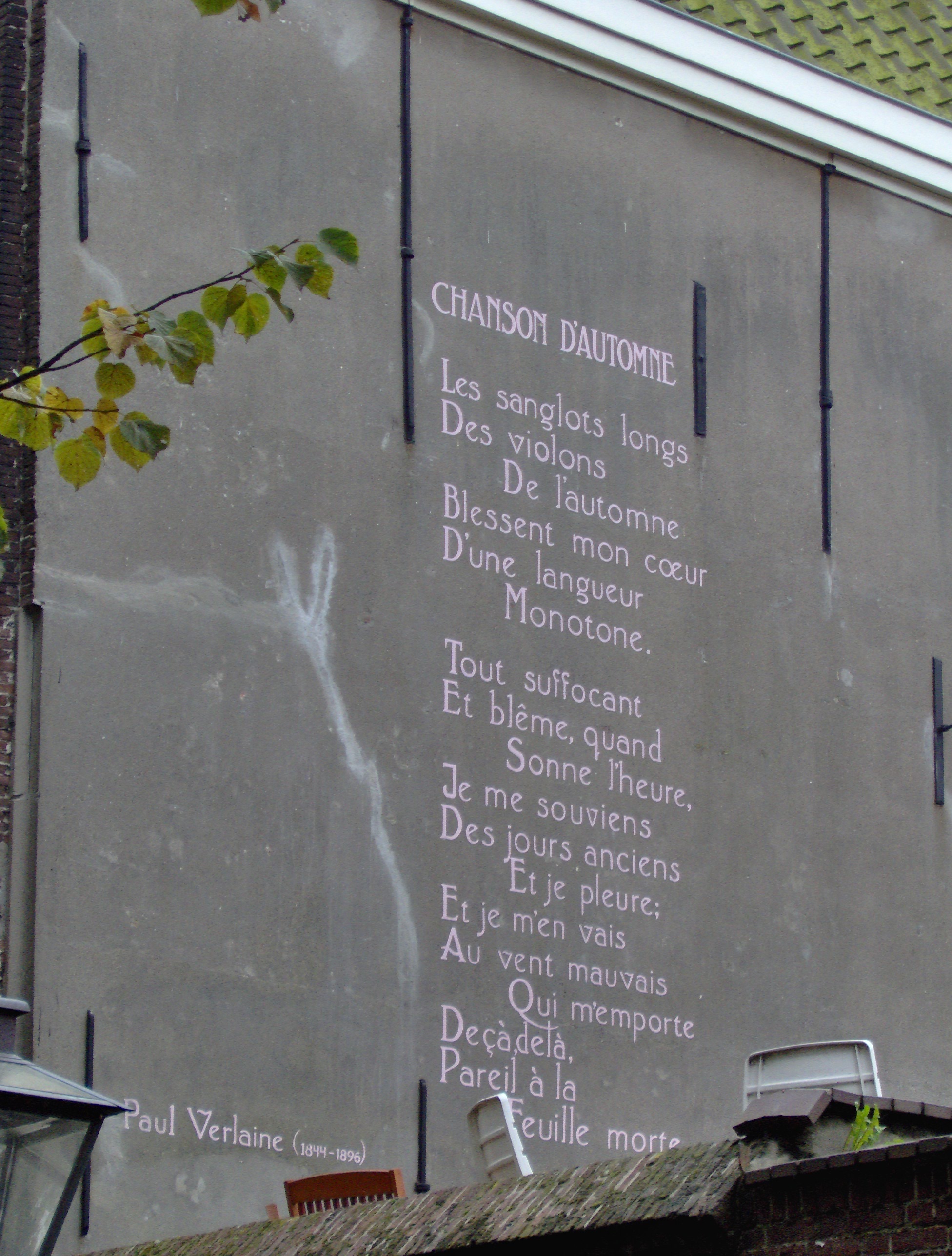
Chanson d’automne

Memorial with the text of the poem Chanson d'automne inscribed
image by Tubantia. CC BY-SA 3.0

In fact, this was the second part of Chanson d’automne to be broadcast. Previously, on 1 June, the BBC had broadcast the first three lines of this famous French poem by Paul Verlaine, published in 1866:

Les sanglots longs
Des violons
De l’automne

Arthur Symons poetically translates the lines as When a sighing begins in the violins of the autumn-song.

These lines were a coded order from the Special Operation Executive (SOE) to the French resistance in Nazi occupied France. For one resistance cell, it was the signal for the saboteurs to stand by and be ready to disrupt the French railways. For other groups, these words indicated that the D-Day invasion would begin within two weeks.

Four days later, on 5 June, the BBC broadcast the lines Mayhew remembers. This was the order to begin cutting railway lines.

Blessent mon coeur
D’une langueur
Monotone

Arthur Symons translates these lines as, My heart is drowned in the slow sound, languorous and long.

D-Day

Photo of Mike Mayhew, gentleman in his 80's

Mike Mayhew image by Kate Moore. Used with permission

Just a few hours later, shortly after midnight on the morning of 6 June, the invasion began. 24,000 American, British and Canadian paratroopers dropped from the skies. There was extensive aerial and naval bombardment. Then, early in the morning, the allied amphibious landings began across the target 50 mile (80 km) stretch of the Normandy coast – code named Utah, Omaha, Gold, Juno and Sword. Mayhew reminisced:

I remember there was a large temporary barracks near where I lived. My mother used to do the washing for the troops. Suddenly it was a ghost town. The departing soldiers had taken what they could carry and left everything else behind – the canteen, their accommodation, mess halls and their dirty washing – no doubt expecting to return.

Many of those taking part in D-Day never returned. German casualties have been estimated at 4,000 to 9,000 men. Allied casualties were at least 10,000, with 4,414 confirmed dead.

Although the operation was not an immediate success, it is recognised that the Germans defending their positions were compromised as a result of the sabotaging of the railways, initiated by a few lines of a famous French poem.

Chanson d’automne - translated by Arthur Symons

When a sighing begins
In the violins
Of the autumn-song,
My heart is drowned
In the slow sound
Languorous and long
Pale as with pain,
Breath fails me when
The hours toll deep.

My thoughts recover
The days that are over,
And I weep.
And I go
Where the winds know,
Broken and brief,
To and fro,
As the winds blow
A dead leaf.


More from East Anglia Bylines

445th Bomb Group memorial, Tibenham
Anglia

Masters of the Air: the legacy of the US 8th Air Force in East Anglia

by Dr Sam Edwards
4 February 2024
The Kerch Bridge after Ukraine's missile strike, showing the surviving railway arch and the collapsed road bridge, with broken sections of roadway lying in the water.
Featured

Ukraine has the cards – and the internet is playing them

by East Anglia Bylines
18 November 2026
Person on wheelchair at the foot of two steps and two escalators either side of a fixed staircase.
Community

Accessible in theory, inaccessible in practice: does the law help?

by Bob Cronk
17 November 2026
Home Secretary Shabana Mahmood speaking at a conference
Employment

The Mahmood immigration plan: what exactly is the point?

by Stephen McNair
17 November 2026
East Anglian Air Ambulance clinician in orange uniform and blue gloves operating a handheld i-STAT Alinity blood analyser, with medical equipment beside them.
Anglia

How East Anglia’s air ambulance is taking hospital medicine to the roadside

by East Anglia Bylines
16 November 2026

Tags: Poetry
Previous Post

Promoting long-term politics

Next Post

WW2 and modern TV gems to binge this month

Kate Moore

Kate Moore

Kate has swapped city life, working in IT, for the rural idyll of North Norfolk where she can indulge her passions for cycling, wildlife and dogs. Whilst primarily an armchair activist she is often to be seen beach cleaning and litter picking.

Related Posts

The Kerch Bridge after Ukraine's missile strike, showing the surviving railway arch and the collapsed road bridge, with broken sections of roadway lying in the water.
Featured

Ukraine has the cards – and the internet is playing them

by East Anglia Bylines
18 November 2026
East Anglian Air Ambulance clinician in orange uniform and blue gloves operating a handheld i-STAT Alinity blood analyser, with medical equipment beside them.
Anglia

How East Anglia’s air ambulance is taking hospital medicine to the roadside

by East Anglia Bylines
16 November 2026
A child holds up a sign that reads, "Clean Our Future", at a Global Strike for Climate Justice
Activism

“Climate of Denial” – a song for a better future

by Marchie
15 November 2026
Peterborough prison aerial view. Geometric buildings some a solid shape, one a cross shape, one a 5-pointed star, all encircled by a wall and within it a fence. Beyond the prison the photo shows parts of Peterborough, and the railway main line runs across the bottom right-hand corner of the image.
Anglia

The growing crisis behind prison walls

by J.J. Jackson
15 November 2026
A notice by a short preserved section of railway track which says that the "Myanmar Thailand Japanese Death Railway Line starts here, 1942 1943."
Community

A forgotten war, a death railway, a town that remembers

by Allan Coleman
11 November 2026
Next Post
Two people watching tv

WW2 and modern TV gems to binge this month

SUPPORT OUR CROWDFUNDER

Tags

Activism Brexit Cartoons Christmas Climate Community Conservation Conservatives Democracy Economy Elections Environment EU Farming General Election 2024 Government Health History Housing Labour Letters Local government Net zero NHS Norwich Opinion Our place in Europe Party politics Pecksniff Politics Polling Pollution Poverty Reform UK Renewables Sewage Social care Something for the weekend Tax Trump Ukraine Voting Wealth Wildlife Women
East Anglia Bylines

We are a not-for-profit citizen journalism publication. Our aim is to publish well-written, fact-based articles and opinion pieces on subjects that are of interest to people in East Anglia and beyond.

East Anglia Bylines is a trading brand of Bylines Networks Limited which is separate to, but allied with, Byline Times.

Learn more about us

No Result
View All Result
  • About
  • Authors and editors
  • Complaints
  • Contact
  • Donate
  • Letters
  • Privacy
  • Network Map
  • Network RSS Feeds
  • Submission Guidelines
  • Download the Bylines Network App

© 2021-2026 East Anglia Bylines. Powerful Citizen Journalism. ISSN 3049-9771

No Result
View All Result
  • HOME
  • News
    • Brexit
    • Health
    • Education
    • World
  • Politics
    • Local government
    • Justice
    • Activism
  • Climate
    • Environment
  • Lifestyle
    • Community
    • Culture
    • History
    • Humour
    • Property
  • Business
    • Development
    • Economics
    • Finance
    • Transport
    • Farming
  • ANGLIA
    • Bedfordshire
    • Cambridgeshire
    • Essex
    • Hertfordshire
    • Norfolk
    • Suffolk
  • Series

Newsletter sign up

Crowdfunder

© 2021-2026 East Anglia Bylines. Powerful Citizen Journalism. ISSN 3049-9771