• Contact
  • About
  • ISSN 3049-9771
  • Authors and editors
NEWSLETTER SIGN UP
East Anglia Bylines
Advertisement
  • HOME
  • News
    • Brexit
    • Health
    • Education
    • World
  • Politics
    • Local government
    • Justice
    • Activism
  • Climate
    • Environment
  • Lifestyle
    • Community
    • Culture
    • History
    • Humour
    • Property
  • Business
    • Development
    • Economics
    • Finance
    • Transport
    • Farming
  • ANGLIA
    • Bedfordshire
    • Cambridgeshire
    • Essex
    • Hertfordshire
    • Norfolk
    • Suffolk
  • Series
No Result
View All Result
East Anglia Bylines
Home Lifestyle History

Christmas in the middle ages – from carols to charity and chess

Margaret Paston’s reference to playing cards in her letter to her husband on Christmas Eve 1459 is the earliest recorded reference to the activity in England

Prof Diane Watt by Prof Diane Watt
23 December 2024
in History
Reading Time: 7 mins read
A A
A medieval feast, circa 1290-1300. British Library

A medieval feast, circa 1290-1300. British Library

Share on Bluesky

The experience of a Christmas in many countries today owes a great deal to the modern era. The Christmas tree, Christmas cards and the image of Santa Claus as a portly bearded gentleman in a red suit with white trimming all date to the 1800s and 1900s. However, there are other festive traditions that go back much further in time.

Medieval festivities in Norfolk

A remarkable account of medieval Christmas celebrations can be found in an English letter dated to Christmas Eve 1459. It was written by Margaret Paston, a wealthy Norfolk gentlewoman, landowner and prolific letter writer, to her husband, John. The original letter is now in the British Library and a modern transcription can be read online.

Christmas in the Middle Ages was a religious festival rather than a secular holiday, and as such it was considered less significant than Easter. In England, as in many places, the Christmas festivities began with vespers, or evening prayers, on Christmas Eve, the day of Margaret’s letter.

In 1459, the Paston family very likely attended their parish church of St Peter Hungate in Norwich. The festival lasted until Twelfth Night in the first week of January, or sometimes until Candlemas in early February.

Feasting fit for a medieval banquet

St Peter's church, Hungate, Norwich
St Peter, Hungate, Norwich. Image by Basher Eyre via Wikimedia Commons (CC BY-SA 2.0)

Advent, the 40 days leading up to Christmas, was a period of fasting, abstinence and penance. Yet, from the autumn, Margaret would have been preparing for the banqueting that lay at the heart of the festival, ensuring that enough food and drink would be available for the duration.

Turkey wasn’t yet on the menu – it only became a staple in the 20th century. But goose or a boar’s head might form a suitable centrepiece, or even swan (we know Margaret kept a herd of her own). This would be served alongside a wealth of other provisions including beef, pork, mutton and game, herring and eel, bread and cheese and pies, puddings and cakes. Ale and wine would accompany the food.

Some of this largess would be shared with the poor in the parish, as charity was seen as an important Christian virtue.

Decoration and funeration

Homes would be adorned with ivy, holly and mistletoe, as well as laurel, conifers and bay. Yule logs burned and tapers were lit.

Carolling was a popular activity that involved dancing as well as singing. Gifts would be exchanged during the festive season, but more typically at New Year rather than on Christmas day.

However, in 1459, the Paston family’s revels were muted and their home may well have remained undecorated. This was because only the previous month, Margaret’s wealthy relative, Sir John Fastolf, had died. Her husband was his principal beneficiary, and the family were in mourning.

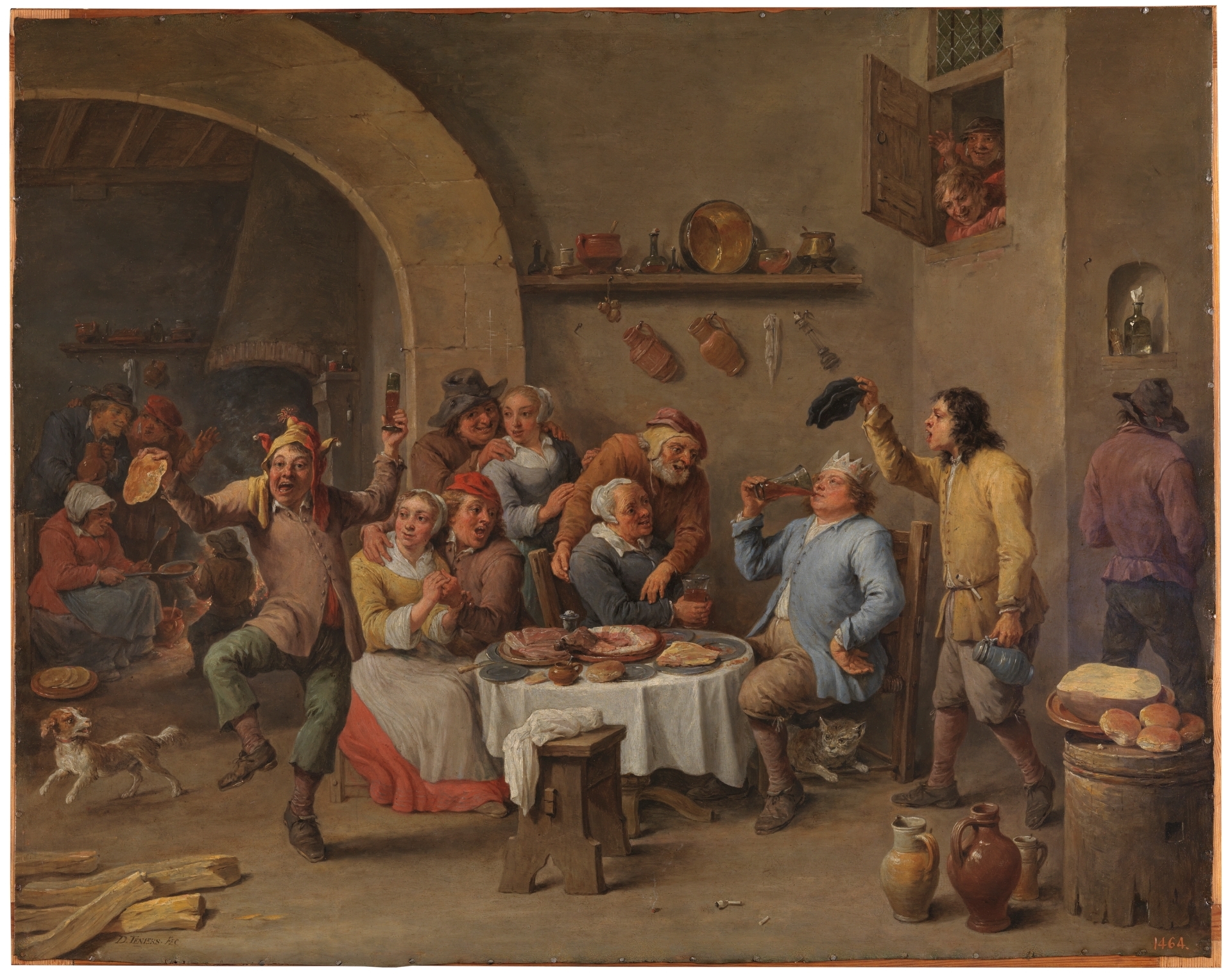
Painting by David Teniers (II): Twelfth-night (The King Drinks)
Twelfth-night (The King Drinks) by David Teniers, Museo del Prado. Image by Prado via Wikimedia Commons (CC0)

Margaret found herself in a quandary. How to combine a suitable period of grief with the seasonal festivities? Conscious of the family’s sudden elevation in social standing owing to Sir John’s death, she consulted more elevated friends. Her letter to her husband, outlining the advice she has received, makes for interesting reading.

Margaret was warned there should be no “harp nor lute playing, nor singing, nor any loud pastime”. She was also instructed to avoid “dressing up”, which may refer to the amateur theatrical performances known as “mummers’ plays”, or to performances put on by members of the household. We know from later family correspondence that the family and their servants put on plays featuring St George, Robin Hood and the Sheriff of Nottingham.

Games and etiquette for the gentry

Instead, Margaret’s connections recommended that the family’s entertainments should be restricted to board games – namely chess, “tables” and cards. Chess has its origins in India and Persia over 1,500 years ago and was extremely popular in Europe by the later Middle Ages. Tables was a version of backgammon.

The family are likely to have also played “triumph”, an early ancestor of whist. Remarkably, Margaret’s reference to playing cards is the earliest recorded reference to the activity in England.

In its list of prohibited as well as permitted activities, her letter provides a unique insight into seasonal domestic recreations for the wealthy gentry class in medieval England.

Yet if Margaret was preoccupied with ensuring the correct etiquette was followed, her own celebrations were overshadowed less by the death of her kinsman than by the absence of her husband, who was either in London or at his newly inherited castle in Caister on the Norfolk coast. She signs off her letter to John Paston: “I consider myself half a widow because you shall not be at home.”

The Conversation

This article is republished from The Conversation under a Creative Commons license. Read the original article.

Share this article on Bluesky:


More from East Anglia Bylines

Image by Clare Sansom. Used with permission
Culture

More gingerbread this Christmas – the perfect comfort recipe

by Clare Sansom
22 December 2024
Infographics from Easyfundraising

We are registered with easyfundraising! 8,000 brands will donate to us for free every time you use it.

It’s super quick and easy to SIGN UP, and will never cost you anything whatsoever. It’s FREE for you and HUGE for us!

Tags: ChristmasFaith
Previous Post

Unwind in the Broads: East Anglia’s amazing wildlife paradise

Next Post

The frightening shadow of black magic comes to Christmas

Prof Diane Watt

Prof Diane Watt

Diane Watt is Professor of English Literature at the University of Surrey and the author of God’s Own Gentlewoman: The Life of Margaret Paston (Icon, 2024). She is the Co-Editor in Chief of The Palgrave Encyclopedia of Women Writers in the Global Middle Ages.

Related Posts

German radio operator WW2. This is a display in a museum in the Ardennes about the 1945 Battle of the Bulge. It shows a soldier sitting at a desk with a telephone attached to the wall, and a radio on the desk. It has wires coming from it to something in his hands - he is probably transmitting in Morse code.
Cambridgeshire

The Nazi spy at large in Cambridgeshire

by Stuart Burrell
8 November 2026
Woodcut of 3 witches on broomsticks flying with the middle one depicted as a devil heading towards a lady.
Culture

The magic hidden in our homes: six centuries-old ways to ward off evil

by East Anglia Bylines
31 October 2026
Old Glory Molly lined up in the dark to process. They are wearing dark clothes and carrying torches which throw light onto the bare branches above them. At the front of the procession is a plough dressed with cloths.
Culture

Glory be! The magic of Molly dancing cheers a winter evening

by Kate Viscardi
25 October 2026
The palace of Westminster on fire. An impressionistic image, viewed from across the river. The white stonework of Westminster Bridge on the right of the image glows orange from half way across the river as it reflects the huge flames from the fire. There are dense crowds on the shore in front of the artist, and boats with more spectators on the river.
Democracy

Westminster: it’s time for reform from the ground up

by Calix Eden
16 October 2026
Composite image showing a hand holding fused Anglo-Saxon coins, with St Peter’s Basilica and the River Tiber in Rome behind.
History

When Anglo-Saxon ex-pats were welcome in Rome

by Dr Tom Almeroth-Williams
15 October 2026
Next Post
A blurry pic through trees with shadows.. The effect is that the branches suggest hair around a face in which shadows suggest two eyes and a mouth with the nose above.

The frightening shadow of black magic comes to Christmas

SUPPORT OUR CROWDFUNDER

Tags

Activism Brexit Cartoons Christmas Climate Community Conservation Conservatives Democracy Economy Elections Environment EU Farming General Election 2024 Government Health History Housing Labour Letters Local government Net zero NHS Norwich Opinion Our place in Europe Party politics Pecksniff Politics Polling Pollution Poverty Reform UK Renewables Sewage Social care Something for the weekend Tax Trump Ukraine Voting Wealth Wildlife Women
East Anglia Bylines

We are a not-for-profit citizen journalism publication. Our aim is to publish well-written, fact-based articles and opinion pieces on subjects that are of interest to people in East Anglia and beyond.

East Anglia Bylines is a trading brand of Bylines Networks Limited which is separate to, but allied with, Byline Times.

Learn more about us

No Result
View All Result
  • About
  • Authors and editors
  • Complaints
  • Contact
  • Donate
  • Letters
  • Privacy
  • Network Map
  • Network RSS Feeds
  • Submission Guidelines
  • Download the Bylines Network App

© 2021-2026 East Anglia Bylines. Powerful Citizen Journalism. ISSN 3049-9771

No Result
View All Result
  • HOME
  • News
    • Brexit
    • Health
    • Education
    • World
  • Politics
    • Local government
    • Justice
    • Activism
  • Climate
    • Environment
  • Lifestyle
    • Community
    • Culture
    • History
    • Humour
    • Property
  • Business
    • Development
    • Economics
    • Finance
    • Transport
    • Farming
  • ANGLIA
    • Bedfordshire
    • Cambridgeshire
    • Essex
    • Hertfordshire
    • Norfolk
    • Suffolk
  • Series

Newsletter sign up

Crowdfunder

© 2021-2026 East Anglia Bylines. Powerful Citizen Journalism. ISSN 3049-9771