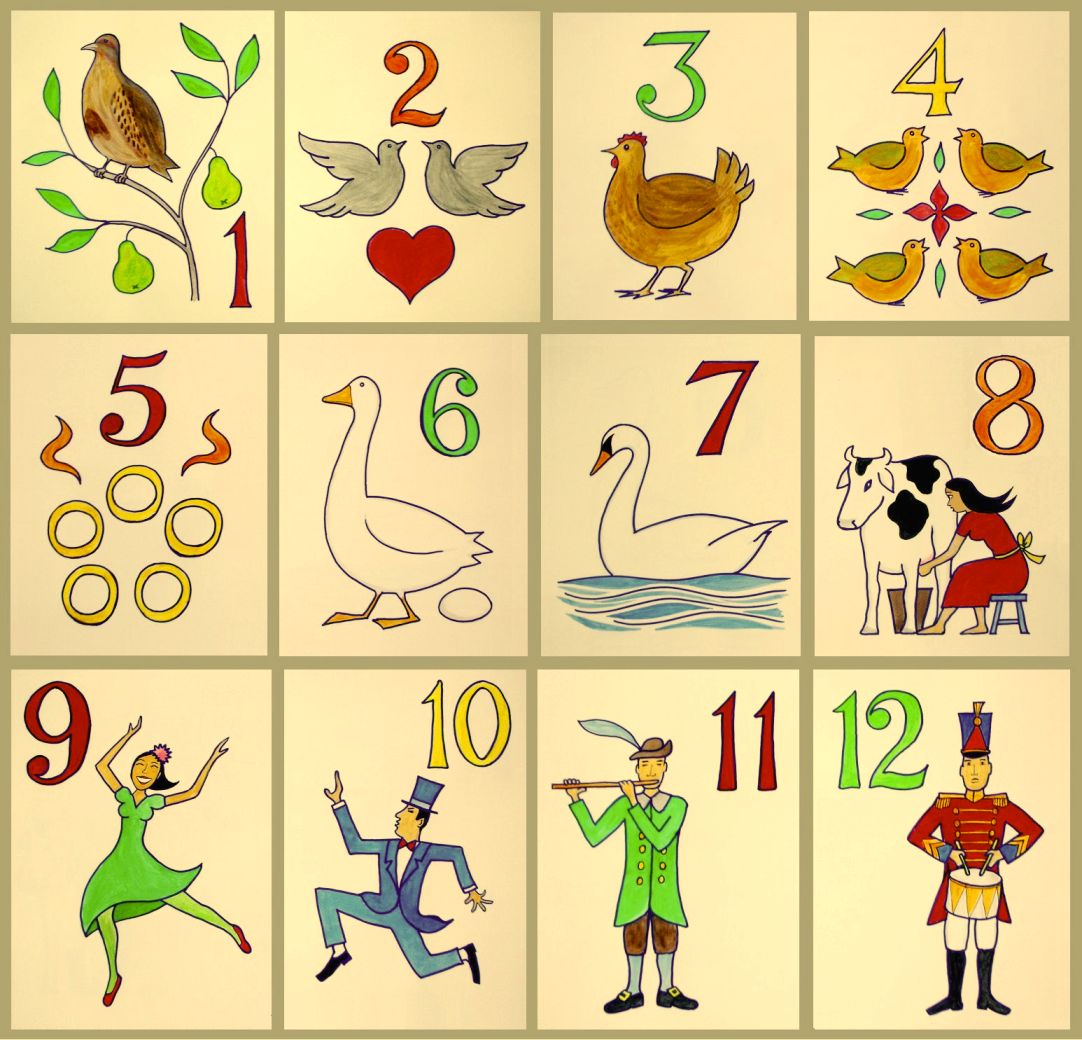
On the fifth day of Christmas my true love sent to me … five gold rings
Deep ploughing is going out of fashion. But when in 1948 a ploughman found something his boss said was a piece of brass bedstead, deep ploughing turned out to have its uses.
The torc: a sign of high status

The ploughman had found the first item discovered in the Snettisham Iron Age hoard. This was no bedstead, it was a gold torc – a solid ornament worn around the neck. Such an item was a key way to display high rank, and torcs have been found buried in Iron Age tombs across Europe, for example at Waldalgesheim in western Germany. The 3rd-century marble Dying Gaul in the Capitoline Museum in Rome is wearing little else.
The so-called Great Torc is the largest one found at Snettisham. It was found in 1950 and is made of 1kg of gold alloyed with a small proportion of silver. The complex design of ropes twisted together displays an extremely high quality of workmanship. Although its history and ownership are not known, the quantity of other finds in the area suggest it may have belonged to the royalty of the Iceni tribe.

Historical associations

The torc has been dated to around 75 BC. The Iceni, according to the Oxford Dictionary of National Biography, are likely to be the tribe called Cenimagni by Julius Caesar in his account of his 54BC campaign to invade our shores. The Iceni initially sought to live peacefully alongside the invaders, but by the time East Anglian heroine Boudica was in power a hundred years later, Roman law had been applied to deprive the tribe of their weapons. The Iceni, not unreasonably, objected, and mounted a fierce revolt, led by Boudica. Her appearance in the film reviewed in 2023 for East Anglia Bylines is based on a description of her by Greek author Cassius Dio:
“She was very tall and severe. Her gaze was penetrating and her voice was harsh. She grew long red hair that fell to her hips and wore a large golden torc and a vast patterned cloak with a thick plaid fastened over it.”
Olga Kurylenko, who plays her in the film, is shown wearing a torc modelled on the Great Torc of Snettisham. However, given that Boudica died when the revolt fizzled out to defeat in the midlands, it may be unlikely that the historical Boudica was wearing the selfsame one found in Snettisham.
Torcs galore at Snettisham
The Great Torc is the star of the hoard, and it lives in the British Museum. A number of other items in the record West Norfolk find, which includes over 60 complete or near-complete torcs and many further fragments, are currently on loan to Norfolk Museums and displayed in the magnificently renovated Norwich Castle. (Hot tip: tickets are expensive, but if you’re in Norwich for the day, you can nip in at the end of the afternoon for just £2.50.) The display includes a photo of a pit where a collection of torcs had been buried for safety.


But are there five?
The Snettisham hoard, which was discovered in several different digs over a period of some 44 years, could certainly supply all five our gold rings, and many more besides. Maybe other hoards in the region might also yield a few gold rings?
Other East Anglian hoards

Most famous is of course the 7th-century Sutton Hoo site and the associated royal palace of King Rædwald. The most famous item, the famous Sutton Hoo mask, sets the tone: many of the gold items found at the site were related to weaponry and clothing, such as this intricately decorated gold buckle.
For 14 years from 1965, a vast area at Mucking in Essex was excavated at great speed in order to glean information that was about to be destroyed by gravel extraction. The site yielded information from the Neolithic, the Bronze and Iron ages, and Romano-British eras. From the subsequent Anglo-Saxon settlement there were more than 800 burials dating from the 5th to the 7th centuries. This was not a high-status settlement, so brooches, which served to secure clothing, feature in the finds rather than rings.
In 2003 an Anglo-Saxon tomb was found at Prittlewell in Essex, dating from the late 6th century. Because of the riches of the items in the tomb, and quality of the workmanship, the occupant – nicknamed locally the King of Bling – is thought to have been a member of the Anglo-Saxon royal family in the very early days of conversion to Christianity in the area. The most significant object in the tomb was a gold buckle that signalled his high status.
So Snettisham is clearly the place to find our Five Gold Rings. In fact, it can even provide the 35 rings that would cumulatively have been offered by your true love over the course of the whole carol. What an amazing East Anglian treasure-trove!
More from East Anglia Bylines


Friends of Bylines Network
There has never been a greater need for grassroots journalism that investigates the stories that really matter, holds power to account and champions the voices of everyday citizens. We are proudly powered by volunteers but what we do isn’t free.
STAND WITH US for independent, citizen-led journalism that makes democracy stronger, and you will even get some exclusive benefits.