• Contact
  • About
  • ISSN 3049-9771
  • Authors and editors
NEWSLETTER SIGN UP
East Anglia Bylines
Advertisement
  • HOME
  • News
    • Brexit
    • Health
    • Education
    • World
  • Politics
    • Local government
    • Justice
    • Activism
  • Climate
    • Environment
  • Lifestyle
    • Community
    • Culture
    • History
    • Humour
    • Property
  • Business
    • Development
    • Economics
    • Finance
    • Transport
    • Farming
  • ANGLIA
    • Bedfordshire
    • Cambridgeshire
    • Essex
    • Hertfordshire
    • Norfolk
    • Suffolk
  • Series
No Result
View All Result
East Anglia Bylines
Home Lifestyle Culture

Funding secured to unlock the secrets of Bronze Age Flag Fen

A major new excavation at Flag Fen Archaeology Park near Peterborough will investigate one of Britain’s most important Bronze Age sites

East Anglia Bylines by East Anglia Bylines
4 October 2026
in Culture, History
Reading Time: 7 mins read
A A
Flag Fen causeway reconstruction. The re are vertical poles on each side, only a few inches apart, and between them planks of wood to create the causeway. They go towards one of the buildings of the museum, which has had the side painted to evoke the marshy landscape across which the causeway would have gone.

Flag Fen causeway reconstruction image by Peterborough Limited. Used with permission

Share on Bluesky

Grant funding of £700,000 has been provided through the Countryside Stewardship Heritage Service – Defra’s partnership with Historic England. It will support archaeological work at the nationally significant site and help protect evidence that has survived for around 3,500 years. Farming Minister Stephen Morgan announced the funding during a visit to Flag Fen on Thursday 10 September.

A unique prehistoric landscape

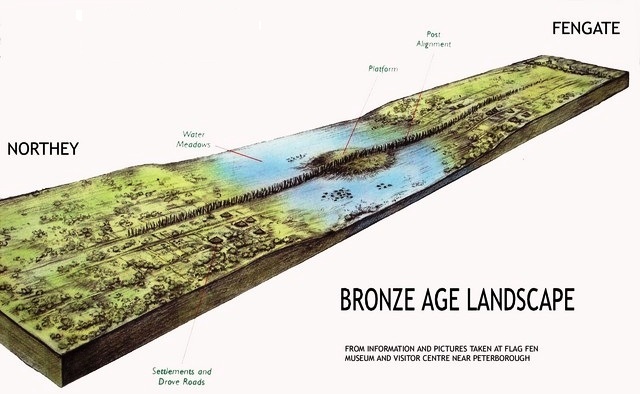
The project is expected to give visitors a deeper understanding of the people who lived in the Flag Fen landscape and built its remarkable timber causeway and platform. Archaeologists will focus on the post alignment on the western (Fengate) side, recording newly uncovered evidence and exploring what it can reveal about the purpose and development of the monumental structure.

Flag Fen sits at the centre of a unique prehistoric landscape in the Flag Fen basin. The site’s timber platform and causeway were constructed during the Bronze Age, when the surrounding environment was changing from dry land into marshland. The scale, complexity and exceptional completeness of the remains make Flag Fen one of the most important Bronze Age platform sites anywhere in the world.

The timber structures provide a rare insight into the ingenuity of prehistoric communities. Faced with a changing climate and increasingly wet conditions, the people who lived in the area adapted to their new surroundings by building substantial wooden structures across the marsh. The causeway enabled movement through the landscape and may also have had social, ceremonial or practical significance.

Serious risk

However, the future of this evidence is under growing threat. Flag Fen has been included on Historic England’s Heritage at Risk Register since 2012. Changes in groundwater levels are causing the surrounding peat to dry out, placing ancient wood and other organic remains at serious risk of decay. Once exposed to oxygen, materials that have been preserved in waterlogged conditions for thousands of years can deteriorate rapidly.

Recent evaluation excavations confirmed that organic remains, including worked ancient timber, are already degrading. Project partners have warned that around 40% of the site’s buried archaeology could be at serious risk of being lost within only a few months. The new excavation will therefore provide an urgent opportunity to investigate, document and preserve information before environmental change causes irreversible damage.

Flag Fen bronze age roundhouse. The conical thatched roof comes down to about 4 feet from the ground, where it rests on the circular wall of the house. There is a door on the left as we look at it, where two little girls are walking into it. The thatch is cut back over the doorway and is covered in grass and wildflowers.
Flag Fen iron age roundhouse. The conical thatched roof comes down to about 18 inches from the ground, where it rests on the circular wall of the house. There is a door on the right as we look at it, where the thatch overhangs the doorway generously to keep the rain off.
Bronze age (L) and Iron age (R) roundhouses at Flag Fen Archaeology Park. Both images by Midnightblueowl via Wikimedia Commons (CC BY-SA 3.0)

Response to a climate crisis

Jacqueline Mooney, General Manager of Flag Fen Archaeological Park, said the funding would allow archaeologists to collect evidence that is currently missing from the understanding of why the Bronze Age settlers built the causeway.

She described the structure as “a monumental example” of how people responded to a climate crisis 3,500 years ago. Rather than simply retreating from the transforming landscape, the community adapted its way of life, using ingenuity to survive and prosper in a marshland environment.

Community focus

The excavation will also create opportunities for local people to take part directly in the project. Volunteers will include members of the surrounding community, university students, young carers and people who have previously participated in surveys at Flag Fen. Progressive training will enable volunteers to develop archaeological skills, with the longer-term aim of helping them become supervisors and tour leaders.

This community focus is central to the wider ambition to revitalise Flag Fen and strengthen its links with the Peterborough area. One of the project’s key objectives is eventually to remove the site from the Heritage at Risk Register. Alongside protecting the archaeology, partners hope to develop Flag Fen as a major visitor destination where Bronze Age history can be brought to life through interpretation, public engagement and reconstructed prehistoric landscapes.

Historic England’s Co-CEOs, Claudia Kenyatta CBE and Emma Squire CBE, said the site was both rare and nationally significant. They also highlighted its potential to strengthen Peterborough’s cultural profile and generate economic benefits for the local community.

Globally significant archaeology, close to home

The new funding has been welcomed by Peterborough City Council and Andrew Pakes, MP for Peterborough. Council leader Cllr Shabina Qayyum described Flag Fen as a unique attraction that gives families the opportunity to experience ancient archaeology close to home. Pakes called it one of Peterborough’s greatest treasures and a site of global historical significance.

For Farming Minister Stephen Morgan, the excavation represents an important investment not only in archaeology but also in public access and the natural environment. He said Flag Fen had survived for thousands of years and that the funding would help protect the history beneath the ground while encouraging more people to discover the secrets of Britain’s ancient past.

A race against climate change

As work begins, archaeologists will be racing against environmental change to capture evidence that may otherwise disappear forever. The findings could help answer long-standing questions about the purpose of the timber causeway, the people who built it and the ways in which Bronze Age communities responded to a changing climate.

By combining excavation, conservation, training and community involvement, the project aims to secure Flag Fen’s future. It will also ensure that one of Britain’s most extraordinary prehistoric sites remains a place where visitors can explore the achievements of ancient communities – and consider how people have adapted to environmental challenges across the centuries.

This article is based on a government press release, edited by East Anglia Bylines.


More from East Anglia Bylines

Montage of several pages of the original 1375 Catalan Atlas
History

How volcanic eruptions led to the Black Death in Europe

by Sarah Collins
8 December 2025
Modern painting of the martyrdom of St Edmund
Culture

A terrifying warrior from beyond the grave: kings knelt before St Edmund

by Peter Thurlow
20 November 2024
Carnyces depicted on the Gundestrup cauldron. The complex image shows a lower layer of 6 foot-soldiers carrying shields with large bosses, marching towards the left. An upper layer shows 4 horsemen riding towards the right. On the left-hand side a large figure, twice the size of the other human figures (maybe a god?) is tossing a warrior from the upper level down to the ground, head first. On the right-hand side the last figure in the lower layer is carrying a sword, but no shield, and is wearing a helmet with a boar on it. He appears to be leading the three figures behind him who are all playing carnyces, which reach up to the head of the leading horse on the upper layer - the height of a whole extra person.
Culture

A historic find in Norfolk: the instruments of Iron Age war

by Sarah Patey
14 January 2026

Bylines Network Gazette is out!

The latest Bylines Network Gazette is out now. Become a Friend of Bylines Network or upgrade to a paid Substack subscription, and you will get access to a vital collection of citizen articles and stories.

Journalism by the people, for the people.

Tags: Climate
Previous Post

The traditional Christmas fruitcake raised to new heights

Next Post

Tots, bots, measles and the surging distrust in vaccines

East Anglia Bylines

East Anglia Bylines

East Anglia Bylines is a not-for-profit regional online newspaper that supports citizen journalism. Our aim is to publish well-written, fact-based articles and opinion pieces by the public on subjects that are of interest to people in East Anglia and beyond. In doing so, we seek to demonstrate democracy in action by giving a voice to local people and holding our elected representatives to account. If you'd like to write something for us, please email us: editor@eastangliabylines.co.uk

Related Posts

The palace of Westminster on fire. An impressionistic image, viewed from across the river. The white stonework of Westminster Bridge on the right of the image glows orange from half way across the river as it reflects the huge flames from the fire. There are dense crowds on the shore in front of the artist, and boats with more spectators on the river.
Democracy

Westminster: it’s time for reform from the ground up

by Calix Eden
16 October 2026
Composite image showing a hand holding fused Anglo-Saxon coins, with St Peter’s Basilica and the River Tiber in Rome behind.
History

When Anglo-Saxon ex-pats were welcome in Rome

by Dr Tom Almeroth-Williams
15 October 2026
Kotor Bay, Montenegro. In the near foreground is a church with a stonebuilt tower and a small octagonal dome, below it are the houses in Kotor, and beyond them is the very blue water of Kotor bay. All around the bay granite mountains rise steeply out of the water. This photo has clearly been taken from a position up the mountainside, as the photographer is on the same level as the top of the church tower.
Culture

Is Montenegro really the budget escape the reels promise?

by Purba Zannat
14 October 2026
Two fruitcakes baked being dosed with alcohol ready for Christmas
Culture

The traditional Christmas fruitcake raised to new heights

by Kate Viscardi
3 October 2026
A wood sign post for Peddars Way against a blue cloudy sky and green hedge
Culture

Peddars Way: a beautiful gentle National Trail through Norfolk

by Sarah Pryor
29 September 2026
Next Post
A toddler whose face is covered in measles

Tots, bots, measles and the surging distrust in vaccines

SUPPORT OUR CROWDFUNDER

Tags

Activism Brexit Cartoons Christmas Climate Community Conservation Conservatives Democracy Economy Elections Environment EU Farming General Election 2024 Government Health History Housing Labour Letters Local government Net zero NHS Norwich Opinion Our place in Europe Party politics Pecksniff Politics Polling Pollution Poverty Reform UK Renewables Sewage Social care Something for the weekend Tax Trump Ukraine Voting Wealth Wildlife Women
East Anglia Bylines

We are a not-for-profit citizen journalism publication. Our aim is to publish well-written, fact-based articles and opinion pieces on subjects that are of interest to people in East Anglia and beyond.

East Anglia Bylines is a trading brand of Bylines Networks Limited which is separate to, but allied with, Byline Times.

Learn more about us

No Result
View All Result
  • About
  • Authors and editors
  • Complaints
  • Contact
  • Donate
  • Letters
  • Privacy
  • Network Map
  • Network RSS Feeds
  • Submission Guidelines
  • Download the Bylines Network App

© 2021-2026 East Anglia Bylines. Powerful Citizen Journalism. ISSN 3049-9771

No Result
View All Result
  • HOME
  • News
    • Brexit
    • Health
    • Education
    • World
  • Politics
    • Local government
    • Justice
    • Activism
  • Climate
    • Environment
  • Lifestyle
    • Community
    • Culture
    • History
    • Humour
    • Property
  • Business
    • Development
    • Economics
    • Finance
    • Transport
    • Farming
  • ANGLIA
    • Bedfordshire
    • Cambridgeshire
    • Essex
    • Hertfordshire
    • Norfolk
    • Suffolk
  • Series

Newsletter sign up

Crowdfunder

© 2021-2026 East Anglia Bylines. Powerful Citizen Journalism. ISSN 3049-9771