I have a confession to make. An embarrassing one.
There’s a GB News presenter who doesn’t instantly make me gag. Well, two actually, but this post is about one in particular: Tom Harwood.
I know. I know. He’s the permanent student politician who somehow tricked Ofcom into giving him a broadcast licence. The boy who never quite grew out of debating society, now with a prime-time slot and a social media following that hangs on his every contrarian take. But I’ve occasionally found him – dare I say it – measured. Almost reasonable. Moments where he appears to wrestle, if only ever so briefly, with the concept of nuance. There was even a time I thought, “God, is he going to become one of the sensible ones?”
Well. That moment passed.
Because this week, Harwood’s mask of moderation slipped right off – and what’s underneath is the same reheated nonsense that’s been doing the rounds in right-wing circles for years: the idea that the NHS wasn’t really “built” by the post-war Labour government, it was just confiscated. A kind of nationalised grave-robbing, apparently. A bureaucratic heist in which Nye Bevan snuck into Britain’s hospitals in the dead of night and slapped a red rosette on everything.
Harwood posted:

Which sounds like a line borrowed straight from a Policy Exchange PowerPoint, sanded down just enough to fit into a tweet. And right on cue, the algorithm served up Tim Worstall – the Tufton Street philosopher king of “actually” takes – with a claim that Attlee and Bevan “stole” the NHS and that the “first NHS built hospital didn’t open until 1963”.
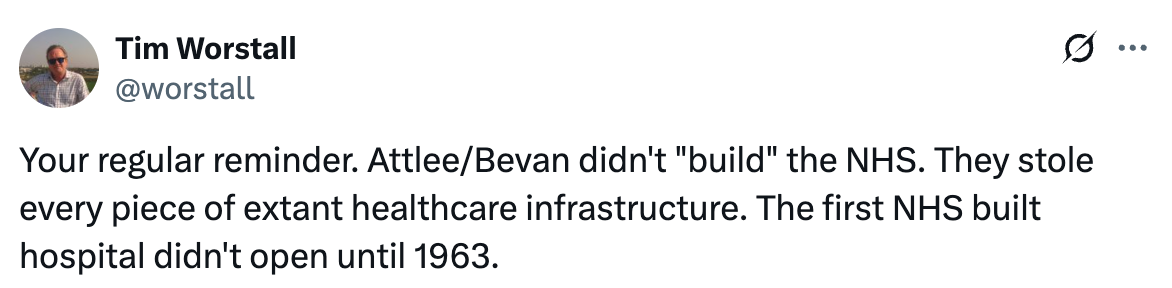
It’s a particularly timely intervention, this bit of historical revisionism. With the NHS under unprecedented pressure, waiting lists at record highs, and politicians from all parties scrambling for solutions that don’t involve admitting we’ve chronically underfunded the thing for decades, what better time to question whether it was ever worth creating in the first place?
The historical reality they’re trying to erase
I think it’s worth saying that no serious historian would deny that the NHS was formed using the existing patchwork of voluntary, municipal and charitable hospitals. That, in fact, was the whole bloody point. Britain was already full of healthcare provision – but it was fragmented, underfunded, deeply unequal and riddled with access barriers depending on your postcode, profession or ability to pay.
But calling this a “healthcare system” would be generous. What existed before 1948 was a lottery. Voluntary hospitals, the prestigious teaching hospitals like Guys and the Westminster, Addenbrooks and Edinburgh Royal Infirmary, cherry-picked patients who could afford to pay or whose cases were medically interesting. Municipal hospitals were underfunded and overwhelmed. Poor Law infirmaries were stigmatised warehouses for the destitute. If you were a farm worker in rural Wales, tough luck – no hospital for miles. If you were a woman needing maternity care, you might get a midwife if you were fortunate, or face childbirth alone if you weren’t.
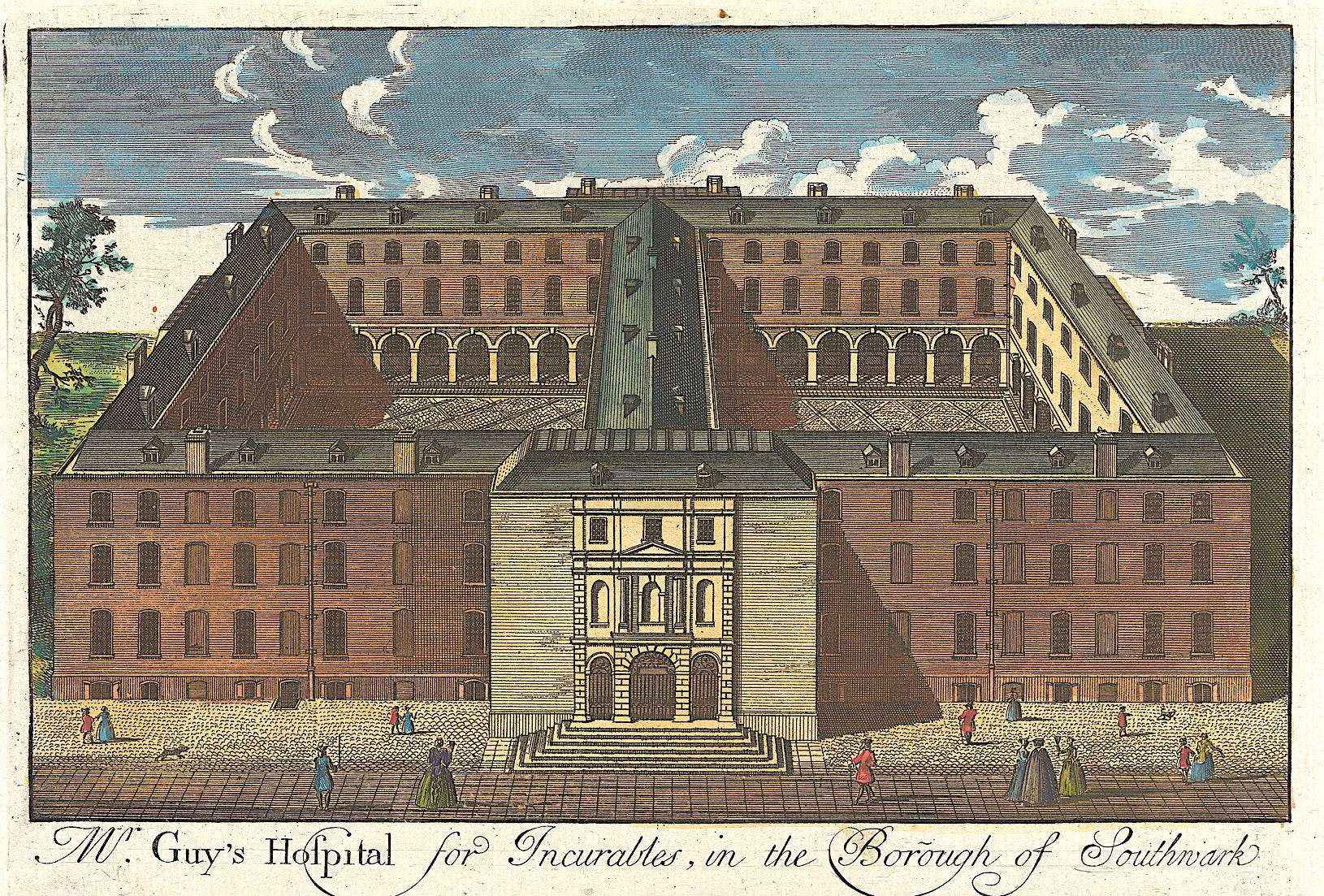
The system actively rationed care through means testing that was both humiliating and exclusionary. Patients were interrogated about their finances before treatment – imagine having to prove you were poor enough to deserve not dying. Many people actively avoided seeking help altogether rather than face the shame of proving their poverty. Geographic inequalities meant that where you lived determined whether you lived – industrial cities had some provision, rural areas had virtually none.
Even when care was available, it was often substandard. Training varied wildly between institutions. There was no coordination between services. Mental health was largely abandoned to asylums. Public health was piecemeal at best. The very idea of preventive medicine was luxury thinking when most people couldn’t afford treatment for existing conditions.
What Bevan and the Attlee government did was take this system built on charity and luck, and transform it into a universal, taxpayer-funded right. They didn’t just flip a sign above the door from “Middlesex Hospital” to “NHS Trust” and call it a day. With the 1946 National Health Service Act they standardised training, guaranteed access, and brought mental health and public health under a single structure where one hadn’t existed before.
The ideological project behind the revisionism
More importantly, the narrative that the NHS was stolen isn’t just wrong – it reframes one of the most ambitious, popular and effective examples of democratic socialism as some kind of authoritarian land grab. And that is very much the point.
What we’re seeing from Harwood, Worstall and many others is a messaging war. A concerted effort to delegitimise the NHS by eroding its founding myth. Because if you can convince people it was never really “built,” then maybe it doesn’t deserve to be saved.
And who benefits from that? Most certainly not patients.
Because once you’ve convinced people that the NHS was simply seized from private hands, it becomes a helluva lot easier to argue that it should be “returned” to them. That’s the long game here. Undermine the origin story, chip away at the legitimacy of the founding, and suddenly the idea of outsourcing cancer care to Virgin Health doesn’t sound quite so grotesque – it’s just “rebalancing the scales”. Restoring what was “taken”.
This rhetorical sleight of hand is ideological prep work. The intellectual version of softening the public up before the next round of cuts, outsourcing, and “reforms” that always seem to mean fewer nurses and more consultants from McKinsey.
And just to reinforce the point, it wasn’t just about the bricks and mortar. From the very beginning, the NHS wasn’t simply nationalising hospitals – it was creating and coordinating an entirely new system of healthcare. General practice, district nursing, health visiting and public health services were all brought together under one umbrella for the first time.

Bevan didn’t become a national hero because he changed the logos on hospital signs. He built something bigger than infrastructure – he built a promise. That no matter who you are, how much you earn, or where you live, healthcare would be available to you, free at the point of use.
That promise changed lives. It still does. And the fact that some hospitals predated that promise doesn’t diminish the scale of the achievement. It just makes it even more impressive.
Why this matters now
Harwood and Worstall aren’t stupid. They likely know everything I’ve just written. But they’re part of a wider trend on the right – one that reframes every progressive achievement as theft, distortion or error. The NHS wasn’t built, it was stolen. The welfare state wasn’t compassion, it was dependency. The Empire wasn’t violent, it was civilising. It’s all part of the same project: tell a new story where the villains wear rosettes and the heroes run hedge funds.
And the reason it works – at least sometimes – is because too many of us on the left have stopped telling our own story with the same conviction. We treat the NHS like an old family heirloom – precious, yes, but dusty. Nostalgic. Something we’re trying to keep from breaking, instead of something worth updating, investing in and expanding.
But the NHS isn’t a museum piece. It’s a living system that still transforms lives every single day. When a child with asthma gets treatment without their parents checking their bank balance first, that’s the NHS working. When someone survives cancer without facing bankruptcy, that’s the NHS working. When a premature baby gets months of intensive care because they’re human, not because they’re profitable, that’s the NHS working.

The founding principles – universal access, free at the point of use, funded through taxation – weren’t just ambitious for 1948. They remain radical now, in a world where American families crowdfund insulin and people die from rationing medications they can’t afford. What Bevan built wasn’t just ahead of its time, it was ahead of our time.
The fight that’s ours to pick
And look, I work for the NHS. I know it’s not perfect. It needs reform – digital systems that actually talk to each other, less admin, shorter waits and a workforce that isn’t permanently on the brink. But acknowledging flaws is not the same as abandoning principles. The NHS doesn’t need selling off. It needs building back up – with the same ambition that created it in the first place.
The danger in Harwood’s revisionism isn’t that it criticises the NHS – criticism is necessary, healthy and welcomed. The danger is that it undermines the fundamental idea that universal healthcare is worth fighting for, making it easier to accept privatisation as inevitable rather than modernisation as achievable.
So maybe the answer isn’t just to roll our eyes at Harwood and move on.
Maybe it’s to fight harder for the founding myth – not because it’s perfect, but because it matters. The NHS wasn’t built by accident. It wasn’t inevitable. It was fought for. And it was built – yes, built – by people who believed that no one should go without care because of what they earn, where they live or who they are.
That principle is worth defending. Worth updating. Worth expanding. Because every time we let revisionist historians chip away at what the NHS represents, we make it easier for the next generation of politicians to chip away at what it provides.
The NHS was built. It’s still being built. And if we want it to survive the next 77 years, we need to remember that building something this important is never finished – it’s a choice we make, over and over again.
If that’s not building something, I don’t know what is.
Oh, and Tom? That hesitant admiration I mentioned at the start? Consider it officially withdrawn. You had me fooled for a moment there – but this week, you showed your true colours. And they’re not nearly as reasonable as I’d hoped.
This article is republished with kind permission of The Bear. Read the original on his Substack here.
More from East Anglia Bylines