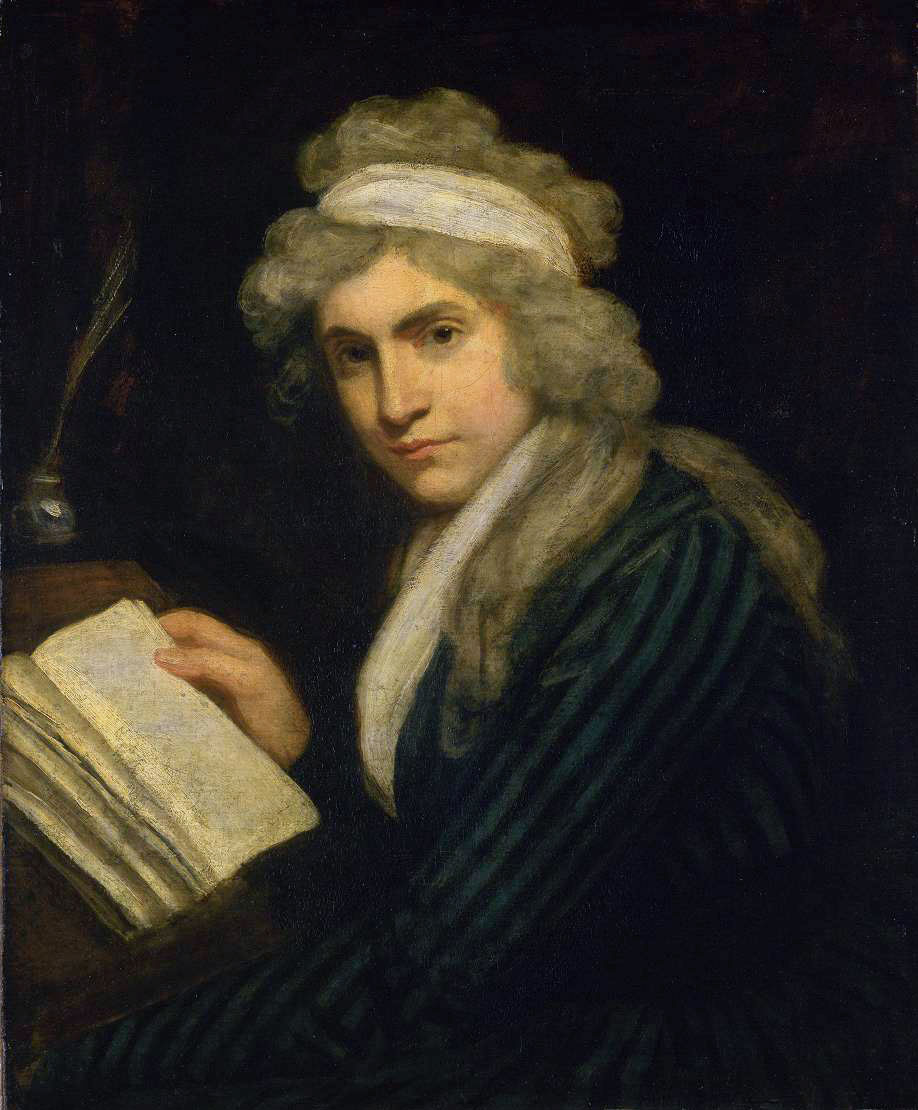
Mary Wollstonecraft has had something of a revival in recent years.
Though considered the mother of first-wave feminism, the 18th-century philosopher long endured her share of trolls refusing to take her seriously. She was dubbed a “hyena in a petticoat” by contemporary politician and writer Horace Walpole, accused of being “unsexed”, unladylike, and of having no shame. She even fell out of favour with some 20th-century feminists.
But in the last decade and a half, popular interest in her life and work has grown exponentially with the emergence of Wollstonecraft blogs, societies, campaigns and even Instagram and Facebook accounts in her name. Her public commemoration has ranged from the traditional blue plaque to a controversial sculpture in her old north London neighbourhood.
As the author of an impassioned plea for human rights, and one of the earliest and most-read statements of feminism, Wollstonecraft today has a well-deserved status as a feminist icon. But we should also take pause when looking at how she is presented, especially when she is shown as the main representative of British feminism.
Education as politics
Born in 1759 in London to a middle-class family, Wollstonecraft spent her youth watching her mother suffer at the hands of an abusive father. An avid reader, frustrated by the limited education and career options open to girls, Wollstonecraft set out to educate herself.
With her sister and friend, she opened a day school for girls in Newington Green. The focus of most of her writings was moral conduct, education and child rearing because she believed that this was the main route to changing the culture and creating a new path for women and girls. For Wollstonecraft, education was political.
Like her fellow north London radicals, Wollstonecraft was a passionate supporter of the French Revolution. She hoped for a similar shift toward democratic republicanism in British politics.
When the political philosopher and MP, Edmund Burke, wrote his famous treatise condemning the revolution and defending the British monarchy, she was so incensed that she wrote and published a response. This was the start of the so-called “pamphlet wars” which resulted in hundreds of responses to Burke (the most famous of which was Thomas Paine’s Rights of Man).
Both Paine and Wollstonecraft defended a doctrine of “natural rights”. This is the idea that man is naturally endowed with rational thought and an ability to think independently, and therefore judge for himself.
But neither Paine nor most of the French revolutionaries that Wollstonecraft so admired actively extended this thinking to women. The new French Republic, in fact, relegated all women (and men without property) to the status of “passive” (non-voting) citizens who were not considered independent enough to make their own decisions.
Wollstonecraft’s most famous text, A Vindication of the Rights of Women, is largely a treatise on the edifying effects of the right kind of education on virtue.
Wollstonecraft did not mean sexual purity when she spoke of virtue, however. Virtue was indicative of moral character and primarily expressed in the ability to make sound, informed and rational judgements.
Moral character also included, for Wollstonecraft, humility and self-discipline and a willingness to look outward from selfish or trivial wants to the needs of others. These were the republican (and indeed Protestant) virtues that good citizens in the new post-revolutionary democracies would need.
Wollstonecraft argued that women are equally capable of acquiring these virtues and of benefiting from a full education if only given the chance to develop their capacities in the same way as men.
Gender norms as social constructs
The idea that reason is not the sole provenance of men also meant that Wollstonecraft was already making an argument, often attributed to Simone de Beauvoir in The Second Sex and to the so-called second-wave feminism of the 1950s and 1960s, that gender norms are socially constructed.
Rational qualities, argues Wollstonecraft, are not naturally gendered. They are learned and shaped by environment, especially by upbringing, education and culture. If education is narrow and confined, it will produce narrow and confined thinking. This is what she meant when she wrote of women: “Make them free and they will quickly become wise and virtuous.”

Wollstonecraft wanted to free women from being forced to focus solely on trivial accomplishments that would make them a better wife. Wollstonecraft herself lived a life that largely defied convention, but it was evidently not an easy one.
This is, far too often, still the life that women live today: caught in a struggle to break free of preconceived notions about who and what we can be, what we should wear, how we should look, and what we should value in ourselves.
Wollstonecraft asserted the simple idea that women were fully fledged people with the capacity to decide on and forge a path for themselves. Obvious to us, but the revolutionary character of this idea, should not be underestimated.
It is the same notion that nearly a century later got John Stuart Mill lampooned and laughed at in the House of Commons when, as Westminster MP, he proposed to substitute the word “persons” for the word “men” in the voting reform bill of 1867 so as to include women in universal suffrage.
This idea, that women are rational beings with a right to self-determination, must still be fought for daily around the world. This is the case in every instance where, as women, we are forced to assert that we are not objects, or property, that we have not been made for someone else’s use or pleasure, that it is not justified to exclude us from education or politics, or prevent us from speaking our minds, whether through laws, violence, intimidation or ridicule.
Personal liberation
Wollstonecraft has striking relevance for us and she is responsible for inspiring generations of activists. However, she had her blind spots. She was not writing for working class women and she said little about women of colour in spite of her abolitionism. Today’s women around the world deal with issues that Wollstonecraft could never have imagined.
Nor is it helpful when she is simplistically presented as paving the way for the suffragettes. In claiming Wollstonecraft, the suffragette movements rescued her memory from a largely negative obsession with her sexual morality. But they also did her a disservice by reducing her aims to a battle for legal and political equality.
Equal treatment is indeed a necessary condition for women’s progress. But it is not a sufficient condition for women’s freedom. Wollstonecraft herself was more interested in personal liberation. In fact, she never made voting a focus of her writings.
Wollstonecraft wanted something much more than voting, something that too often we still do not have: liberation from prescribed notions of who or what we can be and from the fear of being who we are.
Liberation from oppression means being able to define ourselves and the direction of our lives. And this requires access to the intellectual resources and knowledge needed to develop independence of mind. This is Wollstonecraft’s most important message, and one that should speak to everyone regardless of gender.

This article is republished from The Conversation under a Creative Commons license. Read the original article.