• Contact
  • About
  • ISSN 3049-9771
  • Authors and editors
NEWSLETTER SIGN UP
East Anglia Bylines
Advertisement
  • HOME
  • News
    • Brexit
    • Health
    • Education
    • World
  • Politics
    • Local government
    • Justice
    • Activism
  • Climate
    • Environment
  • Lifestyle
    • Community
    • Culture
    • History
    • Humour
    • Property
  • Business
    • Development
    • Economics
    • Finance
    • Transport
    • Farming
  • ANGLIA
    • Bedfordshire
    • Cambridgeshire
    • Essex
    • Hertfordshire
    • Norfolk
    • Suffolk
  • Series
No Result
View All Result
  • HOME
  • News
    • Brexit
    • Health
    • Education
    • World
  • Politics
    • Local government
    • Justice
    • Activism
  • Climate
    • Environment
  • Lifestyle
    • Community
    • Culture
    • History
    • Humour
    • Property
  • Business
    • Development
    • Economics
    • Finance
    • Transport
    • Farming
  • ANGLIA
    • Bedfordshire
    • Cambridgeshire
    • Essex
    • Hertfordshire
    • Norfolk
    • Suffolk
  • Series
No Result
View All Result
East Anglia Bylines
Home REGIONS Anglia

The Witchfinder General: East Anglia’s dark secret

As we tell ghost stories to children, it is time to remember a true horror that stalked these lands

Stuart Burrell by Stuart Burrell
30 October 2025
in Anglia, Culture, Featured, History
Reading Time: 8 mins read
A A
Execution of so-called witches, Derenburg 15th century

Execution of so-called witches, Derenburg 15th century. In England, most were hanged. Image: Wikimedia Commons (CC0)

Share on Bluesky

As retailers across the region stock up on Halloween-themed items from toys to disposable plates, one reoccurring motif on them is that of the witch’s hat. The pointed black appendage is famous the world over and thanks to modern books, television, and films, from Buffy the Vampire Slayer to the Harry Potter series, the wearers are often heroic and inspiring.

The historic reality however is far more bleak and deadly and in Britain, East Anglia was to play a central role.

The death toll of witches

Witch hunts were common throughout Europe between 1300 and 1850. It will never be known how many people were put on trial for witchcraft. Some estimate around 42,000 people, but it may be as high as 90,000 across the continent. In both cases though, around half of that number went on to be executed.

Portrait of James VI and I with the “Mirror of Great Britain” jewel in his hat, by John de Critz. Image by National Galleries Scotland (CC0)

The ratio of men to women accused varies, with around 70% being women. However in Scotland it was higher, at 84%, with up to 4,000 executed. England saw around 1,000 killed in the same period.

The first law in England concerning witchcraft was introduced by Henry VIII in 1542. The Act made the practice of witchcraft punishable by death. It was replaced by the Witchcraft Act of 1604, enacted by James I, a man who even when he was James the VI of Scotland, displayed a dark fascination with the supernatural.

A king’s obsession

Following the execution of James’s mother Mary in 1587 and then fearing for the life of his future wife, Anne of Denmark, on her marriage trip when violent storms impeded the fleet, James returned to Scotland convinced he was the victim of a curse. Once ashore he ordered a witch hunt on a scale unseen before in Scotland. Eventually 70 suspects ‘confessed’ under torture, cementing his belief.

James I: Daemonologie, in forme of a dialogue. Title page image by Wellcome Collection. CC BY 4.0

James I is the only monarch in history to publish a book on witchcraft. Called Daemonologie, its purpose was not only to silence the doubters of the existence of witchcraft, but also to inspire those that chose to hunt them.

After the death of Queen Elizabeth I in 1603, he become James I of England and is remembered for facing the Gunpowder plot, publishing a revised version of the Bible and uniting England and Scotland. But less so for enacting the Witchcraft Act of 1604 and revising the phrase “Thou must not suffer a poisoner to live” to “thou must not suffer a witch to live” in the 1611 bible.

It was just forty years later, as the Roundheads and Cavaliers fought a civil war for the future of the monarchy and parliament, that James I’s rallying cry from Daemonologie was answered.

The Witchfinder General

This is where East Anglia comes in. Matthew Hopkins, a lawyer by trade, began his search for witches in the region in 1645. Those accused would be blamed for using harmful magic on neighbours or livestock and in turn evidence of their guilt would be determined by the presence of scars or marks on the accused person’s body.

A pen and ink etching image of Matthew Hopkins, Witchfinder general, with two supposed witches calling out the names of their demons, some of which are represented by animals.  Dated 1792, after an earlier woodcut.
Matthew Hopkins, Witchfinder general, with two supposed witches calling out the names of their demons, some of which are represented by animals. image by Wellcome Collection. CC BY 4.0

Hopkins gave himself the title of “Witchfinder General” and would falsely claim to have been given permission by parliament to hunt for witches. What is not disputed was that he would be paid for his work. Towns in which he operated would pay the twenty shillings for his work although records in Stowmarket show he was paid £23 – the equivalent of £21,000 in today’s money.

With this financial incentive driving him, Hopkins, accompanied by his colleague John Stearne, would name some 300 women as witches in 1645 alone. Hopkins even published his own book, ‘A Discovery of Witches’ about his exploits. And it is Bury St Edmonds that has the ignominy of being the location for the largest witch trial in England. 18 people were hung for witchcraft in what is now the market square.

Confessions would be gained after those accused had been subjected to sleep deprivation and forced starvation. Other methods of determining if a person was a witch would include cutting them with a blunt knife: if they did not bleed, then they were guilty. Another was the process that Hopkins called ‘swimming’, more commonly known as the dunking stool. This would involve a person being tied to a chair and lowered into a body of water. If they floated, they were guilty, if they stayed submerged, they were innocent. Fye Bridge in Norwich is believed to be one such location where people were submerged.

Between 1645 and 1647 it is believed that 112 people were either drowned or hung for the crime of witchcraft as a result of the actions of Hopkins. Hopkins died in 1647, with Stearne stating in his own book “A Confirmation and Discovery of Witchcraft” that Hopkins had died ‘peacefully in his sleep’. He is buried in Mistley, Essex.

Today’s witch hunters

An exhibition about the Witch Trials in Suffolk may be seen at the Sudbury Arts Centre until 31 Oct and then in The Bull pub, Long Melford after which it travels to Elmswell Library.

Speaking to the BBC, Nadia Cenci, Suffolk County Council’s cabinet member for communities, said she was “excited” about the exhibition and how it could help change the narrative.

“This fascinating collaboration finally sheds light on those persecuted, and the legacy of the fear and loss that ripped through communities.”

The witch hunts have long since passed into history, yet we are perhaps not as enlightened as we’d like to believe. In their day, were they the means to rid oneself of those who challenged your own beliefs or power? Turn on the news and you will see that intolerance has moved onto new pastures and mobs, clothed in good intentions, but still hound the innocent.

On Hallowe’en it may just be children knocking on your door. But for others in these modern times, it may be something far more pernicious and far from supernatural.


More from East Anglia Bylines

Witches being hanged.
Anglia

Misogyny: are witch hunts a thing of the past?

by Kathryn Waters
13 October 2021
Screenshot of 'auditor' being arrested outside Brook Hotel in Bowthorpe from YouTube video
Activism

Lucrative hate: YouTubers target migrant hotels for clicks

by Owen Sennitt, Local Democracy Reporter
30 September 2025
The Witchfinder General
Cartoons

The Witchfinder General

by Dormouse
16 January 2022
Child sitting on a wall with her crutches beside her.
Letters

Letter to the editor: A civilised society does not withhold care based on citizenship

by East Anglia Bylines
13 October 2025


Download the Bylines app to get our content straight to your phone!

Get the app
Tags: FolkloreHistory
Previous Post

Police drop inquiry after man assaulted removing flags

Next Post

Jack Abbott fires starting gun on Ipswich’s City of Culture bid

Stuart Burrell

Stuart Burrell

Stuart Burrell is an article writer for East Anglia Bylines. His interests include history and business. He was born in East Anglia and has lived there for almost half a century.

Related Posts

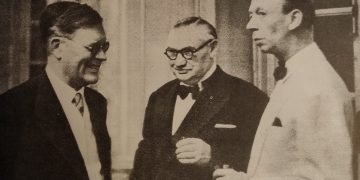
Representatives of Sweden Great Britain and Denmark at the Strasbourg meeting
Featured

Building a new Europe on the ashes of war

by East Anglia Bylines
13 September 2026
Cattle on a parched field, near Alum Bay, Isle of Wight, England
Climate

For food security our diets must change

by Jenny Canham
10 September 2026
The house with finished thatch
Business

Craftsmen at work: time to renew my thatch

by Stephen McNair
9 September 2026
A crowd with one person in the foreground wearing a red baseball cap the wrong way around with Make America Great Again embroidered on it
Democracy

The MAGA paradox of good people and bad politics

by Guy Anthony Ayres
3 September 2026
A flying trapeze troupe of wo girls and two men who are the catchers. All wearing purple leotards. One girl being held, one flying against a stary big top.
Culture

A new era of flying trapeze in Great Yarmouth

by Kate Moore
1 September 2026
Next Post
Local superstar Ed Sheeran playing a surprise concert on the steps of Ipswich town hall

Jack Abbott fires starting gun on Ipswich’s City of Culture bid

SUPPORT OUR CROWDFUNDER

Tags

Activism Art Brexit Cartoons Christmas Climate Community Conservation Conservatives Democracy Economy Elections Environment EU Farming General Election 2024 Government Health History Housing Labour Letters Local government Net zero NHS Norwich Opinion Our place in Europe Party politics Pecksniff Politics Polling Pollution Poverty Renewables Sewage Social care Something for the weekend Tax Trump Ukraine Voting Wealth Wildlife Women
East Anglia Bylines

We are a not-for-profit citizen journalism publication. Our aim is to publish well-written, fact-based articles and opinion pieces on subjects that are of interest to people in East Anglia and beyond.

East Anglia Bylines is a trading brand of Bylines Networks Limited which is separate to, but allied with, Byline Times.

Learn more about us

No Result
View All Result
  • About
  • Authors and editors
  • Complaints
  • Contact
  • Donate
  • Letters
  • Privacy
  • Network Map
  • Network RSS Feeds
  • Submission Guidelines
  • Download the Bylines Network App

© 2021-2026 East Anglia Bylines. Powerful Citizen Journalism. ISSN 3049-9771

No Result
View All Result
  • HOME
  • News
    • Brexit
    • Health
    • Education
    • World
  • Politics
    • Local government
    • Justice
    • Activism
  • Climate
    • Environment
  • Lifestyle
    • Community
    • Culture
    • History
    • Humour
    • Property
  • Business
    • Development
    • Economics
    • Finance
    • Transport
    • Farming
  • ANGLIA
    • Bedfordshire
    • Cambridgeshire
    • Essex
    • Hertfordshire
    • Norfolk
    • Suffolk
  • Series

Newsletter sign up

Crowdfunder

© 2021-2026 East Anglia Bylines. Powerful Citizen Journalism. ISSN 3049-9771