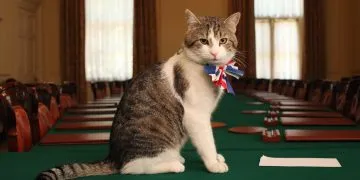
I share my life with a fellow semi-evolved ape, a needy carnivore and two trainee psychopaths.
The semi-evolved ape is watching me beadily. You had better be careful what you write, she seems to be saying.
The needy carnivore is asleep on his blanket, snoring, dreaming of fields full of rabbits and his fellow dogs.
The trainee psychopaths are looking out into the garden, wondering just how many small creatures they can kill once they get out there. They are already showing signs of some potential in that direction. The living room is strewn with balls and small furry toys to be batted away, caught, dispatched and then batted away again.
Once Dorothy and Vita get out into that garden, a number of small animals are going to be, briefly, very sorry indeed.
Dottie and Vi are named after two Bloomsbury Group hangers-on. Had I had the choice of names, they would probably be called Napoleon and Blücher.
East Anglia seems oddly well supplied with cat rescues. We had no trouble finding our two, and they have settled in well.
As I have written here, dogs derive from an extinct species of wolf. They have become Man’s Best Friend, hunting companion and the species most evolved to live with humans.
The wolves may have had another perspective.
The mysterious origins of the domestic cat

No-one is quite so sure where the domestic cat came from, probably because they have not yet deigned to tell us. Most think they date from ancient Egypt, but the first signs of domestication date from much earlier than that.
They probably first turned up in Neolithic times, 10,000 BCE to 2,000 BCE. They will have been attracted to humans by the number of rodents that plagued early agricultural storehouses. They were seen as useful in keeping the number of these in check.
In essence, the first cats were not there because they liked early humans. They were there because of the vermin we attracted. It is a purely transactional relationship, and I would suggest remains that way to this day. You are there to provide food and occasional comfort. Cats have a long way to go before they share the same relationship to humans that dogs do. They are less evolved.
That said, we have had a number of cats over the past few decades who have entered our lives, sniffed disdainfully, and moved on. I have loved them dearly. I have never felt a household complete without one cat, ideally two. It took me a long time to take to dogs.
Ari: the nine-lived legend
There was Ari, The Cat Who Came Back From The Dead. Hit by a car, he was taken by a neighbour to the local veterinary practice. The vet was about to put him down when he noticed one leg was twitching.
Ari gained, given our connections, a temporary notoriety on national media and lived for some years thereafter.
That cold-eyed killer purring next to you on the sofa is far more adapted to living a life without you than most other domesticated species. That said, for a description of how dogs might survive without us, read A Dog’s World by Jessica Pierce and Marc Bekoff. I do not think anyone has been moved to write the equivalent about the future survival prospects of felines.
I have no idea whether, if cats continue to evolve, they will move closer to dogs in their relationship with humans. Will the cats of the future be more accommodating, more subservient, towards their machine overlords?
Somehow I doubt it.