


Now we are on the dark side of the equinox with shortening daylight hours, my thoughts have turned to Christmas cakes. I have a lot to make. So I’ll be making at least two a week from now until mid-November. But if you are a last minute baker and you are reading this when Christmas is just around the corner, don’t worry, you can still make your own delicious cake days before Christmas. For I can tell you how to mature cakes quickly!
A big cake at Christmas has a long tradition here in the UK, although eaten on Twelfth Night in pre-industrial times. Its origins trace back to “satura”, a kind of waybread eaten by Roman soldiers. The common features are sweetness and alcohol, both factors that help preserve freshness.
Varieties around the world
We’re not alone in seeing a fruited cake as an essential part of Christmas celebrations of course. These days the supermarkets have Italian Panettone and German Stollen. And there is a mouth-watering range of special cakes across Europe, from the Portuguese Bolo-Rei to the Finnish Joulutorttu and Ukrainian Perekladanets.
What seems unique about our Christmas cake though, is the marzipan and sugar icing on the top. When I say “our”, the British version extends to Australia and New Zealand, despite Christmas occurring during their high summer.
In America fruitcake has become the butt of jokes, partly because of its longevity and denseness. That longevity made it an excellent choice for mail-order food delivery and it quickly became popular. Americans seem to prefer a topping of candied fruits, which is an excellent alternative to icing.
The wedding variety
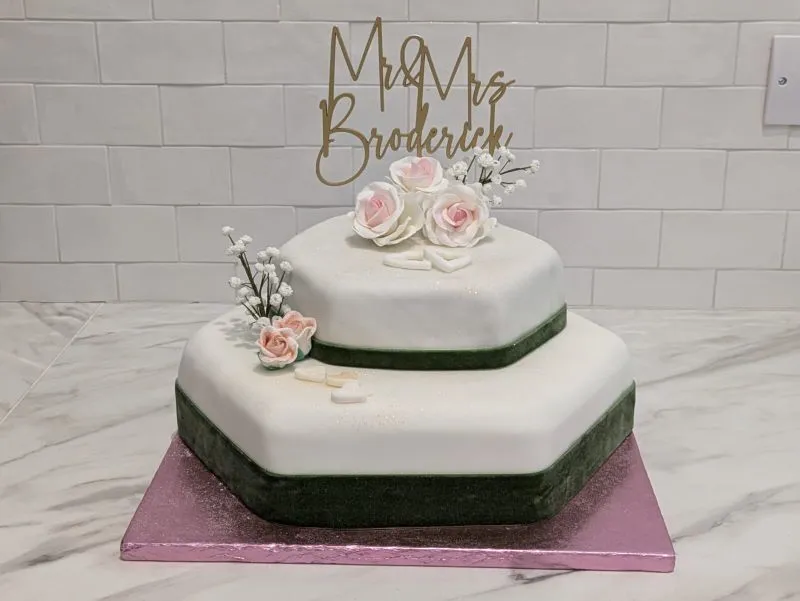
A fruitcake is not only for Christmas though, it’s also a traditional choice for wedding cakes. It offers the sturdiness needed to support the weight of lots of decorations. That said if the cake is to have tiers it’s important to use good-quality dowels for support.
I have been making cakes since I was a little girl and made my own wedding cake. I achieved that without the use of an electric food mixer. That is definitely not something I would attempt now.
I receive many requests to make Christmas cakes, but I am always thrilled when someone asks me to make their wedding cake as their present. I’m not good at decorating cakes but there are other friends keen to do that. It makes the cake cutting ceremony all the more personal.
This year’s wedding cake was very special, being for my daughter-in-law’s brother and his bride. They are all in Ireland, so I made two cakes at Easter, when son and daughter-in-law were able to take them back. As the wedding was not until September, I gave them strict instructions to dose the cakes regularly with whiskey.
Unfortunately, I did not specify how much whiskey. About three weeks before the wedding, son called and admitted the cakes were leaking. But the good news was the resulting liqueur was delicious! It was only when I arrived for the wedding, I learnt they had somehow managed to squeeze 2 and a half litres of whiskey into them, on top of the half litre I added before baking.
The tiers were hexagonal cakes, a 12 inch and a 6 inch, so not even that big. Melissa and Paolo decorated the cake and it all looked terrific. To my surprise the whiskey didn’t overpower it either. People were taking the “polite slice”, then coming back for more, then asking for some to take home.
Secrets of success
So, what makes my cakes so popular? Even though I say this myself, they do taste a bit special. I put this down to two things I do differently from most recipes.
First, if you’re going to make a fruit cake, don’t stint on the ingredients. Long ago I abandoned using currants. They’re awful to clean. And even if you manage to remove all the stalks there will still be pips. But more important, for an alcohol-based cake, currants don’t absorb flavours in the way other dried fruit does. So they are really just a cheap filler.
I use a vine fruit mix that has three different types of raisins, plus sultanas. The raisins are different sizes, which enhances the appearance of the finished cake as well as the taste. Then I include apricots, which I chop into pieces roughly the same size as the sultanas. I use glacé cherries as well, and mixed peel if asked. Some love it, others hate it. Nuts could be added as well, though I don’t as so many people have allergies.
My second trick is to infuse spices in milk, let it cool and add the liquid to the mixture. This gives a better result than using dried mixed spice.
Aside – I also make plain honey cakes with my infusion and a test cake was still fresh after a year. It might well have lasted longer but by then it had been devoured.
My third tip. How to mature cakes quickly? Keep moving them between different temperature zones. If there is room, pop them in the fridge for a few hours then into the living room. My conservatory is excellent for this because it gets a lot of sun but is cold at night.
Fruitcake recipe for an 8”/20cm round or 7”/18cm square tin
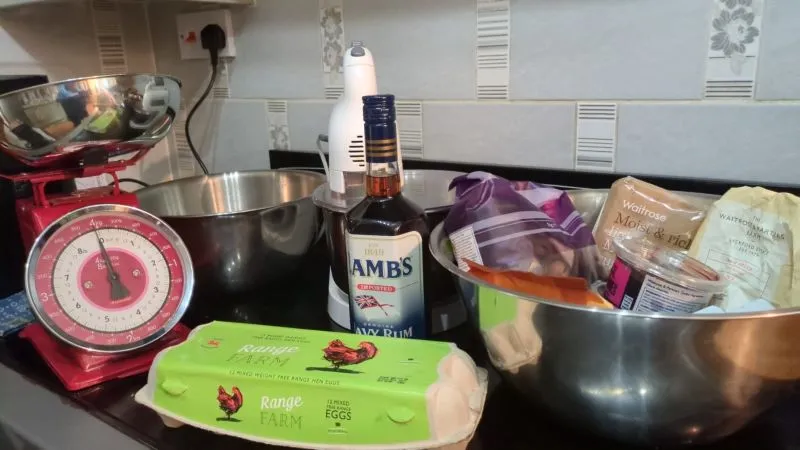
500g vine fruit mix – raisins and sultanas only
250g dried apricots
200g glacé cherries
100g mixed peel (optional, increase apricots by 50g if not used)
240g plain flour
240g unsalted butter
240g soft brown sugar (can use muscovado sugar if spirit is rum)
5 medium or 4 large eggs (check weight of eggs, should be approx. 250g in shells)
pinch salt
1 unwaxed lemon
3 tablespoons brandy, rum or whiskey
For the spice infusion. A third of a vanilla pod, pieces of a cinnamon stick totalling about three inches, four cardamoms, three cloves, about a sixth of a nutmeg, a good pinch of saffron and milk.
You’ll also need greaseproof paper, a cake tin liner (optional but recommended), string and newspaper or brown paper.
Preparation
Start with the spices. Split the vanilla pod and grate the nutmeg into a milk pan with a good pinch of saffron. Add the rest of the spices, making sure you know exactly how many of each you have. Cover with the milk and set on a very low heat. Give the pan a swirl occasionally to stop a skin forming. Allow the spices to infuse for about an hour then remove from the heat and leave to cool.
Meanwhile, chop the apricots and wash well. Pick over the vine fruits to remove any stalks, and rinse at least twice. wash well, ideally rinsing twice. Wash the cherries and break into rough halves (quicker than cutting them and gives more surface area to absorb flavours). Wash the mixed peel if using. Spread the fruits onto baking trays, put in the lowest possible setting of your oven to dry, and turn occasionally.
All that can be done the day before mixing the cake itself.
Putting it together
Weigh the flour, add a good pinch of salt, and sift most of it over the prepared dried fruit. Mix well together. Keep three or four tablespoons of the flour back. Put to one side.
Beat the eggs with a hand whisk. Remove the whole spices from the milk infusion and scrape the seeds from the vanilla pod back into the infusion. Tip the infusion into the beaten eggs and beat again. You won’t need the pod or whole spices again.
Cut the butter into small pieces and put it into the pan the infusion was made in. Warm it gently – there should still be lumps of butter, but this helps collect every bit of the infusion. Tip the butter into a big mixing bowl with the sugar and grate the lemon rind over it all. Beat well until the sugar and butter are well combined and the mix has gained volume.
Add the beaten eggs a little at a time and continue to mix. The infusion and warm butter seem to stop the mixture threatening to curdle, but if it does, add a little flour. Add the rest of the saved flour and mix to a smooth consistency.
Add the fruit and flour mix gradually, stirring with a spoon to mix it all in. Add the spirit, mix it again and let it all rest.
Cooking it
Heat the oven to 140°C fan/150°C/gas mark 2.
Line the cake tin with greaseproof paper or a liner. Spoon the mixture into the tin and smooth it down, making a slight hollow in the middle (because you don’t want the cake to rise in the middle more than the sides).
Take some greaseproof paper and use string to fasten it loosely over the tin. Pull the paper up in the middle so it is not tight and cut a small slit in the middle. Wrap the whole tin in several layers of newspaper or brown paper, including underneath. All this is to enable the middle of the cake to cook without its outside burning. Cut a small slit in this paper as well, above the one in the greaseproof paper.
Put the cake in the oven, with a bowl of water in the bottom of the oven. Cook for about three and a half hours, then test. Push a cake thermometer or skewer into the middle of the cake, through the slits in the paper. If using a thermometer, it should be just below boiling point. But the best test is whether the skewer comes out clean. If not, carry on baking it until you’re happy.
Finally, let the cake cool. Then use a cocktail stick to poke holes at various depths across the cake. Pour a teaspoonful of your spirit carefully across the cake and wrap it in greaseproof paper. Store the wrapped cake in a tin or box and dose it weekly with a couple of teaspoons of your chosen alcohol until you’re ready to decorate it.
I am not good at decorating cakes and most of the ones I make for other people are delivered naked. Which is fine because they are good at decorating cakes and enjoy it. For our own, I buy marzipan, icing and simple decorations.
The important thing is to enjoy your baking and the end result. I hope you enjoy your cake.
Addendum
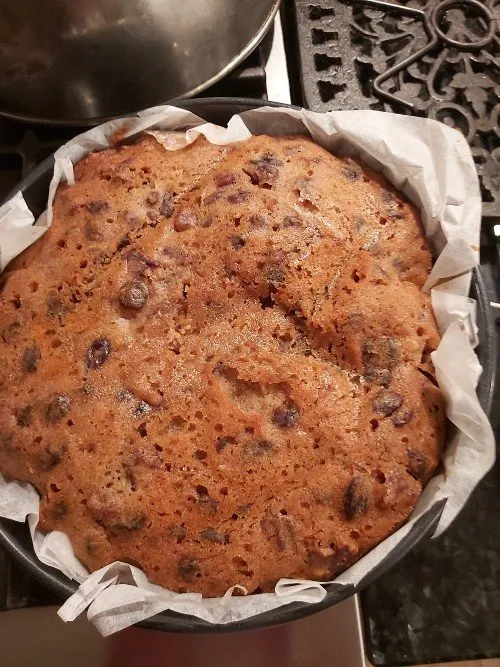
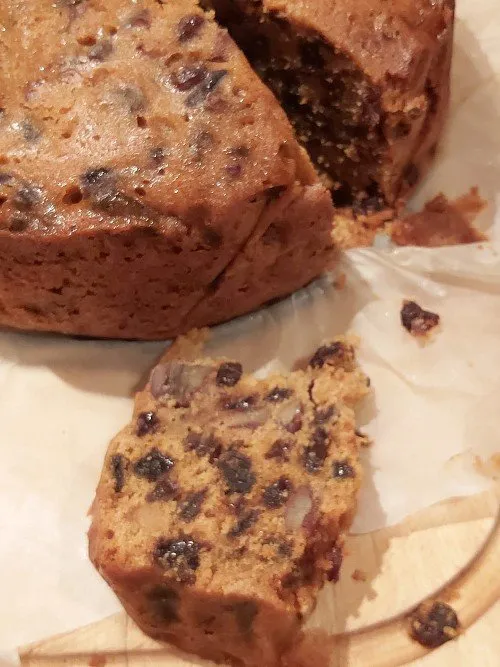
This is a first attempt at this recipe by Kate Moore – a member of East Anglia Bylines’ editorial team who doesn’t usually bake. Substituting pecans and crystallised ginger for things she didn’t have and making the odd mistake, she achieved this excellent result, which she reports tasted wonderful. Following this she has made two more fruitcakes as its proving very popular.
More from East Anglia Bylines







