• Contact
  • About
  • ISSN 3049-9771
  • Authors and editors
NEWSLETTER SIGN UP
East Anglia Bylines
Advertisement
  • HOME
  • News
    • Brexit
    • Health
    • Education
    • World
  • Politics
    • Local government
    • Justice
    • Activism
  • Climate
    • Environment
  • Lifestyle
    • Community
    • Culture
    • History
    • Humour
    • Property
  • Business
    • Development
    • Economics
    • Finance
    • Transport
    • Farming
  • ANGLIA
    • Bedfordshire
    • Cambridgeshire
    • Essex
    • Hertfordshire
    • Norfolk
    • Suffolk
  • Series
No Result
View All Result
East Anglia Bylines
Home News Brexit

Why Britain’s new CPTPP trade deal will not make up for Brexit

While there are some benefits to the free trade agreement, the UK would be better off striking a deal with its neighbours.

Prof Mustapha Douch by Prof Mustapha Douch
15 April 2023
in Brexit, Business, Economics, Foreign Policy
Reading Time: 9 mins read
A A
Container ship from the China Shipping Line docked at Felixstowe port

Port of Felixstowe. Photo credit John Fielding via Flickr (CC BY 2.0)

Share on Bluesky

The UK recently announced that it will join the Comprehensive and Progressive Agreement for Trans-Pacific Partnership (CPTPP), giving British businesses access to the 11 other members of the Indo-Pacific trade bloc and bringing its combined GDP to £11 trillion.

Some commentators have suggested the deal could make up for Brexit. It’s been called “a momentous economic and strategic moment” that “kills off any likelihood that it [the UK] will ever rejoin the EU customs union or single market”. Shanker Singham of think tank the Institute of Economic Affairs has even said: “it’s no exaggeration to say that CPTPP+UK is an equivalent economic power to the EU-28-UK”, comparing it to a trade deal between the UK and EU members.

UK business and trade secretary Kemi Badenoch echoed such sentiments, telling Times Radio: “We’ve left the EU so we need to look at what to do in order to grow the UK economy and not keep talking about a vote from seven years ago.”

Underwhelming benefits

The problem with this fanfare is that the government’s own economic analysis of the benefits of joining this bloc is underwhelming. There is an estimated gain to the UK of 0.08% of GDP – this is just a 50th of the OBR’s estimate of what Brexit has cost the UK economy to date. Even for those that are sceptical about models and forecasts, that is an enormous difference in magnitude.

Of course, the CPTPP is expected to offer the UK some real gains. It certainly provides significant potential opportunities for some individual exporters. But the estimated gains for Britain overall are very small.

The main reason for this is that, apart from Japan, the major players of the global economy are not in the CPTPP. The US withdrew from the Trans Pacific Partnership (the CPTPP is what the remaining members formed without it). And China started negotiations to join in 2022, but current geopolitics now make its entry highly improbable. India was never involved.

In addition, the UK already has free trade agreements with nine out of the 11 members. The remaining two, Malaysia and Brunei, are controversial due to environmental threats from palm oil production to rainforests and orangutans.

Britain’s existing trade agreements with CPTPP members
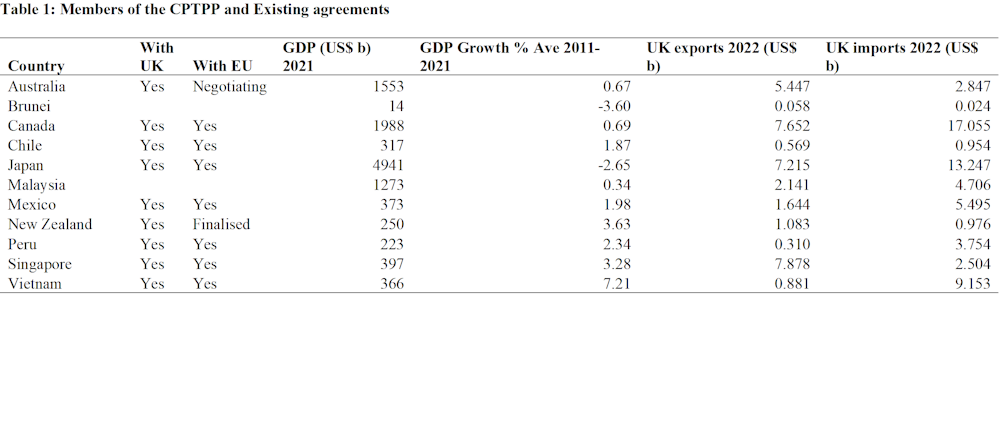
A table listing the existing British trade agreements with CPTPP members.
Author provided using GDP data from the World Bank and trade data from UN Comtrade.

And despite the widespread public perception of the Asia-Pacific area as a hub of future growth, the performance and prospects of the CPTPP members are a mixed bag. The largest member, Japan, is arguably in long-term decline, as is Brunei, while just three members (Vietnam, Singapore and New Zealand had average growth in the last decade above 3% annually.

Finally, distance really does matter in trade. All the CPTPP members are thousands of miles from the UK, which explains their relatively small shares in UK trade at present.

Some benefits of CPTPP

While all of these points pour cold water on the suggested gains, there are some potential benefits from the CPTPP agreement, which allows for mutual recognition of certain standards. This includes patents and some relaxation of sanitary and phytosanitary rules on food items.

However, agreements over standards will involve the UK submitting to international CPTPP courts on these issues. This sits uncomfortably with many of the “sovereignty” objections to the European Court of Justice in relation to Brexit (largely from many of those who have extolled the CPTPP). It’s also notable that out of the nine agreements with CPTPP members that existed before the UK signed this deal, all but two are rollovers of previous EU deals.

But a trade deal with the CPTPP is worth more to the UK than separate deals with each member due to requirements around “rules of origin”, which determine the national source of a product. When a product contains inputs from more than one country, a series of separate free trade agreements may not eliminate tariffs. But if all the relevant countries are members of a single free trade agreement, then rules of origin on inputs from other members cease to be a problem (although there might be some issues if some members do not police the requirements properly).

Secretary of State for Business and Trade, Kemi Badenoch
UK trade secretary Kemi Badenoch has said the UK joining a major Indo-Pacific trade bloc is powerful signal the UK is open for business. Photo credit: Simon Dawson via Wikimedia Commons (Open Government Licence v3.0)

Not the ideal agreement

While these benefits should be recognised, we should also acknowledge that the CPTPP is not the ideal agreement for Britain. As stated above, distance really does matter in trade – this is overwhelmingly accepted by modern trade economists.

Research shows that the rate at which trade declines with distance has barely changed over more than a century. This might seem strange because transport costs have fallen over time. But, as transport and communications have improved, firms have outsourced much of their production to complex supply chains that often cross national borders many times, with “just-in-time” supply schedules to keep down the costs of holding large stocks.

This means that, while trade everywhere has grown, there is still a big premium for trading (many times) across borders between contiguous countries. It is exactly this type of trade which benefits most from big comprehensive trade agreements that simplify rules of origin and regulatory paperwork.

This suggests that, while some elements of the the CPTPP offer benefits to the UK, it is unlikely to boost its trade in the way it does between countries around the Pacific Rim. For this sort of boost, the UK really needs to look towards its own neighbours. Of course, this is just the sort of agreement that Badenoch seems reluctant to discuss.

The Conversation

This article is republished from The Conversation under a Creative Commons license. Read the original article.


More from East Anglia Bylines

EU flag flying in front of Norwich cathedral symbolising British social attitudes
Brexit

For God or Brexit?

by Stephen McNair
30 March 2023
Tags: Trade
Previous Post

Pecksniff’s Diary

Next Post

20 minute communities exist, but are hard to create

Prof Mustapha Douch

Prof Mustapha Douch

Mustapha is an Assistant Professor in Economics at The University of Edinburgh, Business School. He completed his PhD at Loughborough University and is now a Lecturer at Edinburgh University and a Visiting Research Fellow at Aston University (Lloyds Banking Centre). His specialisms include: International Economics, International Macroeconomics and Productivity.

Related Posts

James Talarico and Andy Burnham against a graphic background featuring the US Capitol, the Palace of Westminster and a crowd of people.
Brexit

The politics of blame – who pays the price?

by East Anglia Bylines
13 November 2026
Compilation image of the logos of privatised public companies
Business

No more private rip-offs: we need principled public control

by Stephen McNair
12 November 2026
Large car park with solar structures over the cars, keeping them in shade.
Climate

Good news for the planet: the soaring rise of solar energy

by East Anglia Bylines
10 November 2026
John Healey MP - The Chancellor of the Exchequer, delivering his first budget speech in the House of Commons on 28 October 2026.
Business

Ten things you probably missed in the budget

by East Anglia Bylines
3 November 2026
Pickpocket warning sign, train station, Turin, Italy
Finance

See it. Say it. Sorted. But it’s not that simple

by Aidan Baker
2 November 2026
Next Post
Coltishall High Street

20 minute communities exist, but are hard to create

SUPPORT OUR CROWDFUNDER

Tags

Activism Brexit Cartoons Christmas Climate Community Conservation Conservatives Democracy Economy Elections Environment EU Farming General Election 2024 Government Health History Housing Labour Letters Local government Net zero NHS Norwich Opinion Our place in Europe Party politics Pecksniff Politics Polling Pollution Poverty Reform UK Renewables Sewage Social care Something for the weekend Tax Trump Ukraine Voting Wealth Wildlife Women
East Anglia Bylines

We are a not-for-profit citizen journalism publication. Our aim is to publish well-written, fact-based articles and opinion pieces on subjects that are of interest to people in East Anglia and beyond.

East Anglia Bylines is a trading brand of Bylines Networks Limited which is separate to, but allied with, Byline Times.

Learn more about us

No Result
View All Result
  • About
  • Authors and editors
  • Complaints
  • Contact
  • Donate
  • Letters
  • Privacy
  • Network Map
  • Network RSS Feeds
  • Submission Guidelines
  • Download the Bylines Network App

© 2021-2026 East Anglia Bylines. Powerful Citizen Journalism. ISSN 3049-9771

No Result
View All Result
  • HOME
  • News
    • Brexit
    • Health
    • Education
    • World
  • Politics
    • Local government
    • Justice
    • Activism
  • Climate
    • Environment
  • Lifestyle
    • Community
    • Culture
    • History
    • Humour
    • Property
  • Business
    • Development
    • Economics
    • Finance
    • Transport
    • Farming
  • ANGLIA
    • Bedfordshire
    • Cambridgeshire
    • Essex
    • Hertfordshire
    • Norfolk
    • Suffolk
  • Series

Newsletter sign up

Crowdfunder

© 2021-2026 East Anglia Bylines. Powerful Citizen Journalism. ISSN 3049-9771