• Contact
  • About
  • ISSN 3049-9771
  • Authors and editors
NEWSLETTER SIGN UP
East Anglia Bylines
Advertisement
  • HOME
  • News
    • Brexit
    • Health
    • Education
    • World
  • Politics
    • Local government
    • Justice
    • Activism
  • Climate
    • Environment
  • Lifestyle
    • Community
    • Culture
    • History
    • Humour
    • Property
  • Business
    • Development
    • Economics
    • Finance
    • Transport
    • Farming
  • ANGLIA
    • Bedfordshire
    • Cambridgeshire
    • Essex
    • Hertfordshire
    • Norfolk
    • Suffolk
  • Series
No Result
View All Result
East Anglia Bylines
Home Business

Spotlight on sourdough: are you buying bread or chemicals?

Not all sourdough breads are the same. You may not know which is which, but your body does and will thank you for choosing the good stuff

Kate Moore by Kate Moore
7 September 2025
in Business, Health, Lifestyle
Reading Time: 8 mins read
A A
Making sourdough. The baker is stretching the dough upwards.

Making sourdough. Image by Bread of Haven. Used with permission

Share on Bluesky
Sam and Mark Cornish of Bread of Haven. They are holding a loaf and wearing T-shirts with the logo 'Say no to sourfaux!'
Sam and Mark Cornish. Image by Bread of Haven. Used with permission

Sam Cornish, owner of a micro bakery in North Norfolk, is passionate about making bread, especially sourdough. But she is more passionate that consumers of bread should know exactly what they are eating. Most don’t.

“Authentic sourdough bread,” says Sam, “is made from just 3 ingredients: flour, water and salt. That’s it. Flour, water, salt.” Her concern is that that is not what you will find in supermarkets and some chain bakeries. “There’s a loophole,” she explains, “with regard to bread labelling in the UK. Supermarkets are not obliged to label what is in the sourdough, or any loaf that you buy that is not pre-packed.”

SourFaux

Vanessa Kimbell, a specialist sourdough baker who runs The Sourdough School, is renowned for her work on long slow fermentation. She wrote in 2022, “The increasing presence of chemical additives and agrochemicals in our daily bread is a cause for concern. The long-term health effects of these substances, particularly when consumed in combination, are not yet fully understood.”

A staunch member of the Real Bread Campaign, Sam Cornish advocates their Honest Crust Act which champions stricter marketing and labelling. “There is no legal definition of ‘sourdough’,” Sam explains, “hence the sourdough you buy may contain baker’s yeast, preservatives, enzymes, emulsifiers, improvers and even vinegar to make it taste sour. This is not sourdough bread but an ultra-processed food with questionable nutritional, or health, value.”

To determine if the bread is sourfaux, Sam recommends looking out for terms such as ‘sourdough style’ or ‘with sourdough’. She says that if the ingredients include yeast or other items not found in your typical kitchen cupboard, it’s not real sourdough bread. Other clues are “the use of ‘fermented flour’ which is often just another artificial preservative used to extend the shelf life of the loaf.”

A loaf of five-seed spelt sourdough, with a label showing the ingredients
A loaf of five-seed spelt sourdough, with a label showing the ingredients. Image by Bread of Haven. Used with permission

The real stuff

According to Sam, her customers often comment that her bread does not go mouldy, just dry. In comparison, other sourdough breads they buy develop mould. “And yet,” she says, “they may contain mould inhibitors.” Other customers comment that they can eat her bread without getting bloated or putting on weight and she attributes this to two factors.

First, the long slow fermentation process of real sourdough (Sam puts her sourdough in the fridge for about an 18 hour retarded fermentation), which breaks down the gluten and lowers the glycaemic index, preventing insulin spikes. Second, the ingredients she uses are just flour, salt, water, and from time to time, seeds, olives, herbs, sun dried tomatoes or other natural additions to give her customers variety.

With increasing focus on the health impact of Ultra Processed Foods, Sam argues, “Customers have a right to know what they are eating. I believe every ingredient should be written on the label and every bread sold should have a label.”

The Damascus moment

Sam’s own sourdough journey started 7 years ago. She noticed that after eating bread made using the Chorleywood Bread Process, she was always bloated. Hence she started to bake her own, and often gave some away. When the local vicar suggested she sell a few loaves, Sam had what she calls her ‘Damascus moment’. “In the first week, I took £17.50 and I was hooked.” Now she runs Bread of Haven from her home and bakes four times a week, making 80-100 loaves each day.
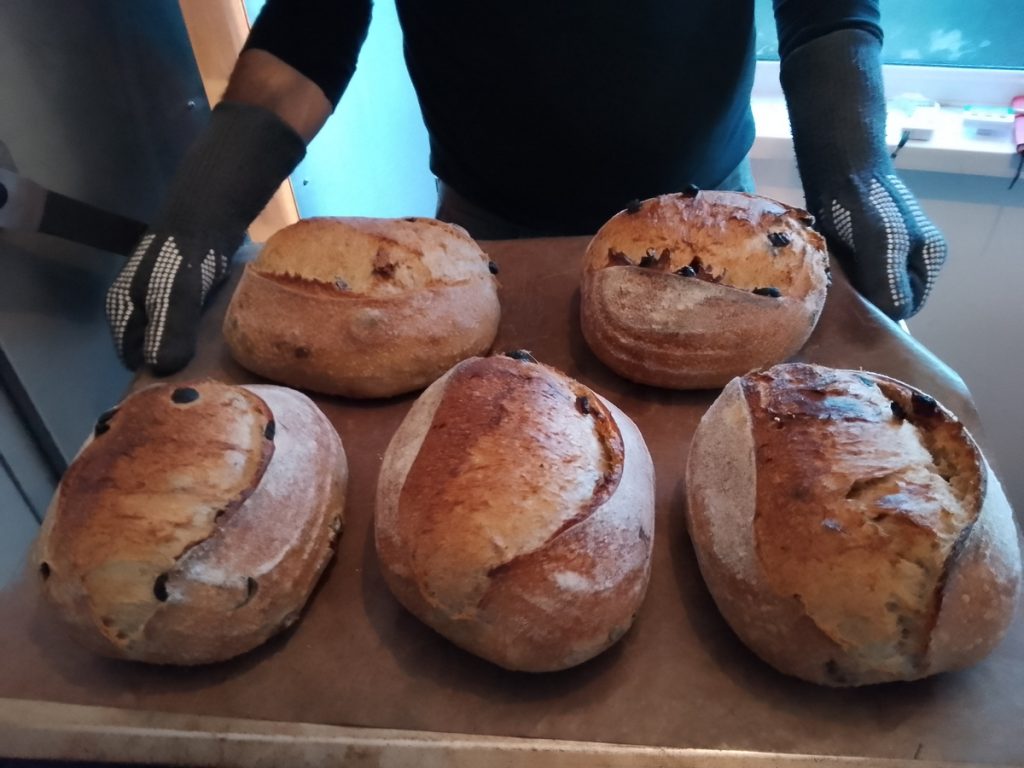
A selection of five different sourdough loaves.
Sourdough selection. Image by Bread of Haven. Used with permission

Key factors for good sourdough bread

In the corner of what was her spare bedroom is an enormous pile of organic strong flour. She orders 500kg every three weeks.

In 2023 Sam and other bakers noticed that the flour quality had degraded. “This may have been due to the war in Ukraine. But now I use Essex grown white wheat flour along with organic flours. The protein in the flour has been more consistent and so there is no longer a need to add higher protein ciabatta flour to compensate as before.”

There are a number of factors involved in the process of making sourdough with consistent crumb – being neither chewy nor with big holes. It is about the protein content of the flour, how the dough feels, calculating the amount of water needed based upon the temperature of the room, the flour, the levain and the friction from the mixer, avoiding too much trapped CO2 as well as having the ‘perfect oven’. Here she almost caresses her RackMaster RM2020 oven, from Wickford in Essex, and waxes lyrical about the designer who, making his own bread, saw the flaws in other bread ovens and “fixed them”.

Cost and trickery

What about cost? At the moment Sam charges £3.60 for 800g white sourdough and £3.70 for an 800g five-seed white & wholemeal spelt loaf. How does she answer the charge that her sourdough is quite expensive?

“Large scale bakeries use dough enhancers to make a loaf look bigger and fluffy. It looks large but will weigh the same. It’s all to trick the eye. And if you are buying a loaf which could contain as many as 19 ingredients, is that really bread?

“Everyone is entitled to wholesome bread. Buying bread which has limited nutritional value is actually a waste of money, and worse if it harms your health.”

To prove her point Sam compared the cost of a supermarket sourdough loaf to her own. The supermarket one cost 59p per 100g. Her own, baked with white and organic wholemeal spelt flour, and seeds, cost 46p per 100g, and is nutritious and lasts well. “Explain that,” she challenges.

For those not living near Sam’s bakery, she recommends Kitty’s Kits bread-making kits, conceived by teenager Kitty Tait. “Everyone, whether they are 5 or 95, can make cheap, nutritious bread,” she says. “And if I can take the next step to baking sourdough, so can you.”


More about nutrition from East Anglia Bylines

Organic food - zero waste
Farming

Be frugal like your grandma: surviving the cost of living crisis

by Jane Berry
30 January 2023
View over an allotment with someone tending their vegetable patch
Community

Growing resilience – food security and health in one patch

by Kate Moore
25 August 2024
Author's photo. Used with permission.
Environment

’Tis the season for tomatoes – get picking

by Celina Błędowska
18 August 2025
5 farmers standing in a field with placards reading "Stop Supermarket Farmwashing"
Activism

Farmers survival fight in face of supermarkets’ shameless tactics

by Rebecca Kay
7 October 2024
Infographics from Easyfundraising

We are registered with easyfundraising! 8,000 brands will donate to us for free every time you use it.

It’s super quick and easy to SIGN UP, and will never cost you anything whatsoever. It’s FREE for you and HUGE for us!

Tags: Food
Previous Post

Nan’s not bankrupting Britain (but politicians might be)

Next Post

Zack Polanski has the mandate to take his party in a more radical direction

Kate Moore

Kate Moore

Kate has swapped city life, working in IT, for the rural idyll of North Norfolk where she can indulge her passions for cycling, wildlife and dogs. Whilst primarily an armchair activist she is often to be seen beach cleaning and litter picking.

Related Posts

A toddler whose face is covered in measles
Health

Tots, bots, measles and the surging distrust in vaccines

by Liz Crosbie
5 October 2026
Flag Fen causeway reconstruction. The re are vertical poles on each side, only a few inches apart, and between them planks of wood to create the causeway. They go towards one of the buildings of the museum, which has had the side painted to evoke the marshy landscape across which the causeway would have gone.
Culture

Funding secured to unlock the secrets of Bronze Age Flag Fen

by East Anglia Bylines
4 October 2026
Two fruitcakes baked being dosed with alcohol ready for Christmas
Culture

The traditional Christmas fruitcake raised to new heights

by Kate Viscardi
3 October 2026
Older man with laptop smiling
Economics

Seven things you need to know about Burnham’s plan for pensioners

by Stephen McNair
2 October 2026
Exterior view of a Wimpy restaurant
Business

A nostalgic fast-food moment: Wimpy restaurants

by Stuart Burrell
2 October 2026
Next Post
Portrait of Zack Polanski

Zack Polanski has the mandate to take his party in a more radical direction

SUPPORT OUR CROWDFUNDER

Tags

Activism Art Brexit Cartoons Christmas Climate Community Conservation Conservatives Democracy Economy Elections Environment EU Farming General Election 2024 Government Health History Housing Labour Letters Local government Net zero NHS Norwich Opinion Our place in Europe Party politics Pecksniff Politics Polling Pollution Poverty Reform UK Renewables Sewage Social care Something for the weekend Tax Ukraine Voting Wealth Wildlife Women
East Anglia Bylines

We are a not-for-profit citizen journalism publication. Our aim is to publish well-written, fact-based articles and opinion pieces on subjects that are of interest to people in East Anglia and beyond.

East Anglia Bylines is a trading brand of Bylines Networks Limited which is separate to, but allied with, Byline Times.

Learn more about us

No Result
View All Result
  • About
  • Authors and editors
  • Complaints
  • Contact
  • Donate
  • Letters
  • Privacy
  • Network Map
  • Network RSS Feeds
  • Submission Guidelines
  • Download the Bylines Network App

© 2021-2026 East Anglia Bylines. Powerful Citizen Journalism. ISSN 3049-9771

No Result
View All Result
  • HOME
  • News
    • Brexit
    • Health
    • Education
    • World
  • Politics
    • Local government
    • Justice
    • Activism
  • Climate
    • Environment
  • Lifestyle
    • Community
    • Culture
    • History
    • Humour
    • Property
  • Business
    • Development
    • Economics
    • Finance
    • Transport
    • Farming
  • ANGLIA
    • Bedfordshire
    • Cambridgeshire
    • Essex
    • Hertfordshire
    • Norfolk
    • Suffolk
  • Series

Newsletter sign up

Crowdfunder

© 2021-2026 East Anglia Bylines. Powerful Citizen Journalism. ISSN 3049-9771