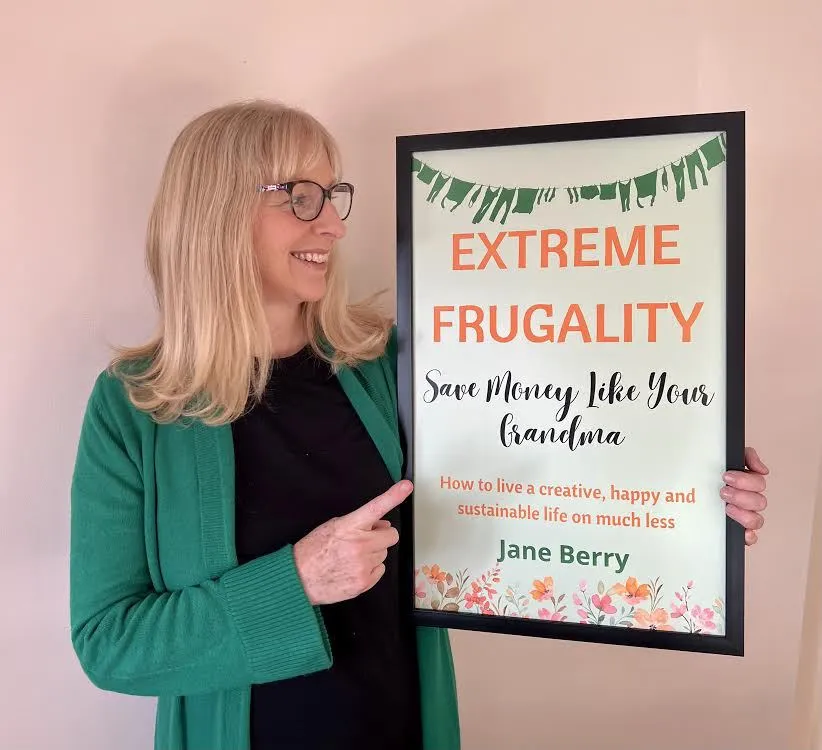
Jane Berry, who writes the blog shoestringcottage.com, has published a money-saving book she hopes will help readers cope with the cost of living crisis. In Extreme Frugality: Save Money Like Your Grandma, she looks at how our wartime ancestors dealt with rationing and food shortages and whether we can learn something from their creativity and resourcefulness.
Over the past decade or so, as I have written about saving money, it has frequently occurred to me that frugality is about going back to basics. Living more frugally tends to naturally create a move towards a more simple life, with less stuff and greater appreciation of the value of things.
Without romanticising the hardships of some of our ancestors, certainly it seems that in modern times we have made living both more complicated and more expensive. We consider items to be essential that our grandparents and great-grandparents wouldn’t even recognise as things, let alone things they couldn’t live without. Can you see washday in the 1940s including a £5 box of fragrance booster beads to make clothes smell like a meadow? I think not.
We have become super consumers, shopping for fun, buying to keep up with the latest social media influencer, and expecting a standard of living that would have been considered the height of luxury by generations gone by. So, can we learn from their example and pare back some of the inessentials to help us to save money and get through the current cost of living crisis? Can we look back to simpler times for inspiration? Here are some ideas to get you started on a more frugal lifestyle.
Reduce food waste
In the UK during World War 2, the government introduced rationing to ensure there was enough scarce food and resources to go around.
In order to stretch their meagre food rations, cooks became somewhat creative. For example, carrot cakes became popular because carrots are naturally sweet, as well as being easy to grow and nutritious. Sugar was rationed, so using carrots in baking could help satisfy a desire for something sweet.
Even potato peelings were used in cooking, as seen in this potato peel pie recipe.
Nothing was wasted. In fact, from 1940 it was illegal to waste food. Nowadays, according to the campaign group WRAP, “In the UK, we throw away 6.6 million tonnes of household food waste a year.” When you need to save money, it makes sense not to chuck it in the bin!
By spending a few minutes each week writing a meal plan, you can ensure you use up what you have and don’t buy more than you will realistically eat. Shopping with a list created from your meal plan will focus your attention so that you don’t get distracted by the special offers in the supermarket for items you don’t need.
Tackle leftovers
Using up leftovers and food scraps will also help you reduce your food budget and prevent waste. Have leftovers for lunch the following day or freeze them for a quick ready meal when you need one. Make soup from bendy vegetables and odds and ends of cooked food. Save your bread ends and any stale loaves to make bread pudding (this recipe from my blog is my favourite) or breadcrumbs, make stock from meat bones and poultry carcasses and create muffins from squishy bananas.
Take inspiration from your grandma, and find ways to get creative in the kitchen to save money.
Grow your own

To help with food shortages during the war, the cry to Dig For Victory came from the Department of Agriculture. People began to grow some of their own food in their gardens and on the allotments that sprang up to enable those without land to do their bit. They kept chickens for eggs, and some people even had pigs!
Both my grandad and my dad kept up this tradition of growing their own produce, and now I keep a vegetable patch in the garden too. Even growing a small amount of your own fruit and veg will help to save money. It has the added benefit of providing free exercise!
Even if you just grow a few salad leaves in a grow bag on the patio, you will save money. Just think of all the half eaten bags of mixed leaves that end up in the bin. By growing a few varieties, you can pick exactly the amount you need straight from the plant.
This article gives some useful tips on how to successfully cultivate food in grow bags.
Clothing

Food wasn’t the only commodity that was rationed. Clothing could be purchased, but with coupons. At one point, only 24 coupons were given each year. These didn’t go far – as a dress cost 11 coupons, this meant that clothing couldn’t be wasted.
Housewives were urged to ‘make do and mend’. Old wool jumpers were unpicked and knitted into new garments, decorative patches were sewn onto worn knees and elbows and socks were darned. People looked after their clothing to make it last as long as possible.
Today, if you are handy with a needle and thread you can still save money on clothing. Dianne from Dianne’s Sewing Room on YouTube is a great inspiration. She buys clothing from charity shops and makes it into brand new garments to suit her style and size.
Another thrifty technique that has taken off in recent years is sashiko, the Japanese art of visible mending. The idea is to accept imperfection, so your repairs are visible and obvious, whilst extending the life of a garment. You can see an example of sashiko here.
I am not suggesting we go back to past times and ignore the useful developments of modern days, but rather that we look at how little our recent ancestors had and how they thrived nonetheless. We can take heart and inspiration from the many examples they offer of resourceful cleverness in the face of adversity, and follow some of their frugal ways.
Frugal living isn’t about being miserable and missing out. On the contrary, living more simply and saving money like your grandma means that you appreciate what really matters. You will be less stressed about money, and probably healthier too.