


The good news
For more than 150 years, life expectancy has been rising in all developed countries, as a result of improvements in public health, lifestyle, working conditions, healthcare and medicines. A child born in 2010 could expect to live ten years longer than their grandparents, born in 1950. A decade ago, women continued to live longer than men, but the decline of dangerous male manual work meant that the gap between women and men was closing.
In 2010 we could confidently claim that, every five years, average life expectancy at birth in the UK would rise by one more year.
A child born in the UK in 2019 could expect to live past 79 years (boys), and 83 years (girls). A man reaching 65 in that year could expect to live past 83 years, and a woman 86. This puts the UK slightly below the average for EU countries, around the same level as Denmark.
People in the East of England live rather longer. A child born here today can expect to live between six and nine months longer than the UK average.
The bad news
However, a recent study led by scientists at Imperial College, shows that progress began to slow in 2010, and has now gone into reverse. Around 2016 overall life expectancy began to fall, for the first time since 1945.
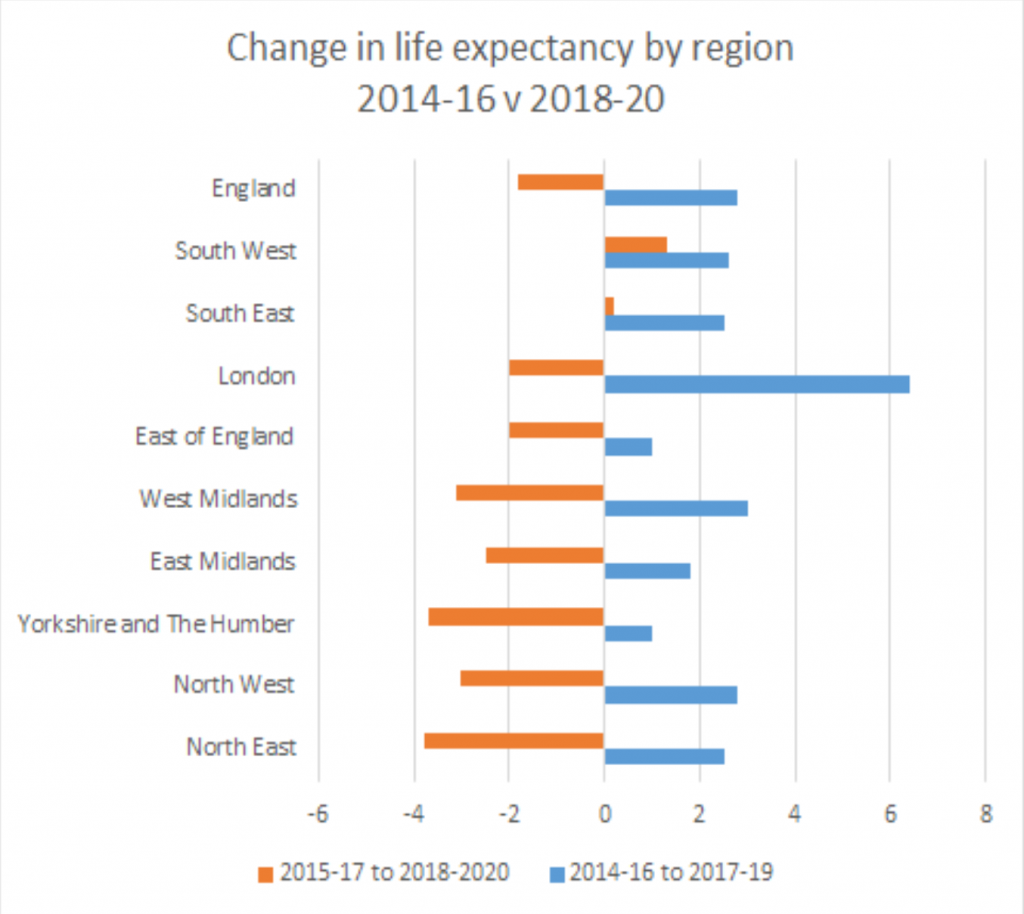
The chart below shows that, between 2014 and 2017, life expectancy was still rising in every region, but between 2015 and 2018 it fell in every region except the South East and South West. In the East a rise of 1 month in the earlier period was followed by a fall of 2 months.
Longer life doesn’t always mean healthy life
Furthermore, longer life does not always mean longer healthy life. Most of us spend some time at the end of our lives with serious disability or illness. In the last decade, the proportion of the average lifespan spent like this has been increasing. This is measured in terms of “healthy lifespan”, which does not differ significantly for men and women, both of who can expect, on average to spend 63 years in good health (all womens’ extra years of life are spent in poor health).
This is significantly worse than in comparable countries. Within the EU, in 2008, the UK ranked 4th for men and 3rd for women in healthy life expectancy. By 2016 both had fallen, to 11th for men and 14th for women.
The Imperial College study concludes that:
Life expectancy at birth, and at age 65, in the UK were increasing rapidly in 2008 but slowed around 2011. Germany, Portugal and France showed evidence of a similar slowing. Healthy Life Expectancy at birth in the UK decreased, whereas it increased in most EU28 countries. The UK experienced a period of absolute expansion of unhealthy life in both sexes. The reduction in Healthy Life Expectancy at birth in the UK was mainly attributable to increases in unhealthy life in younger age groups.
A further factor in this picture is the effect of Covid-19, which has caused a spike in deaths since the last full figures were published. However, the longer term pattern is unchanged, and the pressure which Covid-19 is putting on the NHS and social care will intensify the problems.
Where you live matters
Where you live has a major influence on how long you live. At its most extreme, the difference in average life expectancy at birth is nearly 13 years (from 87 for a woman in Westminister to 74 for a man in Blackpool). And this gap has widened since 2010. In places with high life expectancy, it continued to rise, while it fell in those areas where it was already shorter.
The falls are greatest, for both men and women, in areas with high levels of unemployment, low levels of qualifications, and poverty (one fifth of the population was already in poverty before Covid-19 struck).
What does it look like in East Anglia?
Although the Imperial College study is clear that the biggest differences are between the North and South of England, there is a lot of variation at the very local level.
In the Eastern region the gap can be as much as seven years. In 2020, before Covid-19 struck, the average 65 year old woman in South Cambridgeshire could expect to live for another 23 years, while the average 65 year old man in Fenland, Peterborough and Thurrock had only 15.
The recent changes are deepening the divide. In relatively prosperous areas, life expectancy has risen more rapidly. Between 2000 and 2018, average life expectancy for men at 65 rose by three years in North Hertfordshire, West Suffolk, Three Rivers (Rickmansworth), and Uttlesford (NW Essex). But, for women in Tendring, Harlow and Norwich, the rise was less than one year. The Imperial College study shows that this gap has widened still further in the last two years.
Reasons to be hopeful?
The massive difference in life expectancy between areas reflects deep inequalities in our society. The government has made much of its intention to “level up” the country, though the details remain vague. However, the focus has been mainly on improving life in the North of England. It is not clear that this will make any difference in East Anglia.
There are good reasons to think that things will get worse, not better. The gap between relatively prosperous rural areas and poorer urban ones is likely to grow, in the East as much as the rest of the country.
Poor people die younger, and the recent cut to Universal Credit is bound to increase overall poverty. Child poverty, which leads to poor nutrition, ill health, and poor educational outcomes, is storing up problems which will affect people’s life chances and health for decades to come. Shortages of doctors and nurses, and cuts to public health spending are all likely to result in declining health, and earlier death.
The changes we have seen in the last decade are unprecedented. Since the mid 19th century, the only time life expectancy has fallen was during the two world wars, and the UK’s problems now are worse than in comparable countries. This is a challenge which our politics needs to face.
Are you feeling lucky?



