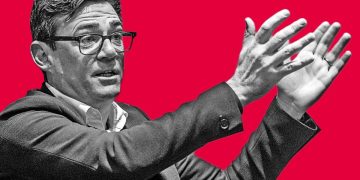
This week we have seen Andy Burnham make two dramatic decisions, both major initiatives and pearl-clutchingly controversial: a delay at least in introducing the planned local government re-organisation, and the change of policy on Israel and the settlements.
They appear on the face of it to have little in common, but here your diarist would disagree. They may address different audiences and different spheres, but they both seem to tell us much about the new prime minister.
We desperately wanted Mr Burnham to bring succour to a nation huddled in almost Balkan misery: introducing hope, having the people believe politics really can be a force for good. (His continued high standing in the polls suggests he has yet to disappoint.) Given the nation’s prevailing cynicism, he appears like the last survivor of a forgotten priesthood. His revanchist ideas suggest we have gone wrong over the past 20 years, and contests that had seemed rained off years ago it seems might be replayed.
The Pecksniff definition of a serious politician is one who tries to find solutions to problems, instead of kicking them into the long grass for some other poor bugger to deal with. So on that basis, Mr Burnham qualifies. Beyond that frequent smiley persona of a clergyman at a school treat, he seems to ‘get’ what by now is running like poison through the bloodstream of the voters: that for years our politicians have invariably taken the cheapest and the easiest way, the mealiest-mouthed and don’t-rock-the-boat approach, shedding our values as we go.
Remember Keir Starmer’s acolytes repeating parrot-like the mantra of taking “tough decisions”, no doubt quoted verbatim from the memo, when we all knew they were simply pursuing the same safe course as all their predecessors? Rachel Reeves in her first budget repeating what every chancellor since Robert Peel has said, and what any voter could have predicted. Tough? It was doing the easy thing. The obvious and the safe thing, the expected thing, the thing that solves nothing. It leaves us with the misery and the lack of hope, but has the merit of not frightening the horses.
Would we think better of him if he had stuck to the morally cynical position on the settlements, or pushed ahead with a councils re-organisation he didn’t believe in? Wouldn’t it be more scandalous if he signed off on a huge policy initiative which he was sure would fail?
*

Mr Burnham makes no bones about how he intends to pursue actual principles – as rare as unicorns in British politics over the past 20 years. In the case of the Israeli settlements, he has chosen simply to follow international law. The fact that this itself is the subject of such controversy, and the cynical nature of the criticisms it has attracted, should tell us all we need to know.
On local government reorganisation, it is hardly surprising that those who have spent the last couple of years trying to make the new scheme workable should be outraged. (The leader of East Suffolk Council, the estimable Councillor Caroline Topping, calls it “frankly scandalous”, and she might be forgiven since it has occupied her every waking hour for months.)
Mr Burnham had already hinted that he was not happy with the new plan. Remember, at the heart of the reforms he seeks is a dramatic devolution of power. It would be surprising if any ideas of Keir Starmer would match the aspirations of Andy Burnham, so it must be likely he has other and more radical things in mind. We know he seeks empowerment of regional leaders to shape fiscal policy, and that the House of Lords should be replaced with an elected “Senate of Regions and Nations”.
Would the existing blueprint have served those objectives? Unlikely, but the easiest decision, the kind of decision we are all used to our politicians making, would have been to go with the flow, rubber stamp the status quo. When did we last have a PM who even admitted there was a long term, who genuinely wanted radical change?
Will the government’s review (following legal advice), which requires postponing the changes for our region, please all of the people? We’ll see.
*
The schisms within Reform continue to grow. On occasions it seems Nigel Farage (Clacton) has little connection: he picks and chooses how and when he will equate himself with his party. On other occasions, as when prominent members of the party exceed the acceptable boundaries of public discourse, he claims he can’t be expected to control how its members behave or express themselves. (Farage was “shocked” at the behaviour of jailed Nathan Gill, describing him as a “bad apple.”)
In the past, the media has colluded. Reform have been exuberantly promoted by cynical hacks for easy headlines, and power without responsibility could hardly have been made available on more advantageous terms. But at the moment, Mr Farage’s personal circumstances threaten to become increasingly uncongenial, he has less time to keep up the pretence of being a party leader, and it shows. Those personal difficulties mean that it is no longer so easy to slip into Reform leader mode when convenient. The party has recruited – sometimes reluctantly – several thwarted egos from the Tories, thwarted from failed attempts to become leader. And all of whom joined merely to inherit the Farage purple.
For Reform is his creature: Frankenstein Farage created it to do his bidding. Without him it will cease to exist in its present form. There is simply no way in which leadership can pass without bloodshed to become a Jenrick or Braverman or Tice or Yusuf or Anderson (don’t laugh) platform. Nor would there ever be the prospect of any of those mentioned donning the same successful jack-the-lad persona that has suckered in attracted his devoted following. The party would most likely split into fratricidal factions or simply disintegrate completely.
*
My dears, doesn’t the Reform conference seem eons ago now? Those joining the beau monde at that windswept and deserted old airfield after the Clacton election result, expecting who knows what Dionysian rites just four weeks later, were to be disappointed. The image of the conference will remain that of an angry old man hitting a young woman with his walking stick, while she is similarly assaulted by others and jeered at by Nigel Farage. There will probably be criminal prosecutions. It is quite possible this was not in the plan.
Nobody will recall a single policy announcement, however melodramatically expressed. Even poor Zia Yusuf was shouted down by the media melée while he was trying to explain that please sir he knew nothing of the Channel 4sting. Indeed not: as usual he was side-lined, and on this occasion he must be thankful for it.
*

This week Private Eye reports that the recent Farage Fest held in Essex (and reported at length by EAB) “flouted licensing rules and failed to get Tendring Council’s permission”. An interesting connection, though: Mr Farage’s campaign manager, Peter Harris, is Reform leader of Essex County Council and, er, also a member of Tendring Council.
*
What motivates the masked and black uniformed violent thugs who attacked police and RNLI crews earlier this week remains a closed book to your diarist, who has not the slightest inclination to riffle through its pages.
It might be easy to guess their motives though. It is much more difficult to explain those of the police. Their interpretation of ‘keeping the peace’ included allowing the self-styled “patriots” to invade a hotel to hunt down suspected asylum seekers – who actually turned out to be the terrified Pakistani Under-19s cricket team – allowing attacks on their own officers, and allowing protesters to threaten, intimidate and abuse RNLI staff.

Nor can we explain why it took the home secretary, Shabana Mahmood, four days to react. It is too glib to suggest she might feel her intrusion could reflect badly on her own immigration policies. Though it is tempting.
As it happens, we are just approaching the 90th anniversary of the Battle of Cable Street, on 6 October 1936. On that occasion too, it was the public who showed the courage, the moral sensibilities and the awareness of incipient danger to the country, rather than the government or police. The East End blocked Cable Street to Oswald Mosley’s fascist march, and much blood was spilled. It has become part of the left’s folklore.
“Breathes there a man so dead
Who was not, in the 30s, Red?”

*
Incidentally, Rupert Lowe (Gt Yarmouth) was proud to offer his public support to those masked ‘patriots’ demonstrating in Portsmouth and Southampton. Though oddly, last year he introduced an early day motion in the Commons calling for a ban on full face coverings.
*

Two weeks ago, Pecksniff explained the problems confronting the Greens arising from entryism. Members are proud of being a broad church, but like Labour before them, they find it difficult coming to terms with the idea they are inviting in many whose specific aim is to take over the party for their own ends.
Among them we might number Eleanora Folan, who your diarist featured; but now we learn she has been suspended – though in accordance with practice the party will not disclose on what grounds.
Better news for the leadership though, in Zack Polanski’s success in being chosen to fight the Holborn and St Pancras by-election. The result will be fascinating. With much of that vaunted new ground lost again, Mr Polanski dearly needs a win.
*
The public’s antipathy to people dressed up as toy soldiers and beating up policemen is reflected in the polls. Back in May, Nigel Farage was seen by many more people as a potential PM than Kemi Badenoch (NW Essex). But now it’s even. Mr Farage’s prevarication between supporting the thugs and declaring they have gone too far has cost him. (An online poll this week for the Clacton and Frinton Gazette claims eight out of 10 of the1001 readers who responded believe he should resign.)
But Ms Badenoch still out-sells her party, who regularly record alarmingly low scores in local elections. Her shadow cabinet are quite remarkably charisma-free. ‘Half man, half porridge’ might apply to most of them.
It is a challenge to take them seriously, which is likely to bring more difficulties before long. Pecksniff has written before about Prosper, a soi-disant “movement for the millions who want politics to match the ambition of the country”, but whose aim is clearly to seize back the Conservative Party from the crazies.
A glance at the Prosper team gives you a clue as to what they are about: David Gauke, Ruth Davidson, Amber Rudd, Andy Street, Gavin Barwell… Lurking there too are Ken Clarke and Michael Heseltine. They will shortly make an important policy announcement, apparently. So dear reader, let us imagine: after all these years, what possible cause could bring the band back together again?


Return to the EU, anybody?
Listeners at keyholes this week were JJ Jackson, Liz Crosbie, John Elworthy, Mark Popay, Malcolm Lynn, David Patey, Stace Richards, Helen Forte, James Porter and Kate Viscardi.
<<< Previous Pecksniff’s Diary
More from East Anglia Bylines


Friends of Bylines Network
There has never been a greater need for grassroots journalism that investigates the stories that really matter, holds power to account and champions the voices of everyday citizens. We are proudly powered by volunteers but what we do isn’t free.
STAND WITH US for independent, citizen-led journalism that makes democracy stronger, and you will even get some exclusive benefits.