• Contact
  • About
  • ISSN 3049-9771
  • Authors and editors
NEWSLETTER SIGN UP
East Anglia Bylines
Advertisement
  • HOME
  • News
    • Brexit
    • Health
    • Education
    • World
  • Politics
    • Local government
    • Justice
    • Activism
  • Climate
    • Environment
  • Lifestyle
    • Community
    • Culture
    • History
    • Humour
    • Property
  • Business
    • Development
    • Economics
    • Finance
    • Transport
    • Farming
  • ANGLIA
    • Bedfordshire
    • Cambridgeshire
    • Essex
    • Hertfordshire
    • Norfolk
    • Suffolk
  • Series
No Result
View All Result
East Anglia Bylines
Home News

Farage lashes out at YouGov as Reform’s poll lead fades

Nigel Farage has attacked YouGov – but the data suggests Reform’s support is falling across multiple polls

Prof Paul Whiteley by Prof Paul Whiteley
28 March 2026
in News, Politics
Reading Time: 7 mins read
A A
Farage looking worried

Image by Gage Skidmore via Wikimedia Commons (CC BY-SA 2.0)

Share on Bluesky

Nigel Farage has accused YouGov of being “deceptive” after the polling company consistently showed Reform with less support than other surveys. He has claimed the company broke transparency rules set out by the British Polling Council over how it presents headline figures. As a result, YouGov has agreed to publish more data in future.

The chart below compares Britain’s monthly voting intentions for Reform in a poll of polls derived from 14 different agencies, with voting intentions for the party from YouGov. The comparison runs from the start of 2025 to March 2026. At first glance, it appears that Farage is right – the YouGov data is below the poll of polls data for most of the time.

However, if we calculate the difference between the two series, the poll of polls average for Reform over the last 15 months is about 28% in voting intentions – for YouGov it is about 26%. This 2% difference is well within the margin of error associated with polling; what statisticians describe as “not statistically significant”.

Vote intentions for Reform, poll of polls and YouGov
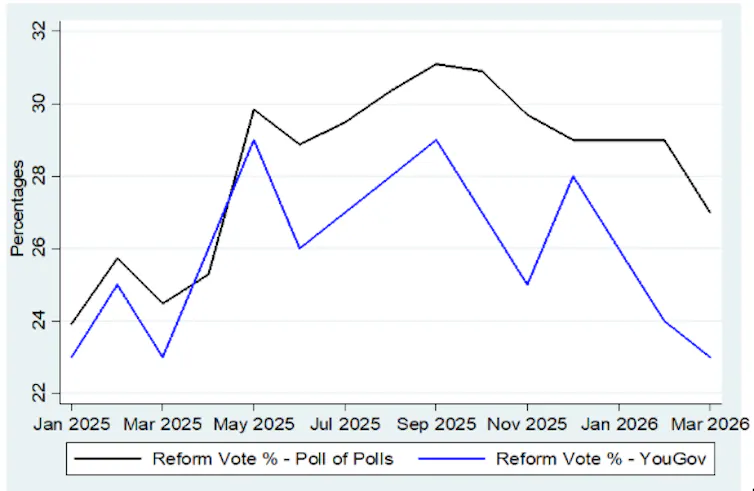
Chart comparing Reform's performance in poll of polls and YouGov
P Whiteley, Pollbase, CC BY-ND

The margin of error arises because polls try to measure support for the party across Britain from a survey of only 1,500 to 2,000 respondents. A good survey tries to replicate the diversity of the country in voting intentions, but it may differ from the country-wide support for the party because of random chance.

There is no real difference between the two series in the chart once this chance element is taken into account. If the survey has a truly representative sample, this random element can be ignored. But if there are problems with the sample, it will be inaccurate.

One such problem is accurately representing ethnic minorities in the sample, because they are less likely to respond to requests to do a survey. If a particular group is underrepresented, this can bias the results. To compensate for this problem, pollsters like YouGov use weighting, which involves giving more weight to some respondents than to others.

For example, the 2021 census shows that 4% of the population in Britain identifies as ethnically black. If only 2% of survey respondents fit this description, pollsters deal with this by counting these respondents twice in the analysis, which produces 4% black respondents.

Different agencies use different weighting schemes, which gives rise to variations in the answers they get to surveys. This is acceptable, providing these differences are not too large (not statistically significant).

Another factor may be the questions asked. This is where YouGov’s discrepancy arises.

YouGov has said it asks respondents first about general voting intention, and then specific constituency-level voting. This, the company says, takes account of tactical voting and is a more accurate representation of how a general election would play out.

There are clear differences between responses to the national and constituency questions – notably, more “don’t knows” in the latter, which means more uncertainty in the constituency responses.

My explanation of this is that when people are thinking about their own neighbourhood, they realise that voting involves a serious decision which can change their lives. When they respond to the national question, they are more likely to use it as a protest against the government and other parties.

Is Reform losing ground?

One reason Farage may be upset is because there is clear evidence that Reform is losing ground in the polls since the start of the year. This can be seen in the chart below, which shows a poll of polls of weekly voting intentions for the five major national parties in Britain since the July 2024 general election.

In the early weeks of 2025, Reform moved ahead of both Labour and the Conservatives – reaching 30% in vote intentions by May that year. The party’s support hovered around this figure until the start of 2026, when it began to decline. In October 2025, Reform was at 31% in voting intentions, but by March this year it was at 27%.

Vote intentions for the five major parties in Britain since the general election
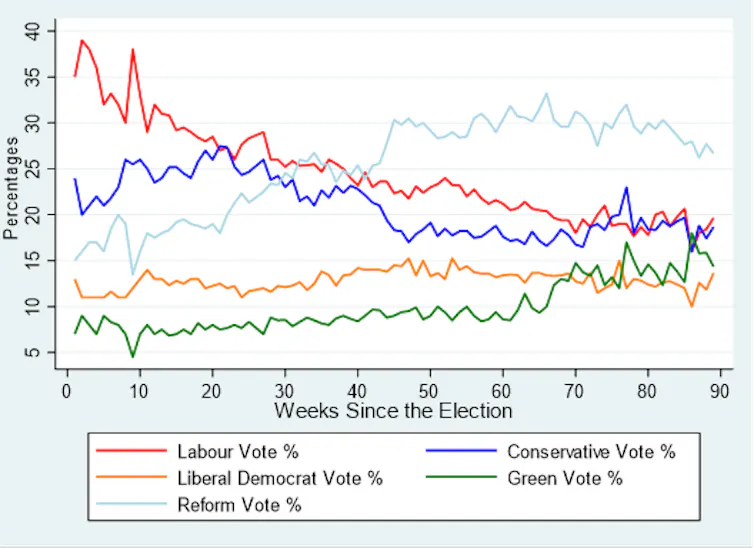
Chart comparing voting intentions for the five major parties since the general election
Voting intentions since the July 2024 general election. P Whiteley, Pollbase, CC BY-ND

Polling is important to all politicians, despite the fact that many criticise it if they appear to be losing ground. Farage is probably more attentive than most because Reform’s support has been so volatile over time – and what goes up can come down.

With its success in local government elections, Reform is now exposed to much closer scrutiny than it was in the past. Some news stories that may explain its now-declining popularity include Reform-controlled councils raising council tax after pledging to “reduce waste and cut your taxes”, and the party receiving the largest-ever political donation from a living individual in British history. Neither of these bode well for a party claiming to represent working-class voters.

Farage (along with Kemi Badenoch) may also be regretting his rush to support the US and Israel in their war against Iran. A recent poll showed that only 28% of UK respondents supported the war, while 49% opposed it.

In the past, Farage has claimed to be a close friend of Donald Trump, but he talks about this much less these days – the US president’s approval ratings are now very poor in the UK.

Both Reform and the Conservatives are on the wrong side of public opinion on this issue, something which is likely to haunt them in the May elections this year if the war continues to damage the economy.

The Conversation

This article is republished from The Conversation under a Creative Commons license. Read the original article.


Ipswich Town FC image by ITFC (CC BY-SA 3.0); Farage by Gage Skidmore (CC BY-SA 2.0). Both via Wikimedia Commons
Community

Anger over Farage visit could cost Ipswich Town promotion

by Peter Thurlow
25 March 2026
Image of Nigel Farage superimposed on an image of a broadcast news studio
Featured

Reform TV? GB News and the rules it keeps bending

by East Anglia Bylines
18 March 2026
Nigel Farage and Rupert Lowe in parliament. A "glitch" treatment has been done to the photo to signify breaking up or a schism.
Democracy

Orr, Farage, Lowe and the battle for Britain’s right

by The Bear
26 February 2026
Nigel Farage holding up a passport
Immigration

Farage wants to deport legal migrants in Britain

by The Bear
23 September 2025

Friends of Bylines Network

There has never been a greater need for grassroots journalism that investigates the stories that really matter, holds power to account and champions the voices of everyday citizens. We are proudly powered by volunteers but what we do isn’t free.

STAND WITH US for independent, citizen-led journalism that makes democracy stronger, and you will even get some exclusive benefits.

BECOME A FRIEND
Tags: Reform UK
Previous Post

Pecksniff: Ipswich Town’s downfall may give a hint as to Reform’s too

Next Post

Water, water everywhere: the climate challenge for Blickling Hall

Prof Paul Whiteley

Prof Paul Whiteley

After studying economics as an undergraduate at the University of Sheffield Paul Whiteley obtained Masters and Doctoral degrees at the University of Essex. After working in the US, Paul returned to Britain as a Professor of Politics at the University of Sheffield before moving to the University of Essex in 2001. His research interests are in electoral behaviour, public opinion, political economy and political methodology. He is the author or co-author of some 27 books on these topics and more than a 100 academic articles. He is an active blogger and broadcaster commenting mainly on contemporary British politics.

Related Posts

Four slightly tilted panels showing the headquarters of Essex, Cambridgeshire, Norfolk and Suffolk county councils, each identified by its council logo, against a textured grey background.
Anglia

East Anglia’s council shake-up is back on – but a year later

by East Anglia Bylines
4 November 2026
Man sitting on a bed looks into an empty wallet
Norfolk

How do you prepare for an emergency when you can’t afford the essentials?

by East Anglia Bylines
30 October 2026
Four schoolgirls wearing lab coats and safety glasses carry out a chemistry experiment in a science classroom.
Education

Where are the women? Scientists missing from school science

by East Anglia Bylines
29 October 2026
St John Ambulance first aiders at the 2014 London Marathon. One of the runners is sitting on the ground and St John Ambulance volunteers are talking to him. One is helping him to stretch a muscle in his right leg. The other runners are streaming around to the left of him and there are crowds behind barriers on the right.
Lifestyle

Funding essential services the competitive way

by Yasmin van der Poel
28 October 2026
French and Swiss customs desks side by side at EuroAirport Basel-Mulhouse-Freiburg, displaying the French and Swiss flags.
Brexit

The Swiss route to a closer relationship with Europe?

by Niall Ó Conghaile
27 October 2026
Next Post
Aerial view of the Blickling estate

Water, water everywhere: the climate challenge for Blickling Hall

SUPPORT OUR CROWDFUNDER

Tags

Activism Brexit Cartoons Christmas Climate Community Conservation Conservatives Democracy Economy Elections Environment EU Farming General Election 2024 Government Health History Housing Labour Letters Local government Net zero NHS Norwich Opinion Our place in Europe Party politics Pecksniff Politics Polling Pollution Poverty Reform UK Renewables Sewage Social care Something for the weekend Tax Trump Ukraine Voting Wealth Wildlife Women
East Anglia Bylines

We are a not-for-profit citizen journalism publication. Our aim is to publish well-written, fact-based articles and opinion pieces on subjects that are of interest to people in East Anglia and beyond.

East Anglia Bylines is a trading brand of Bylines Networks Limited which is separate to, but allied with, Byline Times.

Learn more about us

No Result
View All Result
  • About
  • Authors and editors
  • Complaints
  • Contact
  • Donate
  • Letters
  • Privacy
  • Network Map
  • Network RSS Feeds
  • Submission Guidelines
  • Download the Bylines Network App

© 2021-2026 East Anglia Bylines. Powerful Citizen Journalism. ISSN 3049-9771

No Result
View All Result
  • HOME
  • News
    • Brexit
    • Health
    • Education
    • World
  • Politics
    • Local government
    • Justice
    • Activism
  • Climate
    • Environment
  • Lifestyle
    • Community
    • Culture
    • History
    • Humour
    • Property
  • Business
    • Development
    • Economics
    • Finance
    • Transport
    • Farming
  • ANGLIA
    • Bedfordshire
    • Cambridgeshire
    • Essex
    • Hertfordshire
    • Norfolk
    • Suffolk
  • Series

Newsletter sign up

Crowdfunder

© 2021-2026 East Anglia Bylines. Powerful Citizen Journalism. ISSN 3049-9771
