• Contact
  • About
  • ISSN 3049-9771
  • Authors and editors
NEWSLETTER SIGN UP
East Anglia Bylines
Advertisement
  • HOME
  • News
    • Brexit
    • Health
    • Education
    • World
  • Politics
    • Local government
    • Justice
    • Activism
  • Climate
    • Environment
  • Lifestyle
    • Community
    • Culture
    • History
    • Humour
    • Property
  • Business
    • Development
    • Economics
    • Finance
    • Transport
    • Farming
  • ANGLIA
    • Bedfordshire
    • Cambridgeshire
    • Essex
    • Hertfordshire
    • Norfolk
    • Suffolk
  • Series
No Result
View All Result
East Anglia Bylines
Home Immigration

Who are England’s new Reform councillors?

Reform’s surge delivered hundreds of new councillors — and their views sit sharply right of England’s political mainstream

David Jeffrey by David Jeffrey
5 November 2025
in Immigration, Party politics, Politics
Reading Time: 6 mins read
A A
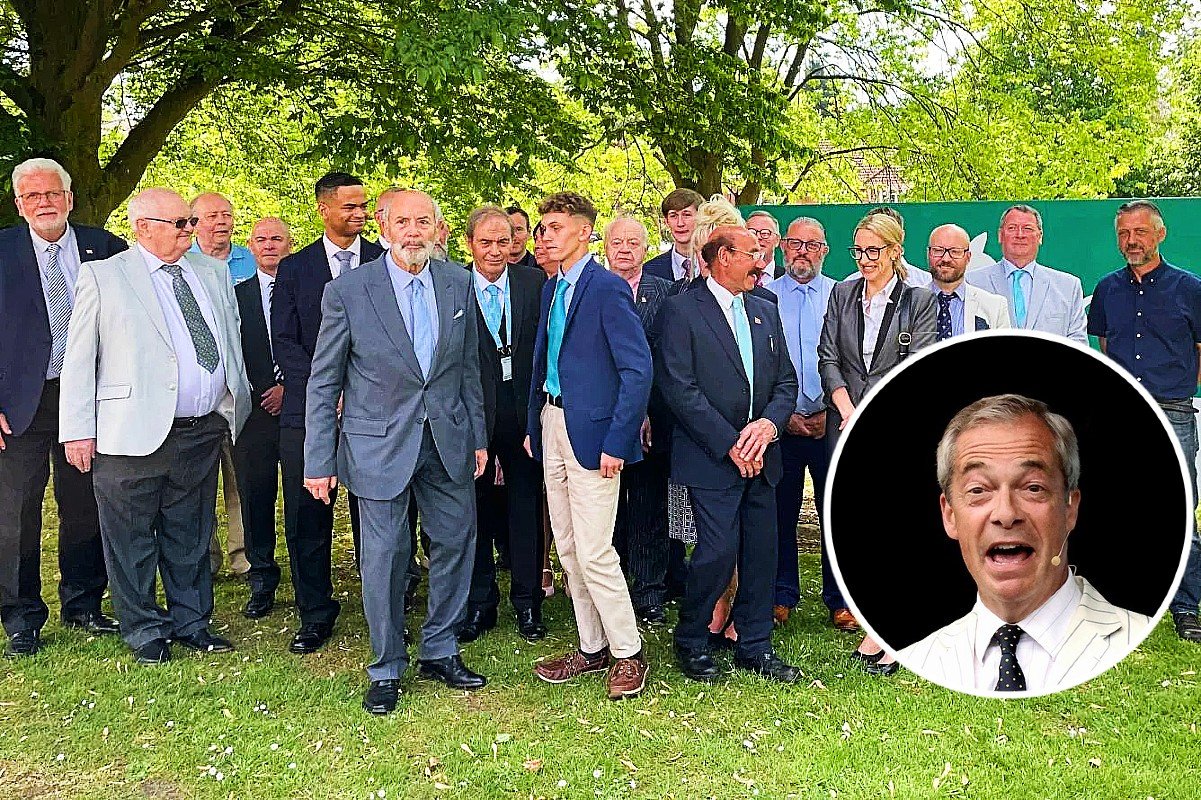
Group of Reform councillors with Nigel Farage inset

Composite image. Farage by Owain Davies via Wikimedia Commons (CC-BY-SA 4.0); Reform councillors by LDRS

Share on Bluesky

Reform UK has positioned itself as the voice of discontent in British politics – a home for voters who feel both Labour and the Conservatives have lost touch with ordinary people. Following elections in May, Reform is now a significant presence in local government with 921 councillors across England. The party pitched itself as an alternative to the traditional mainstream parties – we wanted to see whether this was actually the case on the local level.

We found Reform councillors to be less in favour of building in their local area and more interested in seeing government money spent on crime and policing than their colleagues from other parties.

The surveys

This research is based on survey responses from councillors across the four largest parties — the Green party, Labour, Liberal Democrats and Conservatives — which we conducted as part of our report What Do British Politicians Think? A study into the views of MPs, councillors, and the public. The survey was carried out between January and February 2025 and we then conducted a follow-up survey of Reform UK councillors after the May local elections. This ran between August and September.

We rated the councillors’ responses to some questions on a 0-1 scale. When asked about immigration, for example, a rating of 0 suggests the councillor thought immigration too low, and 1 that they thought it too high. On this issue, Reform UK scored 1 – every councillor surveyed thought immigration had been too high.

Conservative councillors were not far off, with a score of 0.97. Labour and Liberal Democrats were roughly equal at 0.6 and 0.59 respectively, leaning towards too high, whereas Green councillors were slightly more likely to say immigration had been too low, with a placement of 0.44. This reflects one of the key dividing lines in British politics today, but also suggests that the more pro-immigration messages pushed by Labour and the Liberal Democrats nationally may not be overly popular among their councillor bases.

A chart showing how councillors from different parties responded to questions on key issues.
Where councillors from different parties sit on various issues. D Jeffery, CC BY-ND

Labour councillors (perhaps reflecting the stated preferences of the party in government) were more in favour of ramping up building works than other parties. Tory and Reform councillors were more likely to oppose investment in large infrastructure projects in the UK if that also meant government borrowing had to increase significantly in order to fund them. Reform councillors were the most strongly opposed to a large increase in new housing in their area. The Conservatives and Greens were also more likely to be opposed while Lib Dems were somewhere in the middle. Labour councillors were, again, most in favour.

NHS, tax and spend, crime and policing

We found that 96% of Reform councillors think concerns over climate change have been exaggerated, compared to no Green councillors believing this (and just 3% of Liberal Democrat and Labour councillors). On whether the courts are too harsh, Reform councillors were most likely to say not harsh enough, followed by the Conservatives. The Greens are the least likely to say they are too harsh, whereas Labour and the Liberal Democrats are more toward the centre. On the issue of NHS provision, only the Conservative councillors leant towards privatisation. Reform followed behind but privatisation was still a minority view. The other parties all skewed towards maintaining public provision.

On tax and spend, the parties cluster more clearly – the Greens, Labour and Liberal Democrats want more tax and spending whereas the Conservatives and Reform both want a smaller state.

Asked in which areas the government should spend more money, the Conservatives and Reform councillors both selected the same top three areas (although not in the same order) – crime and policing, defence and education. Labour and the Liberal Democrats also chose the same three areas (again, not in the same order) – the NHS, local government and education. Green councillors chose the environment as the area most deserving of extra spending, followed by the NHS and with local government and education neck-and-neck.

Reform leads the rightward shift in town halls

Our polling suggests that a clear divide exists in local government along overlapping economic and cultural lines. Reform councillors typically take the most rightwing positions (except on the NHS), followed by the Conservatives, including on the tax and spend question. There is often little difference between Labour and the Liberal Democrats on the centre left/left, and then the Greens take the most leftwing position.

The one area where this does not hold up, however, is building. Here, the Greens become somewhat aligned with Reform and the Conservatives in their more sceptical views, whereas Labour and the Lib Dems are more in favour – reflecting tensions between environmental priorities, local preferences and economic growth.

The Conversation

This article is republished from The Conversation under a Creative Commons license. Read the original article.


More from East Anglia Bylines

Zia Yusuf, former Chair of Reform UK
Local government

Exposed: Reform UK doesn’t know how government spending works

by The Bear
6 June 2025
Close-up of Nigel Farage's face
History

Reform’s threat to the mainstream parties is unique in UK political history

by Martin Farr
30 May 2025
Cartoon of Nigel Farage standing in front of Number 10
Opinion

What would a Reform UK government mean for the UK economy?

by Martin Waller
5 August 2025
2 canvassers by the Newmarket sign holding Green Party posters
Democracy

Reform UK sell fear – now the Greens must fight back

by Mark Popay
9 September 2025
A newly excavated, muddy pond area containing a shallow pool of water, showing signs of recent conservation work. The clearing is surrounded by bare, turned-up brown earth, mature green trees, and low ground vegetation. In the background to the right sits a traditional black weatherboarded barn with a red tiled roof, separated from the clearing by a wooden fence.
Environment

Seven ponds set to reveal their hidden wildlife potential

by Rebecca Turner
8 November 2026

Download the Bylines app to get our content straight to your phone!

Get the app
Tags: Local governmentReform UK
Previous Post

Overcoming the legacy: what Rachel Reeves really said

Next Post

Letter to the editor: Every child’s ambition matters – whatever their background

David Jeffrey

David Jeffrey

David is a senior lecturer in British Politics at the University of Liverpool, with a PhD in Political Science from Queen Mary, University of London , His current research is around voting behaviour - from the perspective of the electorate and of MPs in leadership elections and key legislative decisions - alongside populism, local government, and party politics more broadly. His book on the causes of Conservative decline in Liverpool - Whatever Happened to Tory Liverpool? is available to download for free from the Liverpool University Press' website.

Related Posts

Four slightly tilted panels showing the headquarters of Essex, Cambridgeshire, Norfolk and Suffolk county councils, each identified by its council logo, against a textured grey background.
Anglia

East Anglia’s council shake-up is back on – but a year later

by East Anglia Bylines
4 November 2026
Around 20 demonstrators outside Princess of Wales Hospital, Ely. Their banner reads 'No Palantir in the NHS'.
Activism

⁠Palantir under fire: the battle over its NHS role

by Aidan Baker
26 October 2026
Climate demonstration. Poster reads 'there is no planet b
Climate

Are we being told enough about the ecological collapse?

by Cllr Gary Champion
25 October 2026
A person holds a small model house and a set of keys in their outstretched hands
Business

Why this Tory obsession with inheritance tax?

by Prof Richard Murphy
20 October 2026
Woman holding an EU flag beside a large yellow bus emblazoned ‘Bollocks to Brexit – It’s not a done deal!’
Brexit

Another referendum on the EU? You must be joking

by Peter Thurlow
16 October 2026
Next Post
Primary school children sitting on the floor as the teacher reads to them

Letter to the editor: Every child’s ambition matters – whatever their background

SUPPORT OUR CROWDFUNDER

Tags

Activism Brexit Cartoons Christmas Climate Community Conservation Conservatives Democracy Economy Elections Environment EU Farming General Election 2024 Government Health History Housing Labour Letters Local government Net zero NHS Norwich Opinion Our place in Europe Party politics Pecksniff Politics Polling Pollution Poverty Reform UK Renewables Sewage Social care Something for the weekend Tax Trump Ukraine Voting Wealth Wildlife Women
East Anglia Bylines

We are a not-for-profit citizen journalism publication. Our aim is to publish well-written, fact-based articles and opinion pieces on subjects that are of interest to people in East Anglia and beyond.

East Anglia Bylines is a trading brand of Bylines Networks Limited which is separate to, but allied with, Byline Times.

Learn more about us

No Result
View All Result
  • About
  • Authors and editors
  • Complaints
  • Contact
  • Donate
  • Letters
  • Privacy
  • Network Map
  • Network RSS Feeds
  • Submission Guidelines
  • Download the Bylines Network App

© 2021-2026 East Anglia Bylines. Powerful Citizen Journalism. ISSN 3049-9771

No Result
View All Result
  • HOME
  • News
    • Brexit
    • Health
    • Education
    • World
  • Politics
    • Local government
    • Justice
    • Activism
  • Climate
    • Environment
  • Lifestyle
    • Community
    • Culture
    • History
    • Humour
    • Property
  • Business
    • Development
    • Economics
    • Finance
    • Transport
    • Farming
  • ANGLIA
    • Bedfordshire
    • Cambridgeshire
    • Essex
    • Hertfordshire
    • Norfolk
    • Suffolk
  • Series

Newsletter sign up

Crowdfunder

© 2021-2026 East Anglia Bylines. Powerful Citizen Journalism. ISSN 3049-9771