• Contact
  • About
  • ISSN 3049-9771
  • Authors and editors
NEWSLETTER SIGN UP
East Anglia Bylines
Advertisement
  • HOME
  • News
    • Brexit
    • Health
    • Education
    • World
  • Politics
    • Local government
    • Justice
    • Activism
  • Climate
    • Environment
  • Lifestyle
    • Community
    • Culture
    • History
    • Humour
    • Property
  • Business
    • Development
    • Economics
    • Finance
    • Transport
    • Farming
  • ANGLIA
    • Bedfordshire
    • Cambridgeshire
    • Essex
    • Hertfordshire
    • Norfolk
    • Suffolk
  • Series
No Result
View All Result
East Anglia Bylines
Home Party politics

Why Reform isn’t being dented by its latest scandals

Nigel Farage is engaged in a very public spat with Rupert Lowe, one of his MPs. But it hasn’t dented Reform’s polling. Here’s why

Prof Paul Whiteley by Prof Paul Whiteley
14 March 2025
in Party politics, Politics
Reading Time: 7 mins read
A A
Reform UK MPs sitting in the House of Commons

Image by UK Parliament via Wikimedia Commons (CC BY 3.0)

Share on Bluesky

The spat between Nigel Farage, leader of the Reform Party and MP for Clacton, and Rupert Lowe, the MP for Great Yarmouth, burst into the open when Lowe was suspended from the party. The allegation was that he had threatened violence to the party leadership, which he denies. The matter is currently being investigated by the police.

The row does not appear to have affected support for Reform in the polls. A YouGov poll completed on March 10, after Lowe’s suspension, shows Reform on 23% in vote intentions, compared with 24% for Labour and 22% for the Conservatives. It is still a three-party race at the top of British party politics.

In the 2024 general election a good deal of Reform’s support came from protest voters. These are voters who dislike all the mainstream parties and so see a vote for the party as a way of choosing “none of the above”. They are not attached to any party and can easily switch support when circumstances change. So why has support for the party not been affected by this row?

Protest politics and support for Reform

The answer to this question is that while Reform attracted a lot of discontented protest voters in the election, it has since acquired a more stable niche in British party politics. It is primarily a party of English nationalism, equivalent to the SNP in Scotland and Plaid Cymru in Wales. These three parties differ greatly in outlook and politics, but they occupy a similar place in the public’s minds.

To examine Reform’s support from protest voters we can look at the relationship between spoilt ballots in the 2024 general election and support for the party in the 632 constituencies in England, Scotland and Wales. Normally, observers of British elections pay little attention to spoilt ballots (or “invalid votes” as they are described in official statistics). However, it turns out that they played an important role in the 2024 election which has a bearing on support for Reform.

Research shows that voters who spoil their ballots can be classified into two categories: those who simply make a mistake when filling in the ballot and those who are protesting about the current system.

Mistakes are easy to make in countries with complex electoral systems. However, in Britain, the first-past-the-post system in which everyone has just one vote, ensures that this is not a significant factor because ballot papers are so simple. The bulk of spoilt ballots are protests of various kinds, taking the form of blank ballots, write-in candidates, or abusive messages about parties and candidates.

This is illustrated in the Lancashire seat of Chorley, which is held by the speaker of the House of Commons, Lindsay Hoyle. By tradition none of the major parties challenge the Speaker by campaigning in his constituency. In the election there were no less than 1,198 spoilt ballots in his constituency. It is fairly clear that these were a result of some voters feeling disenfranchised by the absence of their preferred party on the ballot paper.

The relationship between the Reform vote share and the number of spoilt ballots in constituencies in the 2024 election

A chart showing that Reform voting was higher in areas with fewer spoilt ballots in 2024.
Protest voting takes different forms. P Whiteley, CC BY-ND

There is a strong negative relationship (a correlation of -0.46) between the share of a constituency vote that went to Reform in 2024 and the number of ballots spoiled in that constituency. Where people were voting Reform, in other words, fewer people were spoiling their ballots. The implication is that the party picked up votes from people who would normally spoil their ballots or would not have voted at all if Reform had not stood in their constituency. These are the protest voters.

Identity politics and support for Reform

Not all support for Reform came from protest voters, however. The chart below compares the percentage of Reform voters with those who identified as English in the 2021 census in England. There is a strong relationship between the two measures (a correlation of 0.66). The more English identifiers there are in a constituency, the greater support for Reform. In effect, Reform has become an English national party.

The relationship between Reform voting and English identity in 2024
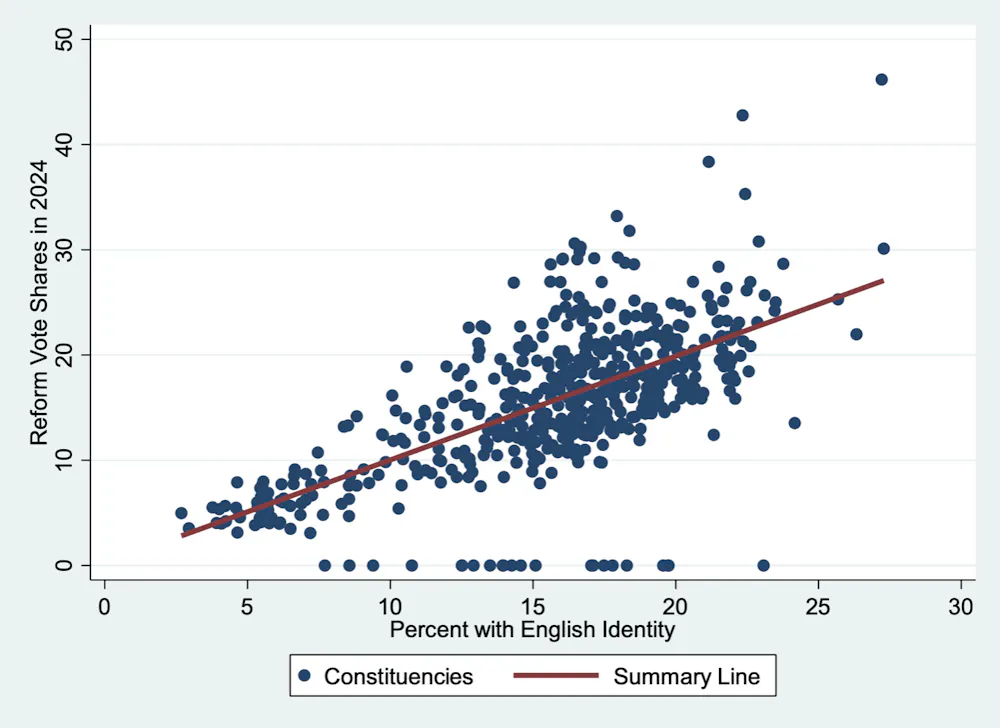
A chart showing that Reform voting is correlated with English national identity.
An English national party in the making. P Whiteley, CC BY-ND

National identities can change over time, but the process of change is slow. There has been a growth in “Englishness” at the expense of “Britishness” over time and this is undoubtedly reinforcing support for Reform.

It means the party has a relatively solid base of supporters to rely on in future elections. While the row between the party’s leader and one of his MPs could play out in any number of different directions at this early stage, it would be wrong to suggest that Reform isn’t thinking big picture and long term.

Farage has clearly learnt from his past and will not let his current party disintegrate into chaos like UKIP or the Brexit party before it.

The Conversation

This article is republished from The Conversation under a Creative Commons license. Read the original article.


More from East Anglia Bylines

Young woman holding a placard that says "We demand democracy"
Democracy

Young people don’t want dictators: they want government that works

by Prof Bobby Duffy
9 March 2025
A pylon in the middle of a housing estate, sits on an island in a residential road
Anglia

Essex, Suffolk, Norfolk pylons: £250 energy bill sweetener derided as ‘patronising’

by Piers Meyler, Local Democracy Reporter
11 March 2025
Image by Rupert Lowe. Used with permission
Democracy

Rupert Lowe: Great Yarmouth is a ‘priority’ after Reform spat

by Owen Sennitt, Local Democracy Reporter
12 March 2025
Composite photo of Great Yarmouth with a portrait of Rupert Lowe.
Letters

Rupert Lowe MP and the Great Yarmouth Mercury

by East Anglia Bylines
2 March 2025
Infographics from Easyfundraising

We are registered with easyfundraising! 8,000 brands will donate to us for free every time you use it.

It’s super quick and easy to SIGN UP, and will never cost you anything whatsoever. It’s FREE for you and HUGE for us!

Tags: Reform party
Previous Post

Address by Claude Malhuret to the French Senate

Next Post

Pecksniff: ‘There is no enemy like a friend betrayed’: American power is gone for good

Prof Paul Whiteley

Prof Paul Whiteley

After studying economics as an undergraduate at the University of Sheffield Paul Whiteley obtained Masters and Doctoral degrees at the University of Essex. After working in the US, Paul returned to Britain as a Professor of Politics at the University of Sheffield before moving to the University of Essex in 2001. His research interests are in electoral behaviour, public opinion, political economy and political methodology. He is the author or co-author of some 27 books on these topics and more than a 100 academic articles. He is an active blogger and broadcaster commenting mainly on contemporary British politics.

Related Posts

Four slightly tilted panels showing the headquarters of Essex, Cambridgeshire, Norfolk and Suffolk county councils, each identified by its council logo, against a textured grey background.
Anglia

East Anglia’s council shake-up is back on – but a year later

by East Anglia Bylines
4 November 2026
Around 20 demonstrators outside Princess of Wales Hospital, Ely. Their banner reads 'No Palantir in the NHS'.
Activism

⁠Palantir under fire: the battle over its NHS role

by Aidan Baker
26 October 2026
Climate demonstration. Poster reads 'there is no planet b
Climate

Are we being told enough about the ecological collapse?

by Cllr Gary Champion
25 October 2026
A person holds a small model house and a set of keys in their outstretched hands
Business

Why this Tory obsession with inheritance tax?

by Prof Richard Murphy
20 October 2026
Woman holding an EU flag beside a large yellow bus emblazoned ‘Bollocks to Brexit – It’s not a done deal!’
Brexit

Another referendum on the EU? You must be joking

by Peter Thurlow
16 October 2026
Next Post
Graffiti on a wall in Calgary, Canada reads: "There is no enemy like a friend betrayed" with an American flag in a red circle with a red line through it.

Pecksniff: ‘There is no enemy like a friend betrayed’: American power is gone for good

SUPPORT OUR CROWDFUNDER

Tags

Activism Brexit Cartoons Christmas Climate Community Conservation Conservatives Democracy Economy Elections Environment EU Farming General Election 2024 Government Health History Housing Labour Letters Local government Net zero NHS Norwich Opinion Our place in Europe Party politics Pecksniff Politics Polling Pollution Poverty Reform UK Renewables Sewage Social care Something for the weekend Tax Trump Ukraine Voting Wealth Wildlife Women
East Anglia Bylines

We are a not-for-profit citizen journalism publication. Our aim is to publish well-written, fact-based articles and opinion pieces on subjects that are of interest to people in East Anglia and beyond.

East Anglia Bylines is a trading brand of Bylines Networks Limited which is separate to, but allied with, Byline Times.

Learn more about us

No Result
View All Result
  • About
  • Authors and editors
  • Complaints
  • Contact
  • Donate
  • Letters
  • Privacy
  • Network Map
  • Network RSS Feeds
  • Submission Guidelines
  • Download the Bylines Network App

© 2021-2026 East Anglia Bylines. Powerful Citizen Journalism. ISSN 3049-9771

No Result
View All Result
  • HOME
  • News
    • Brexit
    • Health
    • Education
    • World
  • Politics
    • Local government
    • Justice
    • Activism
  • Climate
    • Environment
  • Lifestyle
    • Community
    • Culture
    • History
    • Humour
    • Property
  • Business
    • Development
    • Economics
    • Finance
    • Transport
    • Farming
  • ANGLIA
    • Bedfordshire
    • Cambridgeshire
    • Essex
    • Hertfordshire
    • Norfolk
    • Suffolk
  • Series

Newsletter sign up

Crowdfunder

© 2021-2026 East Anglia Bylines. Powerful Citizen Journalism. ISSN 3049-9771