


The Sunday long read
One of the key policies announced at this year’s Labour Conference was a plan to build 1.5 million homes. And unlike recent housing policies, much of it would be in ‘new towns’, rather than by adding more housing to existing communities. Past generations of new towns were the creation of Labour governments. Is that what they are planning now?
The Labour legacy
The term ‘new town’ has a particular resonance for the Labour movement. It was first used by the Attlee government for the new towns they planned in the aftermath of the Second World War, to house an expanding population and overspill from bombed cities. Although much of the building happened under the Conservatives, all were created by Labour governments. In 2017 the Town and Country Planning Association marked the 70th anniversary of the movement with Celebrating 70 years of the New Towns Act.
In all, 22 new towns were created in England, and they now house 2.5 million people. The first was Stevenage, in 1946, and in the 1960s, a final wave included Peterborough and Milton Keynes. Because of proximity to London the first wave included six towns in the East of England: Stevenage, Hemel Hempstead, Harlow, Welwyn Garden City, Hatfield and Basildon.
A single planning authority

Faced with an urgent housing crisis (rather like today), the Attlee government decided that the task of building a new town was too large and complex, and perhaps politically sensitive, for conventional local authorities, and planning processes. So they created independent development corporations with a remit to plan coherent, mixed, and sustainable communities, including housing, shops, surgeries, schools and community centres.
Corporations were created under normal planning processes, but once designated, they had greater powers than local authorities. They were funded by 60-year repayable loans from central government. They could acquire land (through compulsory purchase where necessary) and reinvest resources generated as the towns developed, which meant that they were financially successful: Harlow paid its loan off in 15 years.
Because they were buying land at current (usually agricultural) value, any increase in value from development went to the Corporation to reinvest, not to builders or shareholders. Once the Corporation’s masterplan had been approved by the Minister, work could go ahead without the delays which typically affect planning proposals.
Communities, not dormitories
However, in 1980 the Conservative government dissolved the development corporations, and sold off the assets, leaving the local authorities with responsibilities for maintenance and further development, but without access to some of the income which had previously paid for them. This is a particular problem because the early new towns were built at a time of shortages of good building materials, leading to expensive ongoing maintenance costs. As a result, the physical structure of many of the towns, and especially town centres, has deteriorated. The exception is Milton Keynes, where the assets had been put into a trust for community benefit, and as a result it is now in better condition.

The plan was that new towns would be integrated communities, not simply dormitories for neighbouring cities. Although many were in what would now seem easy commuting distance of London, it was expected that most people would work locally. Many towns had one or two major employers: Ford in Basildon, Nissan in Washington, Gatwick in Crawley. In Hatfield the major employer was the DeHavilland aircraft factory, which built the Comet airliners.
To support this, Hatfield was home to one of the very few Secondary Technical Schools planned as part of the Butler Education Act of 1944. In the early years some towns had a very active civic life, with community groups based around the sense of being part of a pioneering social experiment. Unlike many modern housing developments, architects and planners sometimes lived in the towns they built.
Because the corporations could acquire large tracts of land, it was possible for new towns to incorporate much more green space than current housing developments. Stevenage prided itself on its pedestrian routes, enabling people to walk or cycle to shops and community facilities free of traffic. They were the forerunners of today’s ‘20-minute communities’.
Each town was divided into neighbourhoods, each with its own community facilities, primary schools, shops, surgeries, playgrounds and churches. A large proportion of housing, especially in the first wave of towns, was for rent, with priority going to people employed locally.

There were weaknesses in the model. In many of the new towns, roads and parking were designed for the relatively low levels of car ownership which applied at the time. As car ownership increased, narrow roads, limited garages and parking space led to congestion.
The creation of large quantities of family housing at one time inevitably led to demographic problems. Some of the schools needed quickly for the first generation of young families to arrive later proved surplus to requirements, and some were adapted for other community purposes. At the same time the age profile of the first residents meant accommodation for old people was limited.
Innovation
The new town architects were encouraged to innovate, with unusual house designs and more variety than in many of the large council estates built at the same time. They pioneered pedestrian zones and cycleways. Hatfield experimented with poured reinforced concrete walls. Washington tried district heating.
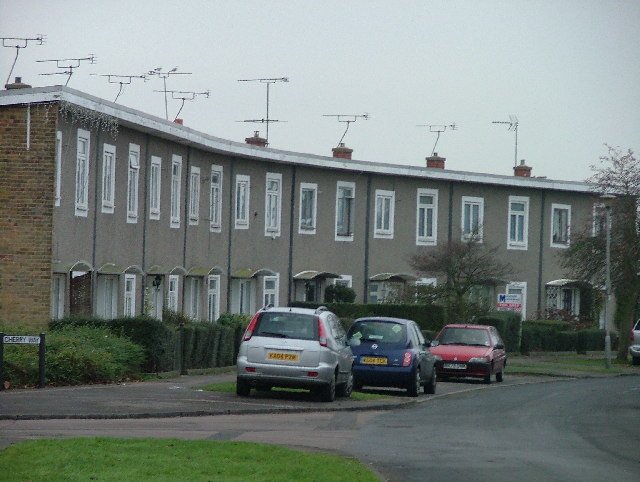
Time was always pressing. Primary schools camped out in colleges while they waited for building to finish. In Washington, where housing was built on the site of a former coal mine, cracks occasionally opened in the ground, revealing still smouldering remains of mining spoil below.
Not all the innovations were a success. In Hatfield, on one famous night in 1957, a storm lifted the sheet metal roofs off whole terraces of houses, leaving people in their beds looking at the sky, with their roofs wrapped round trees.
What does Labour plan now?
Despite these problems, Labour has a good story to tell. In very difficult circumstances, they built a lot of housing and created successful, mixed communities where many people thrived. Had the original funding model been sustained, they would probably look healthier now than they do. Especially in the first wave, they rescued many people from desperate urban living conditions.
There are many now in similarly poor and overcrowded housing. So, could Labour repeat the act? The Town and Country Planning Association has been considering these issues and has put forward some proposals for legislation.
Assuming that Starmer aims to revive the Labour legacy, what are the challenges he faces? There are a number of questions we can ask.
- Finding locations is one. Where will these towns be built? The initiative probably comes from local authorities, but individual authorities are usually too small to accommodate a new town, so some form of collaboration will be necessary. You need a large amount of undeveloped land with decent communications, and with a good prospect of substantial local employment. Starmer has also talked about “grey belt” land: the parts of the existing green belt which are not really “green”. But you can’t build a town on a redundant factory site or a couple of abandoned car parks.
- Will the Development Corporations have the remit to undertake large scale, long term, coherent planning (the legislation for Development Corporations is currently being overhauled in the government’s Levelling Up and Regeneration Bill). How will their remit be updated, to take into account factors not considered when the original (still existing) legislation was drafted? This would include factors such as environmental sustainability, new forms of transport, and home working.
- How will the new structures relate to existing local authorities, and to the plans for devolution of powers to local authorities and mayors?
- How to secure, or overrule, local consent. Not everyone in an area will welcome the transformation. Stevenage was designated with a plan to grow the population tenfold. When the Minister visited in 1946 half the existing population turned out to protest. Even if consent in principle is possible, people are understandably sceptical about the provision of adequate health and transport facilities. So, a model of governance and business which ensures adequate community engagement, infrastructure and community facilities is essential.
- How will they be funded? The original new town model of 60-year repayable government loans would appear to fit with Labour’s fiscal rule to borrow only for investment. If that is the route, can they avoid the problems that arose later, when the New Towns Commission was abolished in the 1980s.
- How will the price of land be set? The original new towns acquired the land at current (usually agricultural) value, so any increase in value from the development went to the corporation. More recent planning law has recognised ‘hope value’: the idea that a landowner could expect the value to rise because of development. That makes funding more difficult.
- What proportions of housing would be private, ‘affordable’ and social, and would the right to buy apply to tenants? It is unlikely that the proportion of rented accommodation will be as high as it was in the 1950s and ‘60s. Would previous new town housing policies to prioritise key workers and local employees continue to apply to tenancies, and/or purchases?
- What will be the role of private developers? Much of the building of the original new towns was done by the development corporations themselves. Now it is likely that there will be much more involvement of private developers. How will they mesh into a fundamentally public-sector model of development?
There are no doubt other pressing questions to answer. Labour’s ambition is large, certainly by comparison with recent years’ house building. If they are going to achieve this, they will need answers to these questions.
Stephen McNair has personal experience of five new towns. He grew up in Hatfield in the 1950s.
He has lived in Washington, and Crawley, and was later responsible for services in Harlow and Basildon.



