


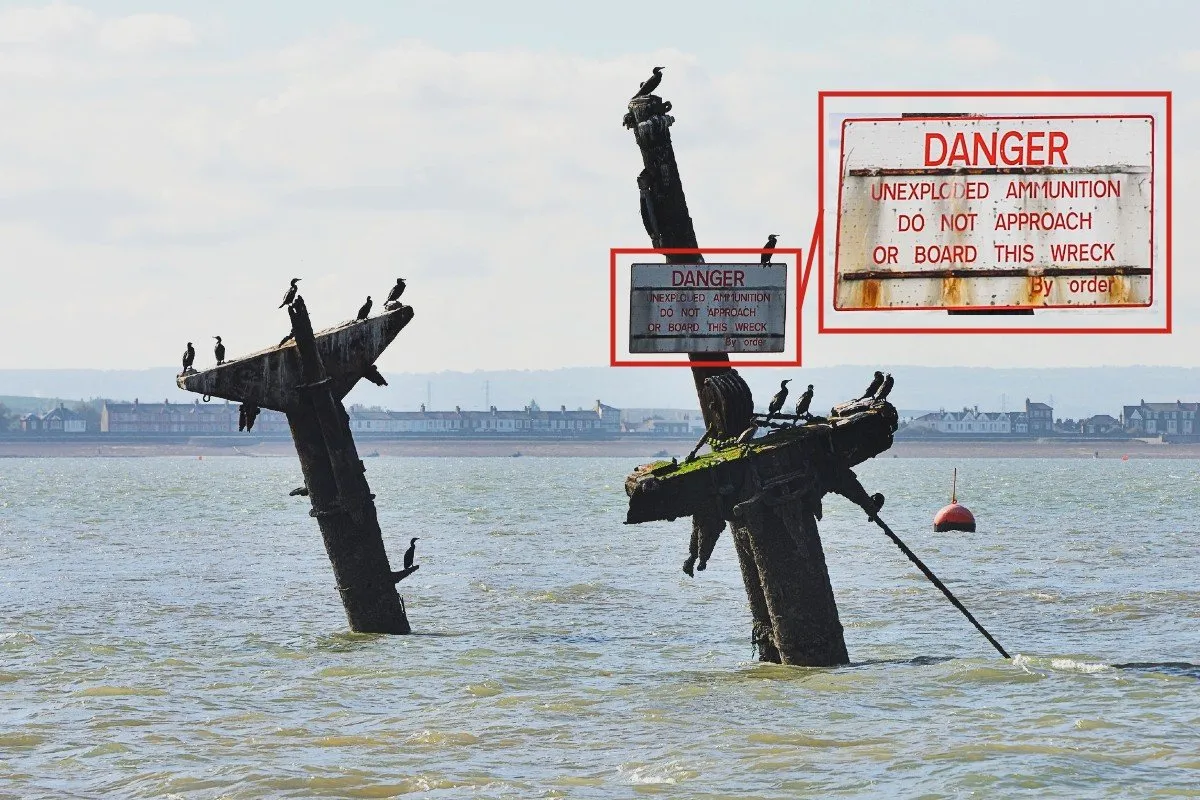
The River Thames is full of mysteries and legends, landmarks and attractions. From defensive forts that have become self-proclaimed principalities, to the famous arcades and pier in Southend. The Thames also has many shipwrecks, each with a story to tell. One is the bomb ship SS Richard Montgomery.
The story of the SS Richard Montgomery is akin to the shipwreck itself, often obscured with only faint clues to its presence. Sometimes the tide of indifference subsides and a new generation becomes aware of it, whilst others get to hear the ominous story being retold.
An explosive shipwreck
For those who do not know the story, the SS Richard Montgomery was a United States Liberty Ship. It was transporting explosives from the USA, to use in the war against the Nazis. She ran aground and broke her back off the Kent coast in August 1944. Salvage crews were able to remove 5,000 tons of explosives after the wreck. But they had to abandon the attempt, leaving 1,400 tons still on board.
The wreck still has enough ammunition and bombs on board to warrant an exclusion zone. If more bad luck were to befall the wreck, the resulting explosion could be the largest man made non-nuclear explosion in human history.
This source of a potential explosion – larger than the devastating blast in Beirut in 2020 – is located just five miles away from, and directly opposite to, the million-pound houses in the Thorpe Bay area of Southend, and even closer to the residents of Sheerness in Kent.
Worst-case scenario
Experts disagree about the level of risk. Decay may have made the materials less dangerous – or perhaps more so. However, if they were to detonate in a chain reaction, then the results could be devastating. A parliamentary report in 1970 suggested that it ‘would hurl a 300 metre wide column of water, mud, metal and munitions almost 3,000 metres into the air, risking not just wildlife but the lives of many people.’
Mud would fall onto Sheerness like marshmallow at the end of Ghostbusters, with the explosion likely damaging all buildings in the town. The nearby Isle of Grain is home to storage tanks holding a million cubic metres of liquefied natural gas. Across the estuary windows would be smashed in Southend and likely even further inland. There would be property damage, disruption and injury.
The explosion could launch a tsunami up to 5 metres high. It would travel up the Medway towards Rochester and Chatham, across the estuary to Southend and Canvey Island. There would be major contamination issues, disruption to essential shipping, and chaos for the local fishing industry.
Balancing probabilities
To be clear, the above scenario is what would happen if a series of unfortunate events were to all occur. It is highly unlikely. It requires something to trigger an explosion, all the explosives to be suitably unstable, and a chain reaction to make all the other explosives detonate in quick succession. One of the limiting factors is that some of the explosives do not have detonators installed.
Whilst it is not possible to calculate the probability of that scenario, it is possible to show what could happen if a small part were to detonate, either due to a structural failure of the wreck itself, or an accident.
So whilst the risk of the whole cargo detonating is still low, even 10% of it would be dangerous.
Surveys that showed the SS Richard Montgomery was deteriorating prompted the authorities to take action in 2020.
SS Richard Montgomery mast removal
The Department of Transport awarded a contract for the removal of the ship’s masts, as they were in danger of falling into the cargo holds and detonating the explosives.
This work was planned in 2020 but has been repeatedly postponed. Most recently it was due to a number of unknown objects found close to the masts. A Department for Transport (DfT) spokesperson said: “Our priority will always be to ensure the safety of the public and reduce any risk posed by the SS Richard Montgomery.”
Professor David Alexander from University College London is an expert in risk and disaster reduction. He has studied the SS Richard Montgomery in detail. He told the BBC recently that “I think over the last 77 years the government has thought to itself ‘well, the longer we leave it, the safer it gets’, It appears if you talk to experts in explosives, that is the opposite of the truth.”
Will the risk of the bomb ship SS Richard Montgomery continue to be told to future generations by the residents of Essex and Kent as it sleeps silently beneath the waves?
Or will the story come to a sudden, frightening, conclusion as the monster wakes in full might?
More Thames coastal heritage from J.J. Jackson





