• Contact
  • About
  • ISSN 3049-9771
  • Authors and editors
NEWSLETTER SIGN UP
East Anglia Bylines
Advertisement
  • HOME
  • News
    • Brexit
    • Health
    • Education
    • World
  • Politics
    • Local government
    • Justice
    • Activism
  • Climate
    • Environment
  • Lifestyle
    • Community
    • Culture
    • History
    • Humour
    • Property
  • Business
    • Development
    • Economics
    • Finance
    • Transport
    • Farming
  • ANGLIA
    • Bedfordshire
    • Cambridgeshire
    • Essex
    • Hertfordshire
    • Norfolk
    • Suffolk
  • Series
No Result
View All Result
East Anglia Bylines
Home REGIONS Anglia

How East Anglia helped build Formula One

The British Grand Prix celebrates Formula One's biggest names, but some of the sport's greatest pioneers came from East Anglia

Stuart Burrell by Stuart Burrell
3 July 2026
in Anglia, Featured, History
Reading Time: 9 mins read
A A
Lewis Hamilton racing during the 2024 British Grand Prix

Lewis Hamilton (Mercedes), 2024 British Grand Prix, Silverstone. Image by Jen Ross via Wikimedia Commons (CC BY 2.0)

Share on Bluesky

Formula One celebrates its drivers like few other sports: the helmet, the cockpit, the split-second drama played out at more than 200mph. The sport is closely associated with Silverstone and Britain’s so-called Motorsport Valley, home to many of its leading teams. But the modern championship was shaped by far more than the men behind the wheel. East Anglia’s influence reaches into almost every corner of Formula One, from the drivers who raced to the engineers who transformed the cars, and the businessmen who helped turn Formula One into a global spectacle.

Portrait of George Russell at Silverstone
George Russell at Silverstone. Image by Jen Russ via Wikimedia Commons (CC BY 2.0)

The region has supplied a number of world-class drivers, from Martin Brundle and Johnny Herbert to Perry McCarthy, with the latter better known to many as the original BBC Top Gear Stig. Their achievements helped prepare the ground for more recent East Anglian talents such as Alex Albon and George Russell – who won last week’s Grand Prix in Austria.

Yet, when the crowd begins to gather and the engines roar at Silverstone this weekend, our attention naturally turns to the starting grid and the names that have become almost mythic in motor sport: Mercedes, Ferrari and Honda. It’s easy to overlook the quieter stories that helped shape the sport we see today.

Bernie Ecclestone: the dealmaker

Bernie Ecclestone in Sao Paulo
Image by Governo do Estado via Wikimedia Commons (CC BY 2.0)

Among the things often overlooked is how Formula One came to be watched, sold and organised. In the late 1970s, the television rights to Formula One were acquired by Bernie Ecclestone, then managing the Brabham racing team. Before that, he had managed drivers, among them Jochen Rindt, the 1970 Formula One drivers’ champion.

Ecclestone was born in St Peter South Elmham, Suffolk, before moving to London. Through the Formula One Constructors Association, he became involved in the administration, logistics and the commercial side of the sport, exerting an influence that would reach into almost every Grand Prix weekend.

Even without Ecclestone’s influence, the shape and style of modern motor racing owe much to a team no longer on the grid and not based in the so-called Motorsport Valley.

Modern Formula One cars would not look as they do today were it not for one of Norfolk’s own.

Lotus: engineering revolution

Kimi Raikkonen driving a Lotus F1 car
Kimi Räikkönen driving a Lotus in 2013. Image by Morio via Wikimedia Commons (CC BY-SA 3.0)

From the 1960s to the 1990s, Lotus was at the forefront of Formula One’s technical development. It pioneered front and rear wings, exploited ground effect and helped transform the sport through commercial sponsorship on the cars themselves. Lotus did not merely follow the sport – it helped lead it.

The cars were fast, too. Lotus machinery carried Jochen Rindt, Jim Clark, Graham Hill, Emerson Fittipaldi and Mario Andretti to world titles. The team also became a home for extraordinary talent. Ayrton Senna, Nigel Mansell, Mika Häkkinen and Kimi Räikkönen all passed through its orbit. Behind the drivers stood engineers who were every bit as innovative.

Of course, great drivers also needed great engines. From the late 1960s into the 1980s, Lotus, and a good portion of the grid, had a formidable one.

When Formula One’s maximum engine capacity increased to three litres, Lotus needed a new power unit. Colin Chapman, the company’s restless chairman, made a succession of calls and eventually found one. Had he failed, Formula One might have looked very different.

Lotus’s success came at a cost. Rindt was killed while leading the championship in 1970 and remains Formula One’s only posthumous world champion.

Cosworth: the game-changing engine

A Cosworth V8 Formula One engine.
A Cosworth V8 Formula One engine. Image by Akela NDE via Wikimedia Commons (CC BY-SA 2.0)

The Ford Cosworth DFV V8 became, in many ways, the Formula One engine. From its winning debut in 1967 through to the early 1980s, it is easier to list the years in which it did not power a car to the constructors’ championship. Ferrari’s successes in 1975–77 and 1979 interrupted the sequence; otherwise, the Cosworth was everywhere. It gave smaller teams the chance to build a car, arrive at a Grand Prix and attempt to qualify on something approaching credible terms.

It’s difficult to imagine modern Formula One without the DFV. The DFV would not have existed without Lotus.

As technology advanced, the cars became faster, but the circuits, communications and safety systems struggled to keep up. Driver fatalities remained an all-too-frequent part of Formula One.

Piers Courage: a forgotten talent

One of the teams using the DFV was run by Frank Williams. He would go on to become one of Formula One’s greatest team principals, winning multiple drivers’ and constructors’ championships, but in the late 60’s he was still assembling the foundations of that future.

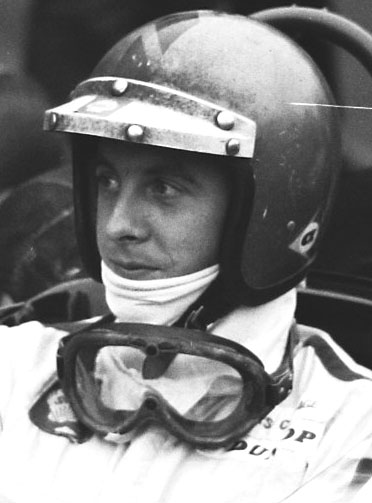
Portrait of Piers Courage, wearing his racing helmet
Piers Courage. Image by Raimund Kommer via Wikimedia Commons (CC BY-SA 3.0)

Williams’s first Grand Prix driver was Piers Courage, who joined the team in 1969. Born in Colchester and heir to the Courage brewing dynasty, Courage had shown considerable talent in the lower formulae, often in machinery that was underpowered or plainly uncompetitive.

In 1969, he finished second in both Monaco and the United States Grand Prix at Watkins Glen, two circuits with very different demands. At Monza, during the Italian Grand Prix, his talent was obvious: he stayed with the leaders for much of the race before a fuel issue forced him to slow.

A number of people, including the three-time Formula One world champion Jackie Stewart, believed Courage had the ability to win races.

For the 1970 season, Williams moved from a Brabham chassis to one built by De Tomaso. The car was less competitive, but Courage continued to impress. At the Dutch Grand Prix, a mechanical failure, believed to have involved either the steering or the front suspension, sent the car straight on through a fast corner. The crash was devastating. The engine was torn from the chassis and the car caught fire. Because the De Tomaso used magnesium in its construction, the blaze was so intense that it set nearby trees alight.

Courage had been struck on the head by one of his wheels with such force that it tore off his helmet. He died in the crash. He was 28.

A lasting legacy

Courage’s career was tragically cut short, but his story forms part of a much bigger East Anglian contribution to Formula One.

So, as fans around the world tune in to the British Grand Prix this weekend, it is worth looking beyond the immediate excitement of the starting grid. Modern Formula One owes more than many realise to figures with deep roots in East Anglia, whose influence helped shape the sport on and off the track.


More from East Anglia Bylines

An underground bunker showing bunks on one side and servicemen dining on the other
Community

Lest we forget: scallywags, escorts and boltholes

by Stuart Burrell
8 May 2025
Execution of so-called witches, Derenburg 15th century
Anglia

The Witchfinder General: East Anglia’s dark secret

by Stuart Burrell
30 October 2025
100th anniversary of the end of WW1 ceremony in Lowestoft, 2018.
History

Remembrance is not just for November

by Stuart Burrell
12 February 2026
Maunsell Sea Fort, in position and ready for action. Air is still seen escaping from the sea cocks as further consolidating water ballast enters the pontoon base. One of the forts was actually in action half an hour after being put into position. These secret forts of the Thames Estuary were an effective defence against attacks by sea and air on the estuary. Visible on the very top of the fort is a Searchlight Control radar, a medium-accuracy system used to help aim a searchlight which would then be used to illuminate the target for conventional optical aiming. The large guns on either side of the fort are 3.7-inch AA. Just left of center, at the "back" of the fort from this position, is a Bofors 40mm gun. The barrel of a second Bofors can be made out just right of centre.
Anglia

Defences, virtual but not invisible

by Stuart Burrell
27 February 2026

Truth is power

Nominate an organisation that needs scrutiny

NOMINATE
Tags: Sport
Previous Post

Our new councillor – are things getting better or worse?

Next Post

Letter: Reform’s motion was the wrong answer to a real problem

Stuart Burrell

Stuart Burrell

Stuart Burrell is an article writer for East Anglia Bylines. His interests include history and business. He was born in East Anglia and has lived there for almost half a century.

Related Posts

German radio operator WW2. This is a display in a museum in the Ardennes about the 1945 Battle of the Bulge. It shows a soldier sitting at a desk with a telephone attached to the wall, and a radio on the desk. It has wires coming from it to something in his hands - he is probably transmitting in Morse code.
Cambridgeshire

The Nazi spy at large in Cambridgeshire

by Stuart Burrell
8 November 2026
Farage creeps away. He is tip-toeing away from a signpost that points in 3 different directions: Westminster and Clacton towards the left and, towards the right, 'Away', which is the direction he's going in.
Featured

Farage is a firebrand

by Helen Forte
6 November 2026
Eleven East Anglia Bylines volunteers gathered around pub tables in Norwich, smiling towards the camera, with large windows behind them.
Anglia

Good news for independent journalism in East Anglia – and for you

by Anna Damski
6 November 2026
Four slightly tilted panels showing the headquarters of Essex, Cambridgeshire, Norfolk and Suffolk county councils, each identified by its council logo, against a textured grey background.
Anglia

East Anglia’s council shake-up is back on – but a year later

by East Anglia Bylines
4 November 2026
Woodcut of 3 witches on broomsticks flying with the middle one depicted as a devil heading towards a lady.
Culture

The magic hidden in our homes: six centuries-old ways to ward off evil

by East Anglia Bylines
31 October 2026
Next Post
Aerial image of King's Lynn with an inset photo of Cllr Rob Colwell

Letter: Reform's motion was the wrong answer to a real problem

SUPPORT OUR CROWDFUNDER

Tags

Activism Brexit Cartoons Christmas Climate Community Conservation Conservatives Democracy Economy Elections Environment EU Farming General Election 2024 Government Health History Housing Labour Letters Local government Net zero NHS Norwich Opinion Our place in Europe Party politics Pecksniff Politics Polling Pollution Poverty Reform UK Renewables Sewage Social care Something for the weekend Tax Trump Ukraine Voting Wealth Wildlife Women
East Anglia Bylines

We are a not-for-profit citizen journalism publication. Our aim is to publish well-written, fact-based articles and opinion pieces on subjects that are of interest to people in East Anglia and beyond.

East Anglia Bylines is a trading brand of Bylines Networks Limited which is separate to, but allied with, Byline Times.

Learn more about us

No Result
View All Result
  • About
  • Authors and editors
  • Complaints
  • Contact
  • Donate
  • Letters
  • Privacy
  • Network Map
  • Network RSS Feeds
  • Submission Guidelines
  • Download the Bylines Network App

© 2021-2026 East Anglia Bylines. Powerful Citizen Journalism. ISSN 3049-9771

No Result
View All Result
  • HOME
  • News
    • Brexit
    • Health
    • Education
    • World
  • Politics
    • Local government
    • Justice
    • Activism
  • Climate
    • Environment
  • Lifestyle
    • Community
    • Culture
    • History
    • Humour
    • Property
  • Business
    • Development
    • Economics
    • Finance
    • Transport
    • Farming
  • ANGLIA
    • Bedfordshire
    • Cambridgeshire
    • Essex
    • Hertfordshire
    • Norfolk
    • Suffolk
  • Series

Newsletter sign up

Crowdfunder

© 2021-2026 East Anglia Bylines. Powerful Citizen Journalism. ISSN 3049-9771