I still remember the first time I cycled to Thorpe Abbotts, home of the 100th Bomb Group (BG) of the US 8th Air Force, the subject of Apple TV+’s Masters of the Air.
It was a spring in the mid-1990s and I had recently discovered the many relics of the Second World War dotted among East Anglia’s farms and fields. Together with a good friend, my weekends were spent seeking them out – the crumbling pillboxes of the coast and, especially, the ruined runways once home to the largest air armada ever assembled: the “Mighty 8th”.
From our homes near Lowestoft it was a 60 mile round trip to Thorpe Abbotts, and as is often the case along the Waveney Valley there was a head wind (perversely, in both directions). But it was worth it.
Once there, stood atop the old Control Tower (renovated into a museum in the 1970s), we tried to imagine the scene half a century before – the revving of engines, the chatter of young Americans.
I have been doing likewise ever since. As a historian, I have researched the history and legacy of the 8th Air Force, and I’ve been especially interested in how this unique episode in East Anglian history has been commemorated in the region.


The American arrival
The arrival of the 8th Air Force in East Anglia was a huge moment in the region’s history, one which irrevocably changed local life and landscape. Around 70 newly constructed airfields were ‘occupied’ by the Americans, with each home to approximately 3,000 personnel. For the vast majority it was the first time they had left the United States, and their encounter with rural East Anglia brought with it a good quota of confusion.
One challenge was language, with Americans and East Anglians discovering that their versions of ‘English’ were in fact rather different. And then there were the occasional lively disputes and disagreements, especially over American relationships with local women. Overall though it was indeed a “friendly invasion”, and close bonds were formed between many locals and these temporary East Anglians.
The latter were tasked with bombing Germany by daylight, an immensely difficult task in the face of experienced German fighter pilots. During the summer of 1943 they suffered accordingly – on the infamous Schweinfurt-Regensburg mission in August the Americans lost 60 aircraft (each of which carried ten men). So high were the losses experienced that year by aircrew flying out of Thorpe Abbotts that they even earned a special moniker: “the Bloody 100th”.
By the war’s end, 26,000 American aircrew had been killed.
The first memorials
Among the earliest of the memorials built in their memory can be found in Great Ashfield in Suffolk. Dedicated to the dead of the 385th BG, the plaque was established in 1944 as an “everlasting tribute” to those killed in action. Originally placed on the nearby airfield, it was later moved to the village churchyard and remains there to this day (a memorial window to the 385th was added inside the church in 1992).
A number of other memorials followed in the months and years afterwards. A few examples show the diversity of style and symbolism.
In Quidenham, Norfolk, for example, a beautiful stained-glass window featuring a depiction of an American airman ascending to heaven was unveiled in 1944. Dedicated to the dead of the 96th BG, it later took centre-stage in a postwar ceremony of remembrance broadcast across the Atlantic by the BBC World Service with commentary provided by Richard Dimbleby.
At Elveden in Suffolk, meanwhile, the wartime headquarters of the 3rd Air Division (one of three such divisions that made up the 8th Air Force), the choice of memorial style was similarly stained glass. This time the design – by British ecclesiastical artist Hugh Easton – featured a fallen airman kneeling before a winged guardian angel. It was unveiled in the church on the Elveden estate in 1947.
Further north, at Wendling in Norfolk, the style was different. A striking obelisk was erected on the airfield in memory of the 392nd Bomb Group. It was unveiled in September 1945 in a ceremony involving a number of locals. At Connington, Cambridgeshire, the memorial was different again: a sculpted bust of a “Stone Airman”, it was the work of a Corporal from the base and unveiled in the churchyard in May 1945 (due to weather damage the original was replaced in the early 1980s). It is dedicated to the 457th BG.
Among the very last in this first era of East Anglian commemoration was the Second Air Division Memorial Library in Norwich, opened in 1963. Unique in the commemorative landscape of the 8th Air Force, this “living memorial” was later damaged in the 1994 Norwich library fire. It was rebuilt and re-dedicated in 2001 as a part of the city’s new ‘Forum’.


The return
It was not until two decades later, in the 1980s, that this commemorative energy and endeavour was matched. The war was forty years distant, and in East Anglia it became a subject of nostalgic fascination, something driven in part by the veterans of the 8th themselves. Now older and retired, hardly a summer went by without a group of them returning to East Anglia to remember absent friends and dedicate a new memorial.
The memorial unveiled at Horham in Suffolk in 1981 was among the first. Dedicated in memory of the 95th BG, it takes the form of the tailfin of a B-17 Flying Fortress bomber (the aircraft type operated by the Group).


Others soon followed.
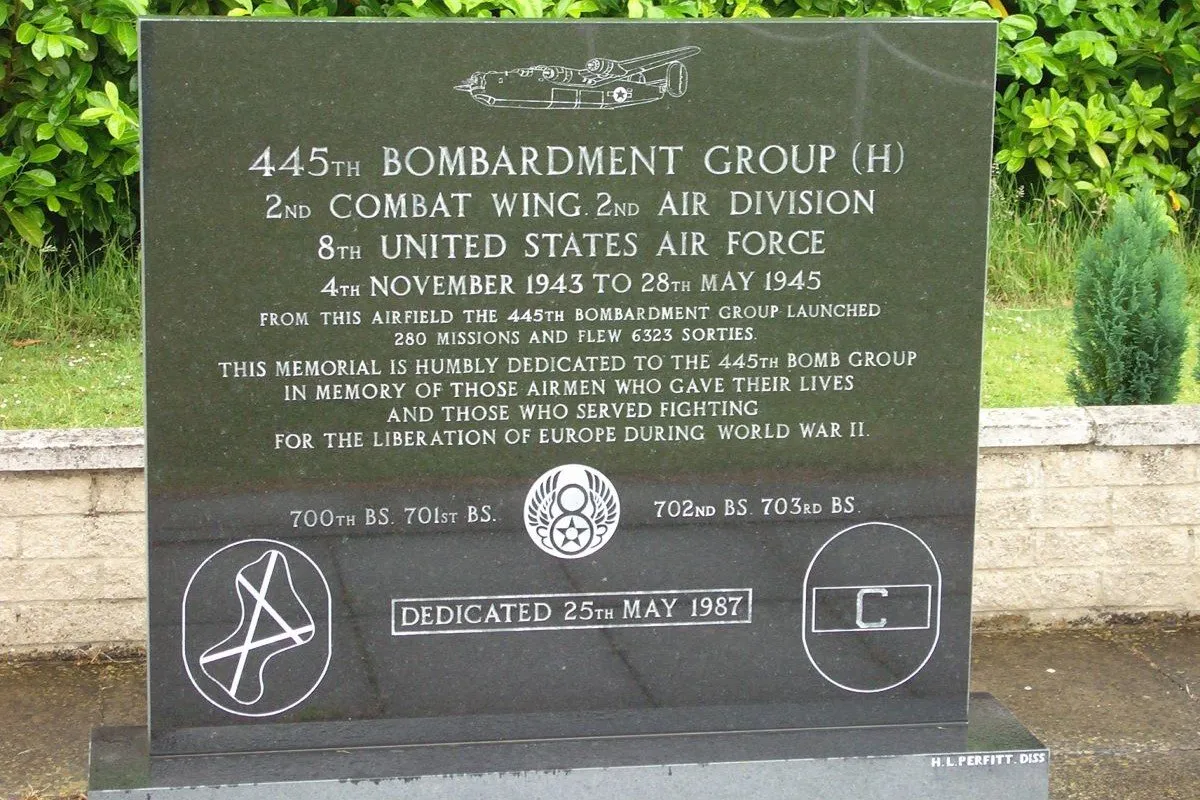
At Ridgewell in Essex an eye-catching memorial – of polished black stone – was dedicated in memory of the 381st BG in 1982. At Shipdham in Norfolk, a stone marker – this time in memory of the 44th BG – was unveiled in 1983 in the village churchyard. At Tibenham in Norfolk, from where Hollywood legend James Stewart had flown B-24 Bombers during the war with the 445th BG, a memorial was placed on the old airfield in 1987. Similar followed three years later at nearby Old Buckenham, wartime home of the 453rd BG. A memorial of black granite (in the form of a B-24 Liberator tailfin) was dedicated there that summer by a group of returning veterans.
And so it went on. By the end of the 1990s most of the 8th’s airfields had been marked in this way. The message was clear: though long since returned to agriculture, these fields were different, special. They were sacred ground.

Today
While the peak of this commemorative activity has now passed, East Anglians nonetheless still closely guard the memory of the young Americans who came into their midst during the dark days of war. Wreaths are often laid before the memorials each May (American Memorial Day) and November (Remembrance Day), and some are now drawing the attention of the children and grandchildren of those who “invaded” the region in the 1940s. Each year, too, thousands of visitors encounter the history of the 8th at the American Air Museum at Duxford (part of the Imperial War Museum). Opened in 1997, the museum itself a moving memorial to the deep US-UK connections forged during the Second World War.
The impact of Masters of the Air remains to be seen, but perhaps it will spark the interest of a new generation of East Anglians in the legacy of the 8th Air Force, a legacy that so fired my own imagination almost three decades ago.

Sam has also reviewed the series in The Conversation. You can read it here.