• Contact
  • About
  • ISSN 3049-9771
  • Authors and editors
NEWSLETTER SIGN UP
East Anglia Bylines
Advertisement
  • HOME
  • News
    • Brexit
    • Health
    • Education
    • World
  • Politics
    • Local government
    • Justice
    • Activism
  • Climate
    • Environment
  • Lifestyle
    • Community
    • Culture
    • History
    • Humour
    • Property
  • Business
    • Development
    • Economics
    • Finance
    • Transport
    • Farming
  • ANGLIA
    • Bedfordshire
    • Cambridgeshire
    • Essex
    • Hertfordshire
    • Norfolk
    • Suffolk
  • Series
No Result
View All Result
East Anglia Bylines
Home Environment Climate

Could space reflectors help solar farm productivity?

Orbiting reflectors could help provide clean energy when demand peaks near dawn and dusk by 'making the day longer'

Onur Çelik by Onur Çelik
13 January 2024
in Climate, Featured, Science, Technology
Reading Time: 8 mins read
A A
Representation of a train of mirrors reflecting sunlight to a solar farm on Earth: ground view. The mirror size is not to scale.

Representation of a train of mirrors reflecting sunlight to a solar farm. The mirror size is not to scale. Image credit: Andrea Viale, University of Glasgow

Share on Bluesky

If you happened to be looking at the sky in Europe on a cold night on February 5 1993, there is a chance you could have seen a dim flash of light. That flash came from a Russian space mirror experiment called Znamya-2. Znamya-2 was a 20-metre reflective structure much like aluminium foil (Znamya means “banner” in Russian), unfurled from a spacecraft which had just undocked from the Russian Mir space station. Its goal was to demonstrate solar energy could be reflected from space to Earth.

This was the first and only time that a mirror had ever been launched into space for that purpose. But, three decades on, my colleagues and I believe it’s time to revisit this technology. Unlike proposals to build solar power stations in space and transmit energy down to earth, all the generation would still happen down here. Crucially, these reflectors could help solar farms generate electricity even when direct sunlight is not available, especially during evening and early morning hours when demand for clean energy is greatest. My colleagues and I call this concept “orbiting solar reflectors”.

German scientist 100 years ahead of his time
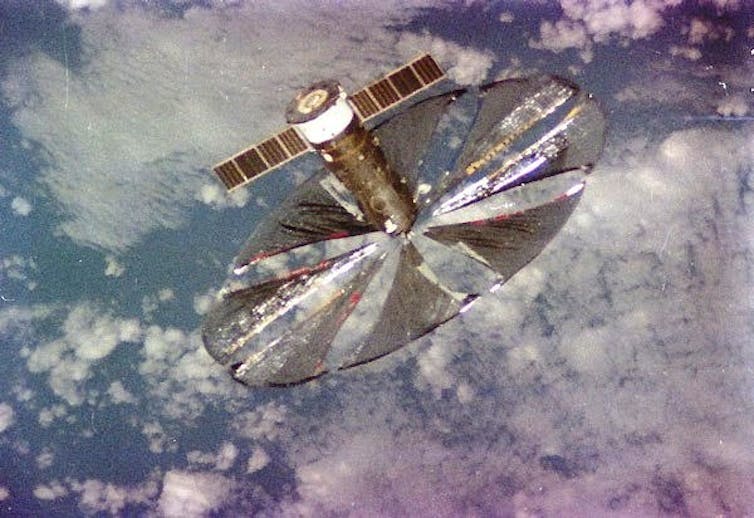
Satellite with reflective material
Znamya-2 produced a 5km-wide bright spot that travelled across Europe from France to Russia. RSC Energia (РКК , CC BY-SA

Pioneering rocket scientist Hermann Oberth recognised the potential all the way back in 1929, when he envisaged reflectors in space relaying sunlight to illuminate large cities and ship routes. He predicted that these reflectors would be very large, thin and ultralightweight, and built in space by astronauts wearing diving suits.

We recently published a paper in which we explored the possibility of orbiting solar reflectors in the near term. Oberth’s vision may now be achievable thanks to up-and-coming technologies such as robotic spacecraft that can manufacture and assemble structures in space. The reflectors and other materials necessary to build such large structures could be launched by modern rockets such as SpaceX’s colossal Starship.

Each time a reflector passes over a solar power farm, it could angle itself to illuminate the solar farm and its immediate surroundings. Each “pass” would extend the “day” of the solar farm and hence its hours of electricity generation.
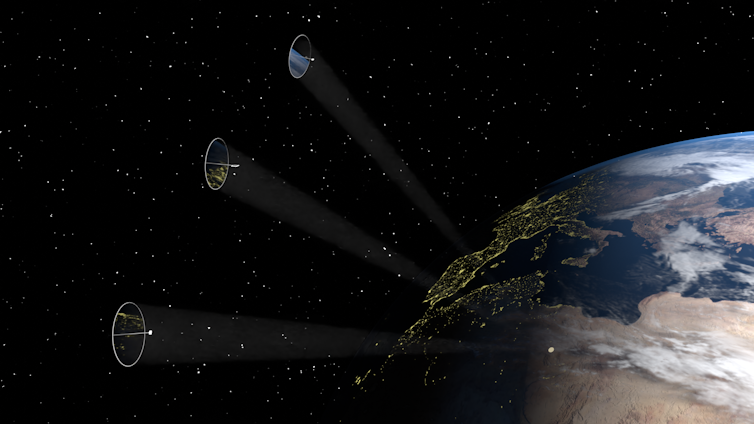
Reflectors in space bouncing sunlight down to earth
When the reflectors can see a large solar farm, they would steer themselves to redirect sunlight towards it. Andrea Viale, University of Glasgow; NASA (for Earth texture)

When the reflector can no longer illuminate the solar farm, it can be rotated such that it is edge-on to the Sun and no light is reflected to the ground. For this reason, we expect the potential disturbance to ground-based astronomical observations would be minimal.

Space reflectors would illuminate a 10km area

With the reflectors orbiting 900km above us – about twice the altitude of the International Space Station – we estimate that the illuminated area on the Earth would be approximately 10km across when at its brightest. Therefore, a system like this would not be aimed at individual rooftop solar panels but large solar power farms, typically located away from inhabited areas.
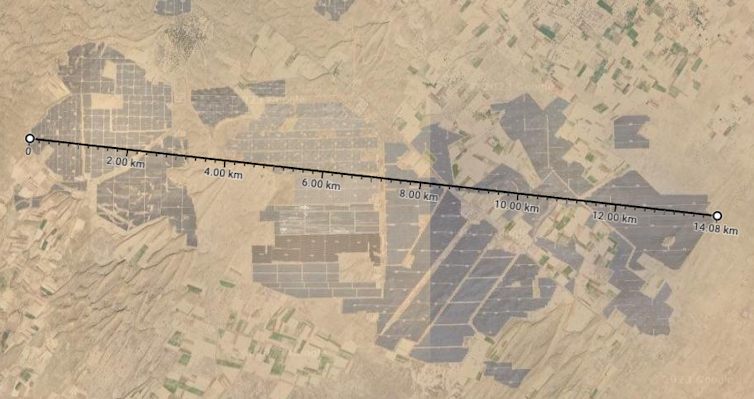
Satellite image of solar park in desert
Potential target? The vast Bhadla Solar Park in a desert in India is 14 km (8.7 miles) end to end. Google Maps, CC BY-SA

Each pass would extend energy generation by about 15 to 20 minutes around the dawn or dusk hours. This is important because those hours are when electricity demand is the highest and often exceeds the amount being generated by wind and solar, meaning gas power plants are used to compensate. Reflectors may therefore help abate fossil fuel use without needing to store energy during the day.

These reflectors would be high enough to service multiple solar farms on the same orbit. Their orbits could even be used to inform where to build new solar farms in especially sunny regions.

Our proposal uses hexagonal reflectors with sides 250 metres long. Each weighs about 3 tonnes. It would currently cost a few thousand US dollars per kilogram to launch something like this into space, though costs are on a downward trend. If costs are reduced to a few hundred US dollars per kilo, then we would expect orbiting reflectors to be viable within a few years.

We expect these reflectors to operate for 20 to 30 years, though the carbon footprint of a system such as this is hard to estimate since spacecraft generally take a long time to design, build and operate. Further research will be needed to produce a full lifecycle assessment, but in the long run, we expect the reflectors would help generate enough clean energy to outweigh their carbon footprint.

No more nighttime?

Three days after the news of the Znamya-2 experiment was published in the New York Times, a reader wrote to the editor wondering whether we would give up our nights. The short answer is no.

Even at its brightest, we estimate that the illumination levels would last only a few minutes per reflector and not exceed an overcast day level. This means that, unless you are very close to the solar power farm, the illumination may not even be noticeable most of the time, especially at dawn/dusk times when the sky is already quite bright compared to nighttime.
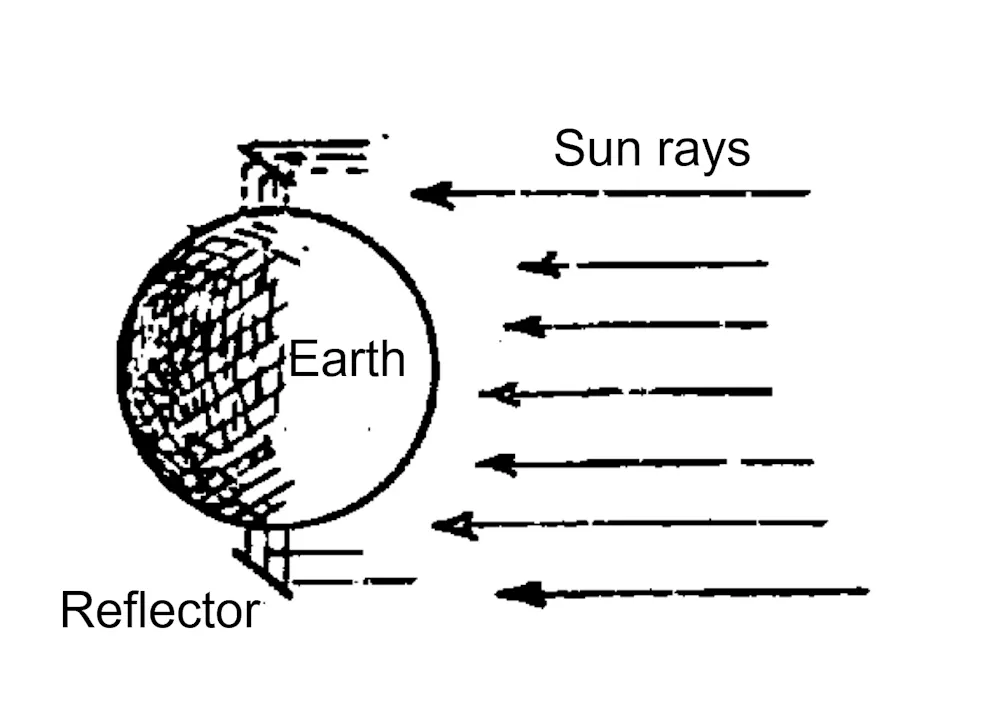
Diagram of earth and solar reflectors
A 1929 sketch by Hermann Oberth of solar reflectors. Oberth / NASA / Internet Archive

We also estimate that the reflector itself would not be visible to the naked eye unless you are close to the solar farm. These estimations suggest that the impact of these reflectors on the natural environment around the solar power farm may also be minimal, though more research is necessary.

When the solar reflectors are old or no longer needed, they could “sail” on sunlight into less-congested higher orbits or into a lower orbit to burn up safely.

Orbiting solar reflectors are still some way off. But they represent a way to connect the space and energy sectors to help accelerate the transition towards clean energy and tackle climate change.

How this might work (Video: Andrea Viale, University of Glasgow)
The Conversation

This article is republished from The Conversation under a Creative Commons license. Read the original article.


More from East Anglia Bylines

Geothermal energy
Energy

Marking the million: Geothermal energy could be a key to net zero

by Stephen McNair
14 November 2023
Tags: Net zeroRenewablesSolar farms
Previous Post

Join EU and we’re with you

Next Post

An exceptional historic house rescued just in time

Onur Çelik

Onur Çelik

Dr Onur Celik is a postdoctoral research associate in space technology at the University of Glasgow. He is interested broadly in the fields space systems engineering and planetary science and how we can use Space-based solutions to generate solar energy through the European Research Council SOLSPACE project, and is investigating the underlying orbital dynamics in this area.

Related Posts

Farage creeps away. He is tip-toeing away from a signpost that points in 3 different directions: Westminster and Clacton towards the left and, towards the right, 'Away', which is the direction he's going in.
Featured

Farage is a firebrand

by Helen Forte
6 November 2026
Woodcut of 3 witches on broomsticks flying with the middle one depicted as a devil heading towards a lady.
Culture

The magic hidden in our homes: six centuries-old ways to ward off evil

by East Anglia Bylines
31 October 2026
Houses stand close to the edge of a steep, eroding sandy cliff above the beach at Thorpeness, Suffolk.
Anglia

Dredging for profit but losing our villages?

by Rachel Fulcher
30 October 2026
Four schoolgirls wearing lab coats and safety glasses carry out a chemistry experiment in a science classroom.
Education

Where are the women? Scientists missing from school science

by East Anglia Bylines
29 October 2026
A collage of academic journal covers
Science

The machines are marking our science – and doing it better

by Stephen McNair
28 October 2026
Next Post
Northwold Manor, 2022. An view of the whole house, probably taken from the top of the church tower.

An exceptional historic house rescued just in time

SUPPORT OUR CROWDFUNDER

Tags

Activism Brexit Cartoons Christmas Climate Community Conservation Conservatives Democracy Economy Elections Environment EU Farming General Election 2024 Government Health History Housing Labour Letters Local government Net zero NHS Norwich Opinion Our place in Europe Party politics Pecksniff Politics Polling Pollution Poverty Reform UK Renewables Sewage Social care Something for the weekend Tax Trump Ukraine Voting Wealth Wildlife Women
East Anglia Bylines

We are a not-for-profit citizen journalism publication. Our aim is to publish well-written, fact-based articles and opinion pieces on subjects that are of interest to people in East Anglia and beyond.

East Anglia Bylines is a trading brand of Bylines Networks Limited which is separate to, but allied with, Byline Times.

Learn more about us

No Result
View All Result
  • About
  • Authors and editors
  • Complaints
  • Contact
  • Donate
  • Letters
  • Privacy
  • Network Map
  • Network RSS Feeds
  • Submission Guidelines
  • Download the Bylines Network App

© 2021-2026 East Anglia Bylines. Powerful Citizen Journalism. ISSN 3049-9771

No Result
View All Result
  • HOME
  • News
    • Brexit
    • Health
    • Education
    • World
  • Politics
    • Local government
    • Justice
    • Activism
  • Climate
    • Environment
  • Lifestyle
    • Community
    • Culture
    • History
    • Humour
    • Property
  • Business
    • Development
    • Economics
    • Finance
    • Transport
    • Farming
  • ANGLIA
    • Bedfordshire
    • Cambridgeshire
    • Essex
    • Hertfordshire
    • Norfolk
    • Suffolk
  • Series

Newsletter sign up

Crowdfunder

© 2021-2026 East Anglia Bylines. Powerful Citizen Journalism. ISSN 3049-9771
