• Contact
  • About
  • ISSN 3049-9771
  • Authors and editors
NEWSLETTER SIGN UP
East Anglia Bylines
Advertisement
  • HOME
  • News
    • Brexit
    • Health
    • Education
    • World
  • Politics
    • Local government
    • Justice
    • Activism
  • Climate
    • Environment
  • Lifestyle
    • Community
    • Culture
    • History
    • Humour
    • Property
  • Business
    • Development
    • Economics
    • Finance
    • Transport
    • Farming
  • ANGLIA
    • Bedfordshire
    • Cambridgeshire
    • Essex
    • Hertfordshire
    • Norfolk
    • Suffolk
  • Series
No Result
View All Result
East Anglia Bylines
Home Environment

New signs help deaf people connect with the ocean

Today, on Sign Language Day, we look at work to enable deaf people to talk about marine species and ocean conservation

Dr Audrey Cameron by Dr Audrey Cameron
23 September 2024
in Environment, Featured, Science
Reading Time: 7 mins read
A A
Jellyfish body is translucent with bronw edges, and it has long tentacles under it with orange frills.

New British sign language terms will cover marine creatures like this jellyfish. Image byPedro Szekely vis Flickr (CC BY-SA-2.0

Share on Bluesky

For deaf people, including schoolchildren, teachers and scientists, talking about marine species like the shortfin mako shark, loggerhead turtle and tiny phytoplankton usually means spelling out each term letter by letter. The lack of specific British Sign Language (BSL) signs for many marine species and concepts has made it challenging to have meaningful conversations about ocean conservation without resorting to tedious fingerspelling.

This gap in sign language not only hinders communication, it excludes a significant portion of the population from important environmental discussions. Until now, most marine BSL terms have related to food or iconic groups of animals such as whales.

That’s why my team and I have been working with project partners from five European countries to develop 100 new signs that will enable deaf people to get more involved with marine sciences and conservation – from an education and public engagement perspective, and also to open up more career opportunities.

As part of a three-year project called Muffin (that stands for Marine, Underwater, Fish For Inclusion), we will create a taxonomy of signs related to the sea and marine life, such as seagrass, shore crabs, basking sharks and kelp.

Like all sign languages, BSL is inherently visual – it incorporates the use of facial expressions and body language as well as hand signals. This makes it particularly suited for describing the dynamic and diverse world of marine life. Unlike spoken languages, complex concepts can be explained visually through sign language, offering new ways of understanding marine ecosystems.

Rewilding BSL

Here at the Scottish Sensory Centre, I’m working with a team of 37 deaf scientists, sign linguists and educators from all over the UK. Our online glossary aims to support deaf students’ access to education in science, technology, engineering and maths (STEM subjects).

Since the glossary launched in 2007, nearly 4,000 signs and accompanying definitions for scientific terms from ten subjects – from astronomy and biology to computing and physics – have been collected and developed.

A woman signing "ghost fishing"
Many new BSL signs cover complex environmental issues. Scottish Sensory Centre, CC BY-ND

We are now building on recent work on the glossary linked to environmental science, which was funded by the Royal Society. For that, we focused on some of the terms linked to the ocean and the negative effects of fishing – for example, ghost fishing, bycatch and ocean acidification. Now, we are expanding the glossary to include more specific marine species, and schools are already using this science glossary to support young people in classrooms and labs.

Pan-European programme

Each country (Malta, Croatia, Italy, Spain and the UK) is developing its own national sign language glossaries and educational resources tailored to its specific needs and linguistic contexts. Hopefully, this will make it possible for deaf people to participate fully in discussions about ocean conservation.

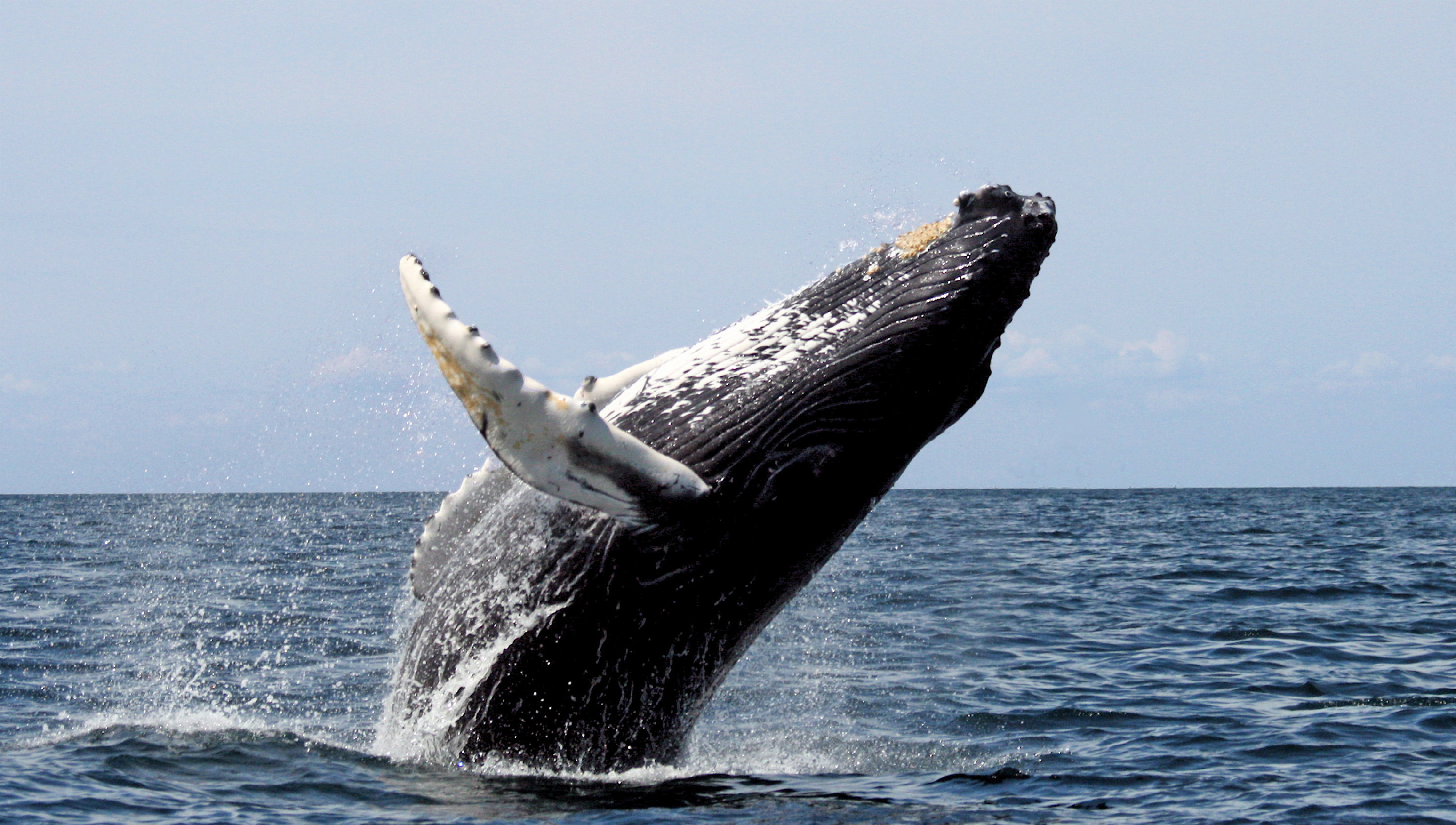
A breaching humpback whale.
BSL users can sign ‘cetacean’ for whales such as this humpback. Image by Whit Welles via Wikimedia Commons (CC BY 3.0)

With our European partners, we identify marine wildlife commonly found in the Mediterranean and waters surrounding the UK, from microscopic plankton to large cetaceans. Then, in collaboration with the UK sign development team and deaf marine experts from Canada, France, Germany, the Netherlands and the US, we develop new visual signs that represent some of the characteristics and behaviour of these species.

For instance, the sign for jellyfish might incorporate flowing hand movements to represent its many tentacles, while the sign for dolphin could mimic this marine mammal’s distinctive leap out of the water.

As we continue to develop these new marine-related signs, we’re working with marine education centres around the UK to develop more resources for young deaf children, such as educational videos. By bridging the communication gap, we are empowering BSL users to participate fully in discussions about the future of our oceans. This is not just about creating new signs for complex terms – it is about fostering a deeper connection between people and the marine environment.

Ten new marine signs

Aquaculture, biome, bycatch, cetaceans, dolphin pingers, ghost fishing, no-take zone, ocean acidification, overfishing, shellfish.

The Conversation

This article is republished from The Conversation under a Creative Commons license. Read the original article.


More from East Anglia Bylines

David Attenborough giving a speech at COP26 in Glasgow, 2021
Climate

Save our wild isles

by Elana Katz
7 May 2023
Large car park with solar structures over the cars, keeping them in shade.
Climate

Good news for the planet: the soaring rise of solar energy

by East Anglia Bylines
10 November 2026
A newly excavated, muddy pond area containing a shallow pool of water, showing signs of recent conservation work. The clearing is surrounded by bare, turned-up brown earth, mature green trees, and low ground vegetation. In the background to the right sits a traditional black weatherboarded barn with a red tiled roof, separated from the clearing by a wooden fence.
Environment

Seven ponds set to reveal their hidden wildlife potential

by Rebecca Turner
8 November 2026
German radio operator WW2. This is a display in a museum in the Ardennes about the 1945 Battle of the Bulge. It shows a soldier sitting at a desk with a telephone attached to the wall, and a radio on the desk. It has wires coming from it to something in his hands - he is probably transmitting in Morse code.
Cambridgeshire

The Nazi spy at large in Cambridgeshire

by Stuart Burrell
8 November 2026
A home energy adviser points to information on a leaflet while discussing energy-saving measures with a woman in her home.
Lifestyle

Keeping Norwich homes warm: free advice as Britain invests in cleaner energy

by East Anglia Bylines
7 November 2026
Infographics from Easyfundraising

We are registered with easyfundraising! 8,000 brands will donate to us for free every time you use it.

It’s super quick and easy to SIGN UP, and will never cost you anything whatsoever. It’s FREE for you and HUGE for us!

Tags: Disability
Previous Post

Labour’s endless cycle: battle, rise, battle, fall

Next Post

Goodbye to UKICE: how will we understand the EU now?

Dr Audrey Cameron

Dr Audrey Cameron

Dr Audrey Cameron is a Chancellor’s Fellow at the University of Edinburgh, where her research focuses on visualising complex scientific concepts using sign language. She also teaches PGDE Secondary Education (Chemistry with Science) and MSc Inclusive Education (Deaf Studies) courses. She embarked on her academic journey at Paisley College of Technology (now the University of West of Scotland), earning a BSc Hons in Chemistry, followed by a PhD in polymer chemistry at Strathclyde University. In 2003, she transitioned to the world of education, completing a PGCE course in Secondary Education (Chemistry with Science) at the Moray House School of Education in 2004. She then taught in mainstream schools.

Related Posts

Large car park with solar structures over the cars, keeping them in shade.
Climate

Good news for the planet: the soaring rise of solar energy

by East Anglia Bylines
10 November 2026
A newly excavated, muddy pond area containing a shallow pool of water, showing signs of recent conservation work. The clearing is surrounded by bare, turned-up brown earth, mature green trees, and low ground vegetation. In the background to the right sits a traditional black weatherboarded barn with a red tiled roof, separated from the clearing by a wooden fence.
Environment

Seven ponds set to reveal their hidden wildlife potential

by Rebecca Turner
8 November 2026
Farage creeps away. He is tip-toeing away from a signpost that points in 3 different directions: Westminster and Clacton towards the left and, towards the right, 'Away', which is the direction he's going in.
Featured

Farage is a firebrand

by Helen Forte
6 November 2026
Jason Williams, also known as the Cloud Gardener, with Harriet Festing in her Norwich balcony garden. They are sitting together looking at the garden, which has wide variety of plants, all in pots. Beyond them at the other end of the balcony a group of people are sitting on the balcony and chatting.
Environment

How a Norwich balcony became a haven for wildlife

by East Anglia Bylines
1 November 2026
Air source heat pump: photo Stephen McNair
Economics

The great heat pump paradox: more heat, less progress

by Stephen McNair
1 November 2026
Next Post
UK and EU flags flying near the Houses of Parliament

Goodbye to UKICE: how will we understand the EU now?

SUPPORT OUR CROWDFUNDER

Tags

Activism Brexit Cartoons Christmas Climate Community Conservation Conservatives Democracy Economy Elections Environment EU Farming General Election 2024 Government Health History Housing Labour Letters Local government Net zero NHS Norwich Opinion Our place in Europe Party politics Pecksniff Politics Polling Pollution Poverty Reform UK Renewables Sewage Social care Something for the weekend Tax Trump Ukraine Voting Wealth Wildlife Women
East Anglia Bylines

We are a not-for-profit citizen journalism publication. Our aim is to publish well-written, fact-based articles and opinion pieces on subjects that are of interest to people in East Anglia and beyond.

East Anglia Bylines is a trading brand of Bylines Networks Limited which is separate to, but allied with, Byline Times.

Learn more about us

No Result
View All Result
  • About
  • Authors and editors
  • Complaints
  • Contact
  • Donate
  • Letters
  • Privacy
  • Network Map
  • Network RSS Feeds
  • Submission Guidelines
  • Download the Bylines Network App

© 2021-2026 East Anglia Bylines. Powerful Citizen Journalism. ISSN 3049-9771

No Result
View All Result
  • HOME
  • News
    • Brexit
    • Health
    • Education
    • World
  • Politics
    • Local government
    • Justice
    • Activism
  • Climate
    • Environment
  • Lifestyle
    • Community
    • Culture
    • History
    • Humour
    • Property
  • Business
    • Development
    • Economics
    • Finance
    • Transport
    • Farming
  • ANGLIA
    • Bedfordshire
    • Cambridgeshire
    • Essex
    • Hertfordshire
    • Norfolk
    • Suffolk
  • Series

Newsletter sign up

Crowdfunder

© 2021-2026 East Anglia Bylines. Powerful Citizen Journalism. ISSN 3049-9771