Readers may recall stories about Prince (now King) Charles talking to plants. Whatever one may make of those reports it begs the question, can plants hear? At the risk of spoiling the story that follows, I’m pleased to say that yes, plants can hear. Not only that, but they have versions of our four other major senses.
True, plants don’t have eyes, or ears, or a nose, that our human-centric view of life might consider necessary for sight, hearing or odour-detection. But they have equivalent senses that enable them to obtain important information about their environment. And do bear in mind that the great majority of plants can’t move around to a better place. Fixed in the soil, they are therefore potentially easy prey for a hungry herbivore or at the mercy of variable environmental conditions. Being able to detect such threats or changed conditions – and react appropriately – can mean the difference between life and death for a plant. But, rather than just tell you this is so, let’s have some examples.
Plants can see

Sight is receipt of information about the environment that’s conveyed to an organism by light. For us it is manifest as images created in our brain in response to light that enters our eyes. Plants don’t work like that. But they certainly detect – and respond appropriately – to light. The importance of this ability is emphasised by plant behavioural phenomena that begin with the prefix ‘photo-’, e.g. ‘phototropism’, ‘photomorphogenesis’.
We see phototropism, for example, when plant stems bend and grow towards a light source: the light acts as an important positional or visual cue ensuring that the plant is placed in the maximum light possible to drive photosynthesis. Photomorphogenesis uses information contained in light to ensure that a plant grows ‘in the right way’.
Potatoes left at the back of a darkened kitchen cupboard for a few weeks form shoots that look ‘odd’, white and very long with tiny yellow leaves: photomorphogenetic responses to the very low light levels in the cupboard. The plant is putting its potato-stored energy into growing long and thin in an attempt to reach the light coming through the gap under the cupboard door. If it reaches the light, stem extension slows down, leaves develop more fully, become green and photosynthetic. We manipulate this process when producing mung bean sprouts.
Plants can smell

Smell in humans is the detection of chemicals in the atmosphere. Plants also have this ability. And a very good example is fruit-ripening. Many fruits ripen in response to ethylene – usually, their own. However, it could also be ethylene produced by another plant (and not necessarily of the same species). Ethylene – a gas – readily escapes into the atmosphere where it can be detected by another plant, triggering ripening in the receiving plant. This phenomenon has been recognised, if not understood, for hundreds of years in the phrase ‘one bad [i.e., an over-ripe] apple can spoil the whole barrel’.
Certain seeds can detect chemicals in smoke from burning vegetation, which can trigger them to germinate and, for example, revegetate the scorched earth after an Australian wildfire.
Plants can taste

Human taste is the detection of molecules dissolved in water on our tongue, e.g. within our food. Plants can interpret the chemical environment within the water in the soil. At a beneficial and basic level, plant roots detect and grow towards water: hydrotropism.
A harmful example is seen in the seeds of Striga, a parasitic plant that affects important crops in sub-Saharan Africa. They detect chemicals released from roots of other plants. Germinating in response to the appropriate chemical messenger, Striga grows towards its target and becomes intimately connected to the internal plumbing of the soon-to-be host plant. Taking food and water from its host to fuel its parasitic lifestyle has earnt this colourful plant the nickname “the violet vampire”.
Plants can feel
When we feel or touch we are detecting pressure or vibrations on our skin. When the hairs on the leaves of Venus flytrap are bent, for example, the plant detects this. If an insect touches the right number of hairs the right number of times (yes, plants can also count!), the two teeth-fringed halves of the modified leaf fold up and trap the unsuspecting creature. Entombed in this prison it will eventually be digested by plant-released enzymes and the resulting slurry of insect juices will be absorbed by the plant supplementing its own nutritional requirements.

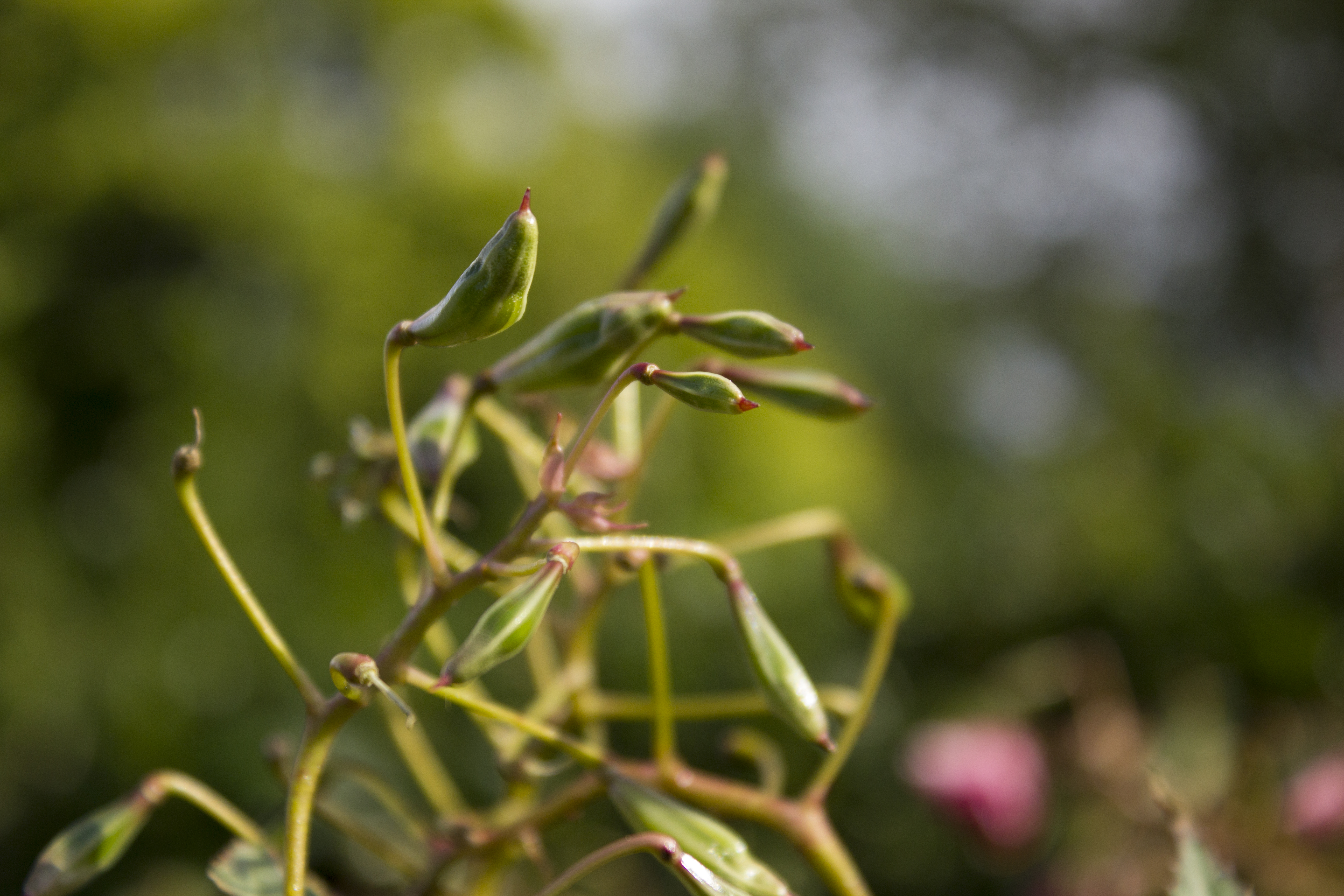
Another – less macabre, but equally dramatic – example is seed release by Himalayan balsam. When the seed capsules are ripe, the slightest touch – e.g. from a passing human, is enough to cause them to ‘explode’, flinging seeds away from the parent plant.
Plants can hear

Hearing in humans is the ability to detect sound waves that reach our ears through the air. Historically, hearing is the most contentious of plant senses, and it’s probably the one that’s hardest to demonstrate. But, probably the clearest evidence we have that plants can hear was provided in 2014 by Heidi Appel & Reginald Cocroft. They showed that plants could change their chemistry to produce defence compounds against herbivores in response to audio recordings of a caterpillar’s leaf-chewing activity. Being cautious scientists, they stress that it is vibrations in the plant caused by receipt of the chewing sound waves that trigger the defence response.
Vibrations of the human ear drum, generated by soundwaves, trigger the sense of hearing in humans. So this seems to be the plant equivalent of hearing – and evidence that they can anticipate herbivore attack.
Summary
Plants do have equivalents of our five human senses. They are truly sensitive lifeforms whose senses are fine-tuned to their particular lifestyle, just as our human ones are. For a more detailed, evidence-cited look at plant senses, see the author’s blog post.
More from East Anglia Bylines


Friends of Bylines Network
There has never been a greater need for grassroots journalism that investigates the stories that really matter, holds power to account and champions the voices of everyday citizens. We are proudly powered by volunteers but what we do isn’t free.
STAND WITH US for independent, citizen-led journalism that makes democracy stronger, and you will even get some exclusive benefits.