• Contact
  • About
  • ISSN 3049-9771
  • Authors and editors
NEWSLETTER SIGN UP
East Anglia Bylines
Advertisement
  • HOME
  • News
    • Brexit
    • Health
    • Education
    • World
  • Politics
    • Local government
    • Justice
    • Activism
  • Climate
    • Environment
  • Lifestyle
    • Community
    • Culture
    • History
    • Humour
    • Property
  • Business
    • Development
    • Economics
    • Finance
    • Transport
    • Farming
  • ANGLIA
    • Bedfordshire
    • Cambridgeshire
    • Essex
    • Hertfordshire
    • Norfolk
    • Suffolk
  • Series
No Result
View All Result
East Anglia Bylines
Home Politics

70 years of data suggest the Conservatives will suffer a big defeat at the next election – here’s how I worked it out

Polling only provides a snapshot of the current moment but modelling across decades can help us predict the next election result.

Prof Paul Whiteley by Prof Paul Whiteley
9 November 2022
in Politics, UK
Reading Time: 7 mins read
A A
Sunak surrounded by his new cabinet at a large table in Number 10

Sunak is on course for a big loss at the next General Election. Photo by Number 10 via Flickr (CC BY-NC-ND 2.0)

Share on Bluesky

With the UK’s new prime minister in office, it looks like the political turmoil of the last few months is likely to ease, at least for the time being. Rishi Sunak and his fellow MPs must put their political differences aside to focus on stabilising the economy and calming financial markets. But Sunak will of course have one eye on the next election, which he must call before January 2025.

It might seem ambitious to predict what will happen in that election. Indeed, pollsters always emphasise that the information they give us about what voters think represents a snapshot of the current moment rather than a prediction. They are projections of what would happen were an election held immediately rather than in a few years time. The huge volatility of voting intentions in the polls taken since the last general election reinforces this point.

But if you look at polls over a very long period, you can see there is a lot of inertia in voting intentions. It is true that major shocks such as the financial crash of 2008 or the Brexit referendum in 2016 can change the public’s minds quite rapidly, but if we zoom out to take in a long enough time period these shocks to the system tend to average out.

It turns out that voting intentions in monthly polls collected over more than 70 years are highly correlated with each other over time (r = 0.95). In other words, this month’s voting intentions are highly predictable from last month’s voting intentions.

The seats-votes model

This fact is the basis of an electoral forecasting model known as the seats-votes model. The model is based on an earlier analysis of the relationship between vote shares and seat shares in the House of Commons in general elections, known as the law of cubic proportion.

This was formalised by statisticians Kendall and Stuart in a landmark paper published in 1950 which represents the starting point of electoral forecasting in Britain. There is an advantage in focusing on seats rather than vote shares, since parties win general elections in Britain by gaining a majority of seats in the House of Commons, not a majority of votes in the country.

The seats-votes model is very simple. It predicts seat shares in elections for the political parties in the House of Commons based on the seats won in the previous election, updated with current voting intentions in the polls. The inertia in voting intentions means that we don’t have to wait until just before an election to predict what is likely to happen. Instead, we can use voting intentions in the polls many months prior to the election, although the strength of the relationship between current and past polls weakens the further back in time we go.

May is the most common month to have a general election in Britain. Of the 21 national votes that have been held since the second world war, six have taken place in May. With that in mind, let’s assume that the next general election takes place in May 2024, in 19 months.

We can use Conservative seat shares in the House of Commons in the last general election plus voting intentions 19 months prior to our 2024 election to make a forecast, both of which are known today. But to estimate the model we need to look at voting intentions 19 months before all 21 general elections since 1945.

We do this using the Pollbase database created by the prolific polling analyst, Mark Pack. This database has voting intentions data which goes back to 1943. For example the Conservatives took 44% of the vote when Margaret Thatcher won the 1979 election and a Gallup poll conducted 19 months prior to that election predicted they would get 45%.

Conservative seats won and predictions of seat wins, 1945 to 2024.
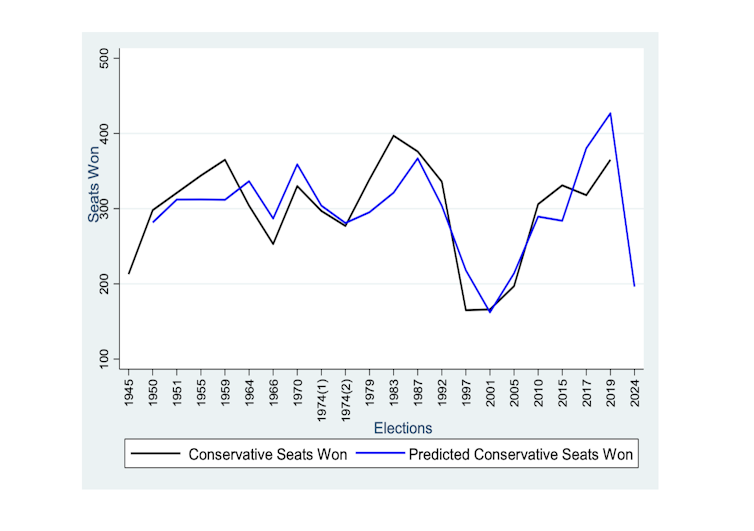
A chart showing that the Conservatives are on course to lose a lot of seats in the next election.
How the forecast performed over the years. P Whiteley, Author provided

The results of this exercise appear in the figure. The black line is the number of seats won by the Conservatives in each of these elections and the blue line is the number of seats forecast by the model. The average number of seats won by the party in these elections was 300 and the average number of forecast seats won was 297, so the model is fairly accurate.

That said, the party did better than predicted in 1959 under Harold Macmillan and the model did not pick up the surge in support for the party in the turbulent years of the 1970s, when Labour was in power. It did, however, pick up the loss of support for the Conservatives when Tony Blair won the 1997 election.

On course for a big loss

The actual seat total line ends in 2019 but the forecast continues further. It predicts that the Conservative party would win just 196 seats if an election were held in May 2024. This is based on the 365 seats the party won in the December 2019 election and their voting intentions in a YouGov poll completed on October 22 which gave the party 19%.

The poll was conducted just before Sunak became prime minister, so things were really bad at that time. If he experiences a honeymoon then Conservative vote intentions should increase and the loss of seats would not be so large. But overcoming a deficit of this size and subsequently winning the general election in 2024 looks extremely unlikely.

If the Conservatives lost 169 seats compared with the 2019 total it would amount to a catastrophe. Many prominent figures, most notably former prime minister Boris Johnson, would lose their seats to Labour. The chancellor of the exchequer, Jeremy Hunt, could lose his seat to the Liberal Democrats.

In the absence of a major shock to the system, the Conservatives should expect to be in opposition for some time after the next election.

The Conversation

Paul Whiteley, Professor, Department of Government, University of Essex

This article is republished from The Conversation under a Creative Commons license. Read the original article.


More from East Anglia Bylines

Rishi Sunak and Boris Johnson clink beer glasses together in a toast
Politics

2019 manifesto pledges – have the Tories delivered?

by Cameron Holloway
8 November 2022
Tags: ConservativesElectionsPoliticsPolling
Previous Post

2019 manifesto pledges – have the Tories delivered?

Next Post

Why as a doctor I’m fighting NHS privatisation

Prof Paul Whiteley

Prof Paul Whiteley

After studying economics as an undergraduate at the University of Sheffield Paul Whiteley obtained Masters and Doctoral degrees at the University of Essex. After working in the US, Paul returned to Britain as a Professor of Politics at the University of Sheffield before moving to the University of Essex in 2001. His research interests are in electoral behaviour, public opinion, political economy and political methodology. He is the author or co-author of some 27 books on these topics and more than a 100 academic articles. He is an active blogger and broadcaster commenting mainly on contemporary British politics.

Related Posts

Four slightly tilted panels showing the headquarters of Essex, Cambridgeshire, Norfolk and Suffolk county councils, each identified by its council logo, against a textured grey background.
Anglia

East Anglia’s council shake-up is back on – but a year later

by East Anglia Bylines
4 November 2026
Around 20 demonstrators outside Princess of Wales Hospital, Ely. Their banner reads 'No Palantir in the NHS'.
Activism

⁠Palantir under fire: the battle over its NHS role

by Aidan Baker
26 October 2026
Climate demonstration. Poster reads 'there is no planet b
Climate

Are we being told enough about the ecological collapse?

by Cllr Gary Champion
25 October 2026
Woman holding an EU flag beside a large yellow bus emblazoned ‘Bollocks to Brexit – It’s not a done deal!’
Brexit

Another referendum on the EU? You must be joking

by Peter Thurlow
16 October 2026
Peterborough Town Hall
Democracy

They planned to rewire local government. Now they’ve pulled the plug

by Stephen McNair
12 October 2026
Next Post
Nurse treating a child in hospital while her mother looks on.

Why as a doctor I'm fighting NHS privatisation

SUPPORT OUR CROWDFUNDER

Tags

Activism Brexit Cartoons Christmas Climate Community Conservation Conservatives Democracy Economy Elections Environment EU Farming General Election 2024 Government Health History Housing Labour Letters Local government Net zero NHS Norwich Opinion Our place in Europe Party politics Pecksniff Politics Polling Pollution Poverty Reform UK Renewables Sewage Social care Something for the weekend Tax Trump Ukraine Voting Wealth Wildlife Women
East Anglia Bylines

We are a not-for-profit citizen journalism publication. Our aim is to publish well-written, fact-based articles and opinion pieces on subjects that are of interest to people in East Anglia and beyond.

East Anglia Bylines is a trading brand of Bylines Networks Limited which is separate to, but allied with, Byline Times.

Learn more about us

No Result
View All Result
  • About
  • Authors and editors
  • Complaints
  • Contact
  • Donate
  • Letters
  • Privacy
  • Network Map
  • Network RSS Feeds
  • Submission Guidelines
  • Download the Bylines Network App

© 2021-2026 East Anglia Bylines. Powerful Citizen Journalism. ISSN 3049-9771

No Result
View All Result
  • HOME
  • News
    • Brexit
    • Health
    • Education
    • World
  • Politics
    • Local government
    • Justice
    • Activism
  • Climate
    • Environment
  • Lifestyle
    • Community
    • Culture
    • History
    • Humour
    • Property
  • Business
    • Development
    • Economics
    • Finance
    • Transport
    • Farming
  • ANGLIA
    • Bedfordshire
    • Cambridgeshire
    • Essex
    • Hertfordshire
    • Norfolk
    • Suffolk
  • Series

Newsletter sign up

Crowdfunder

© 2021-2026 East Anglia Bylines. Powerful Citizen Journalism. ISSN 3049-9771
