The Berlin theatre Volksbühne has built a pop-up lido in front of its doors as an “urban intervention” and commentary on the state of public infrastructure in the city. The Volksbad (‘The People’s Pool’) is open until the beginning of October. Last Friday I attended the opening session and spoke to several of the swimmers there.
A stage production
With so much media presence – there seem to be more reporters than swimmers – the lido feels a little like a film set. In fact, given that the Volksbühne (‘The People’s Stage’) experiments a lot with live filming as part of its stage productions, the intervention could almost be a Volksbühne play itself. And I suppose that’s the point.
The weather is a little cold and overcast for the beginning of August. Frank, a man from Freiburg I speak to outside, suggests this might be why there are fewer swimmers than he’d expected. Indeed, Frank himself has two spare tickets – my wife and I had been refreshing the website on repeat three days earlier while waiting at Stansted, trying to get tickets, and he had spares?! – and he asks if I’d like him to let me in. I can’t believe my luck!
Frank waves to his grandkids, who are already in the water, before we head over to the entrance. He calls out to his son and asks what the water temperature is like. “It’s… ok”, he replies. The kids don’t seem to have a problem with it.
Why has a theatre built a pop-up lido in the middle of Berlin?
The theatre’s new creative director, Mathias Lilienthal, is known for gestures that reach outside conventional theatre. In 2015 he erected 24 “shabby” pop-up apartments in expensive districts of Munich: people could stay for the night as a protest against high rents.
The lido is a response to what the theatre calls Berlin’s “dilapidated infrastructure”. In response to the increased commercialisation of public spaces, entry to the Volksbad is free. Public lidos in the city have increased security checks – there are none at the Volksbad.
But this isn’t just social commentary; it’s also theatre. As a theatre director, Lilienthal is clearly acutely aware of the theatricality of water as a substance, as well as of the vulnerability of semi-naked bodies on display in the middle of the city.


Author’s images, used with permission
Is the lido an extravagance?
Poolside, I meet Birgit and Claudia. They’re reclining in deckchairs and seem to be enjoying themselves. They are both pensioners. Birgit is from East Berlin and therefore grew up in East Germany; Claudia is from Hamburg, and was socialised in West Germany. Claudia has been for a swim, but Birgit is just here to relax and spend time with her friend.
Birgit says the lido is “good fun”, but has her reservations about the cost. “People will think that the cultural institutions have got plenty of cash – but they don’t!” she says. The project is reported to have cost €300,000 and Birgit suggests the money could have been better spent on subsidising swimming lessons for all the children in the city. She points out there have been many drownings this year in Germany (the German Lifesaving Society has registered 261 swimming-related deaths so far this year) – overwhelmingly men and boys.
Birgit herself attends productions at the Volksbühne sometimes, but notes that some can be quite unusual: “They’re not to everyone’s taste, let’s say”. So something like the lido could broaden its appeal. But she also points out that Berlin is spoilt for lakes, and asks whether the city really needed a new swimming location.
Theatre for the people
Thomas and Julia, a Berlin couple, have come to the lido with their son. Julia is impressed that the theatre has pulled off this bold undertaking. “I think it’s just a wonderful statement,” she says. Like Birgit, Thomas notes that the theatre could be said to be somewhat elitist. “This thing happening here, outside the theatre, is great. And I think it would be even better if what happens inside the theatre could be more like what is going on here outside the theatre. It’s so accessible.”
Julia says she’s aware that there have been reservations about spending money from this cultural budget on what could be seen as public infrastructure, instead of funding more obviously dramatic productions. But then she points out that with the synchronised swimming lessons also being offered, there’s clearly a theatrical element to the whole thing.
Water as theatre
Indeed, in many ways, the entire pop-up pool is one big performance, and water is enjoying a particular focus in the theatre’s work at the moment. A leading director at the theatre, Florentina Holzinger, had a glass-walled pool on stage in her Volksbühne production Ophelia’s Got Talent two years ago, and her current installation at the Venice Biennale investigates water in many different ways; it is rumoured that she will be doing a performance involving the pool later in the summer. Lilienthal confirms the intentional connection between swimming and theatre when speaking to the German newspaper Der Tagesspiegel: “I have a very broad understanding of culture – and swimming is culture.”
Given I only gained access to the pool by chance, I don’t have my trunks with me so cannot take a dip. But it’s magical just to sit in a deck chair by the water, looking up at the TV Tower at Alexanderplatz and seeing people move through the rippling water in front of me, right in the centre of the city.
Paris now boasts a swimmable Seine, and later in August the Volksbad team are running an event in partnership with an organisation campaigning to remove the ban on swimming in the Spree – the river that runs through Berlin. As a resident of Norfolk, where wild swimming is best done only after checking the sewage situation on an app, I can relate to the desire to provide Berlin’s residents with clean water for bathing right on their doorstep.
Reaching beyond the theatre world
Perhaps it’s unsurprising for a first, media-heavy day, but the crowd is not overly diverse. Many (white) young guests have the habitus of the theatre world, or the art world more generally. While entry is free, tickets are released three days in advance at 2pm, and certain occupations are more likely to be able to be online to book the tickets at this time than others (for the first two days, tickets sold out in seconds). But it feels like the Volksbühne is aware of this – for example, they’re running several sessions throughout the summer reserved for members of underrepresented communities to encourage engagement.
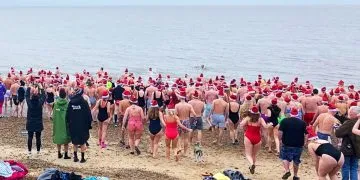
In the evening I return to the pool to see how things have developed. A DJ is playing Afrobeat and reggae, and a crowd of around 200 people have gathered on the grass in front of the pool, drinking beers and occasionally standing up to take a photo of the construction. Lilienthal is being interviewed by another TV crew at the edge of the pool. A week after highs of 38 degrees in the city, this evening it’s a nippy 19 degrees, and the swimmers quickly wrap round a towel once they emerge from the water. However, the next day the heat is due to return, and the idea of a cooling dip in the city will certainly appeal.


Author’s images, used with permission
Sitting in a deckchair in the occasional sun that afternoon, I simply didn’t want to leave. Yet I do have a couple of reservations. I’m unsure whether people from marginalised communities will really choose to come here to bathe, on a street full of exclusive shops and trendy bars – outside of the officially scheduled slots, that is. And the synchronised swimming lessons: again, it’s an elegant theatrical gesture – but is it any more than that? For people like me, who know the Volksbühne, it’s clearly something very enjoyable and easy to navigate. But for people who’ve never been to the theatre, I’m unsure how much the presence of this lido will really change their relationship with the institution.
However, the boldness of the gesture is indisputable. Lilienthal’s optimism and vision are clearly on display here. The message: think big, and turn your city into whatever you want it to be.
More from East Anglia Bylines



Friends of Bylines Network
There has never been a greater need for grassroots journalism that investigates the stories that really matter, holds power to account and champions the voices of everyday citizens. We are proudly powered by volunteers but what we do isn’t free.
STAND WITH US for independent, citizen-led journalism that makes democracy stronger, and you will even get some exclusive benefits.