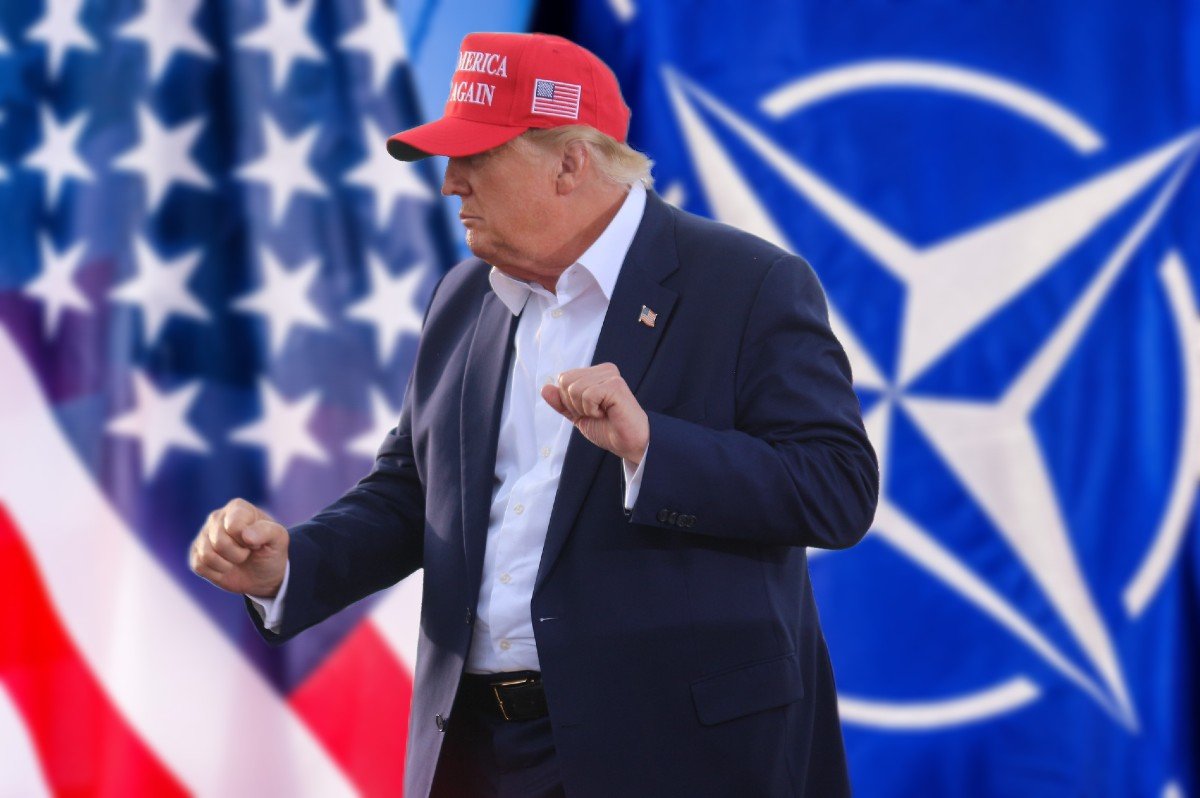
A few days ago, when Trump repeated threats he has made before about withdrawing from NATO, I wrote a Bluesky post saying that while I did not think he would actually go through with his threat, Trump had, in effect, already trashed the NATO alliance. Europe, I said, must be strengthened. The post drew quite a few responses, and East Anglia Bylines asked if I would expand my thoughts a little.
Trust
Simple, banal, as it may seem, it is often forgotten that most human relationships depend on trust, whether it is the relationship between two individuals, or relations between two or more states. Every time we make an agreement of any kind, we are trusting that the other party, or parties, will keep their side of the bargain. And most of the time, they do. The vast majority of the billions of transactions between humans made every day are honoured, delivered on, and add to the basis of trust for the next time. Contracts kept far outnumber those broken, whether unintentionally or intentionally.
This is, when you stop to consider, a remarkable fact. Without the simple nod, or handshake that often must have marked such acts of faith, humanity would not have come this far. It is one of the reasons that the breaking of trust is often at the basis of stories and dramas that have enthralled us for thousands of years.
NATO – so far
So we come to the present day and to NATO. As most people probably know by now, the operative clause is Article 5, which states that an armed attack against one or more in Europe or America will be considered as an armed attack against all, triggering collective defence. As is also well known by now, Article 5 has been invoked once, following the 9/11 attack by Al Qaeda. NATO responded.
Trump’s threats to withdraw from NATO therefore immediately call into question the willingness of the US to respond to an attack against a fellow NATO member in Europe. As the major power in NATO, the Trump threat to withdraw the US immediately undermines the credibility of the Article 5 commitment, and NATO as a whole. This not to say that other NATO members would not respond in the event of an attack against a member in Europe; NATO without the US still has some teeth, but it is undoubtedly gravely weakened.
Where are the risks?
The power most likely to attack a European state is obviously Russia; games could be played by getting proxies to claim to be acting in self-defence, but it would be play acting, nothing more. However, right now, Russia is still struggling to complete a campaign it launched in 2022, which it expected to last a few days. Ukraine still holds out and what is more, is now beginning to win back some territory from Russia, and to have success with long range weapons it has developed itself, and advances in the use of drones, including ground drones which are proving effective.
Russia is losing, by some estimates, 5,000 more troops each month than it can replace through recruitment. To meet the immediate needs of Russian commanders at the front, training and preparation time for troops is being reduced, diminishing their effectiveness when deployed. Even some military bloggers within Russia seem to be voicing concern, at some personal risk, that Russian tactics are not working, and that Ukraine is proving more agile and successful in the war.
Of course, the situation is still very grave, Russia remains large and powerful and Putin is clearly committed to the long haul, at pretty much any cost. But first, Ukraine’s resistance gives the European powers some breathing space, and second, it is plain that every amount spent helping Ukraine in its fight is money well spent on European defence. Strengthen Ukraine and you strengthen Europe.
Unplanned outcomes
Not for the first time, Trump’s actions may be stimulating the opposite reaction to that which he hoped. The Chinese response to America limiting its use of AI Large Language Models was to develop their own in “Deep Seek”, at lower cost than the US versions. Trump’s attack on Iran has in all probability strengthened the position of the Islamic Revolutionary Guard Corps (IRGC) within the regime, and thus made the lot of ordinary Iranians worse. The rise in the price of oil now seems to be giving a big push to the use of renewables; short-term oil may gain, but in the long term it seems more likely Trump has driven another nail in the coffin.
NATO – what next?
So what of the threat to withdraw from NATO, and will he go through with it? My post prompted a number of responses from Americans pointing out that the Biden Administration had included a provision in the 2024 Defence Authorisation Act that prevented withdrawal without a two thirds majority in Congress. That may be an obstacle to Trump if he wanted to withdraw, but it would probably be unwise to rely on it alone, with a President who holds the law in contempt, backed by a Supreme Court including many of his appointees. I don’t think it would stop Trump trying, and even the attempt would further weaken NATO and the American position within it.
But there are other reasons which might weigh more heavily against withdrawal. It might raise an immediate cheer from the MAGA right, but taking the US out would remove NATO as a convenient domestic “whipping boy” to rouse supporters, and would leave a situation not unlike that in post-Brexit UK; unable to blame an outside body for its own failures. NATO also gives Trump something he loves: status. It adds to his figure on the world stage that he is the most powerful person in this international alliance. It would deprive the Americans, even more than they are in their current campaign, of bases in Europe and their use. Of course there might be a fight over this, but the closure of airspace by some European countries and limitations on the use of bases is an indication that in the long run, American capacity would be reduced. Does Trump care? Maybe not, I don’t know, but there would be some, even on his own team, who would recognise this fact.
And watching from the East … Putin
I’m not much enthused by conspiracy theories, but for the sake of argument it’s worth pausing on whether Putin would prefer Trump inside NATO or out. Out might seem the obvious answer but the ability to “speak on their own level” Putin/Trump might give Putin some leverage, the ability to sow confusion, and to slow down responses to his moves; all things he values highly.
So while you can leave nothing out as impossible when dealing with an individual whose mental capacity is questionable, and who is given to utter threats, and possibly, as I write, act on those which would be illegal, I still think the balance is he does not withdraw. NATO with him on the inside is already an organisation in which trust has gone, to Putin’s satisfaction.
It is up to us in Europe to find an answer.
More from East Anglia Bylines


Friends of Bylines Network
There has never been a greater need for grassroots journalism that investigates the stories that really matter, holds power to account and champions the voices of everyday citizens. We are proudly powered by volunteers but what we do isn’t free.
STAND WITH US for independent, citizen-led journalism that makes democracy stronger, and you will even get some exclusive benefits.